Autonomous Drones Report
: Analysis on the Market, Trends, and TechnologiesThe autonomous-drone market is accelerating toward platform-scale commercial use, with a reported market size of $25,240,000,000 in 2025 and a projected $54,920,000,000 by 2029, indicating sustained high-double-digit expansion driven by mission automation, fleet software, and BVLOS enablement.
This report was last updated 49 days ago. Spot an error or missing detail? Help us fix it by getting in touch!
Topic Dominance Index of Autonomous Drones
To identify the Dominance Index of Autonomous Drones in the Trend and Technology ecosystem, we look at 3 different time series: the timeline of published articles, founded companies, and global search.
Key Activities and Applications
- Infrastructure inspection and industrial maintenance — Autonomous systems replace manual inspections on power lines, pipelines, wind turbines, and offshore assets by combining scheduled, BVLOS missions with on-board AI for defect detection, reducing operational risk and human exposure.
- Drone-as-a-Service (DaaS) for enterprise workflows — Service models convert capital-intensive fleets into subscription outcomes (inspection reports, surveying deliverables), enabling enterprises to consume autonomy as managed outcomes rather than procure hardware.
- Last-mile and long-range logistics — eVTOL and hybrid VTOL platforms extend payload and range for time-sensitive medical and commercial deliveries; pilots are redefined as supervisors as BVLOS approvals expand.
- Security, rapid response, and persistent perimeter monitoring — Drone-in-a-box and 24/7 autonomous patrol kits provide immediate aerial response to alarms and scheduled surveillance across critical sites, replacing routine human patrols with automated dispatch and live streaming.
- Specialized interaction tasks — Contact-capable platforms and tiltable-rotor flying robots perform non-visual actions (NDT probes, tool-assisted maintenance) where the drone must physically interact with assets rather than only sense them Voliro.
- GPS-denied and contested operations — Navigation stacks designed for GNSS denial enable missions in electronic-warfare, indoor, or subterranean contexts, making autonomy dependable in high-risk defense and industrial environments.
Emergent Trends and Core Insights
- Software first, hardware commoditization — Market signals show value concentrating on fleet orchestration, data pipelines, and certified autonomy stacks rather than proprietary airframes, shifting long-term margins to software and services.
- BVLOS and regulatory certification as economic moats — Firms that secure BVLOS approvals and Type/production certifications create durable customer access to large industrial contracts and recurring revenue.
- Energy and endurance innovations change use cases — Hydrogen fuel cells, hybrid propulsion, and automated battery/payload swapping are expanding mission envelopes from minutes to multiple hours, opening long-distance logistics and persistent monitoring use cases.
- Swarm and decentralized control for scale — Decentralized coordination reduces operator load per vehicle and enables simultaneous multi-site coverage; this delivers cost per hectare reductions for mapping, firefighting, and large-area security.
- Data integrity and verifiable autonomy — The next competitive layer is provable decisioning: secure telemetry, immutable flight logs, and trust layers (secure comms, tamper-evident records) become procurement criteria for infrastructure and defense clients.
- Outcome pricing and insurance integration — Pay-per-mission insurance and mission-assurance platforms tie pricing to documented operational history and risk scores, shifting commercial contracts from unit sales to outcome guarantees Precision Autonomy.
Technologies and Methodologies
- AI-first perception and mission planners — On-board deep learning stacks perform real-time object detection, anomaly scoring, and automated replan in the field to keep missions on schedule without human micromanagement.
- GPS-denied visual positioning systems (VPS) — Computer-vision and SLAM stacks provide centimetric pose in GNSS-compromised environments, enabling indoor and contested sorties.
- Drone-in-a-box and automated docking — Integrated ground stations provide unattended launch, autonomous battery/payload swaps, and secure data offload for continuous operations.
- Hybrid propulsion and battery-swap architectures — Combined electric/hydrogen and rapid swap stations extend range while keeping operational turnaround times low for enterprise fleets.
- Edge analytics and digital twins — On-platform inference reduces latency for time-critical decisions and feeds simulation twins that optimize mission plans and predictive maintenance schedules.
- Decentralized swarm control and V2V coordination — Localized peer-to-peer protocols enable formation flight, cooperative payload handling, and rapid redistribution of tasks without central bottlenecks Icarus Swarms.
- UTM/airspace-as-service and certified traffic management — Certified traffic management layers and shared airspace segmentation are becoming productized offerings that monetize the "right to operate" over high-value assets The Business Research Company - Autonomous Drones Market 2025.
Autonomous Drones Funding
A total of 415 Autonomous Drones companies have received funding.
Overall, Autonomous Drones companies have raised $17.5B.
Companies within the Autonomous Drones domain have secured capital from 1.8K funding rounds.
The chart shows the funding trendline of Autonomous Drones companies over the last 5 years
Autonomous Drones Companies
- Eighth Dimension — Eighth Dimension builds a lightweight, software-centric autonomy stack that retrofits off-the-shelf airframes to full autonomy via mesh-distributed AI and GPS-resilient navigation; the product is intended to let operators scale heterogeneous fleets while maintaining shared AI capabilities. Their plug-and-play modules target military and high-security clients that require GNSS denial performance and rapid reconfiguration. The company profile emphasizes swarm capability and zero-downtime skill swapping to keep fleet availability high.
- Zero Industries — Zero Industries focuses on defence-grade Visual Positioning Systems for GNSS-denied navigation, delivering computer-vision and onboard inference stacks that maintain mission integrity under jamming and spoofing conditions. Their lightweight VPS is positioned for integration with existing airframes to meet contested-environment requirements for government and critical-infrastructure customers.
- Microavia — Microavia supplies autonomous drone-in-a-box hardware plus traffic management software for continuous perimeter surveillance and remote inspections, enabling unattended 24/7 operation for utilities and security applications. Their Landspot docking station and Atlas platform emphasize turnkey deployment and reduced human intervention at scale.
- Nomadic Drones — Nomadic Drones develops self-recharging autonomous platforms for high-volume power-line inspection, combining automated basing with analytics tools for grid operators to reduce outage risk and inspection costs. Their focus on continuous, contactless recharging along transmission corridors targets large utilities seeking to replace costly helicopter patrols.
- Airrow — Airrow builds universal battery and payload swapping stations that aim to extend mission endurance through rapid in-field swaps, addressing a core operational bottleneck for long-range and heavy-use fleets. Their universal docking concept reduces dependence on bespoke infrastructure and supports mixed-fleet operations where range and turnaround govern economics.
Identify and analyze 1.4K innovators and key players in Autonomous Drones more easily with this feature.
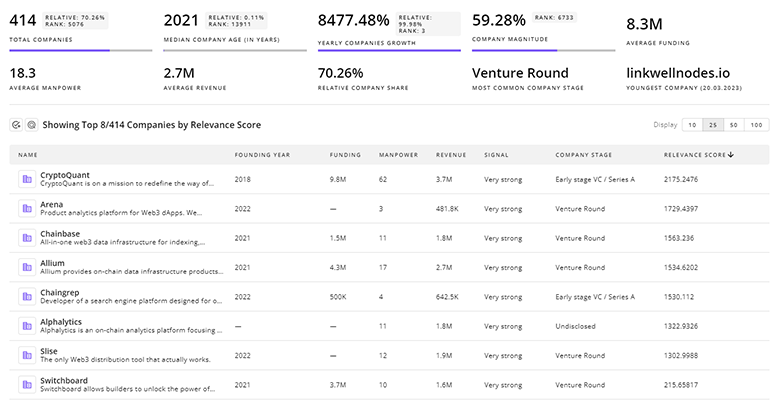
1.4K Autonomous Drones Companies
Discover Autonomous Drones Companies, their Funding, Manpower, Revenues, Stages, and much more
Autonomous Drones Investors
TrendFeedr’s investors tool offers a detailed view of investment activities that align with specific trends and technologies. This tool features comprehensive data on 2.2K Autonomous Drones investors, funding rounds, and investment trends, providing an overview of market dynamics.
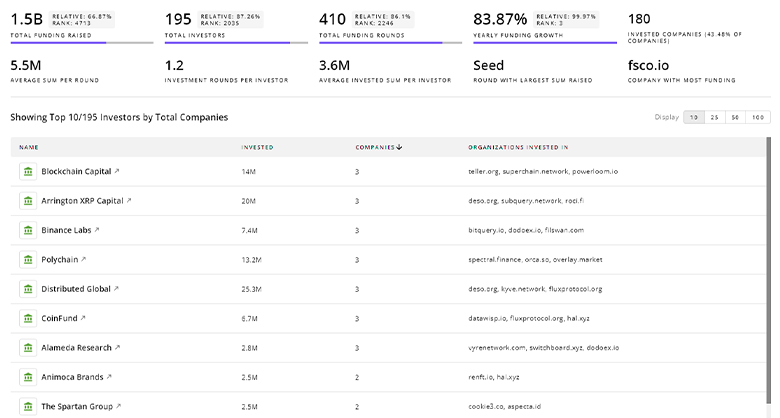
2.2K Autonomous Drones Investors
Discover Autonomous Drones Investors, Funding Rounds, Invested Amounts, and Funding Growth
Autonomous Drones News
Stay informed and ahead of the curve with TrendFeedr’s News feature, which provides access to 2.4K Autonomous Drones articles. The tool is tailored for professionals seeking to understand the historical trajectory and current momentum of changing market trends.
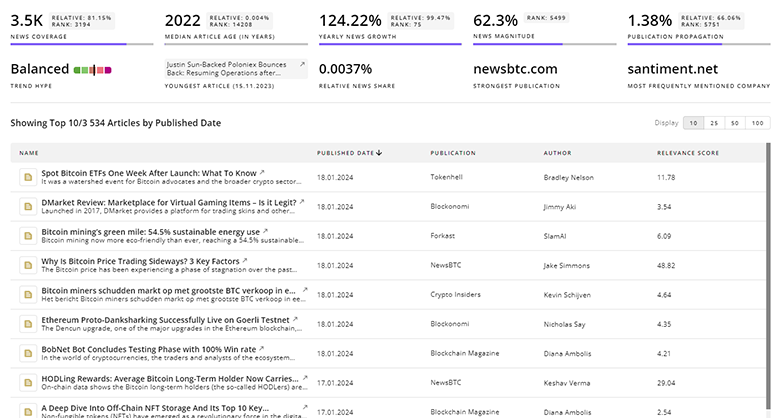
2.4K Autonomous Drones News Articles
Discover Latest Autonomous Drones Articles, News Magnitude, Publication Propagation, Yearly Growth, and Strongest Publications
Executive Summary
Autonomous drones are moving from demonstration projects into repeatable enterprise offerings where certified autonomy, mission assurance, and platform interoperability determine value capture. The industry's near-term winners will be firms that combine certified BVLOS capability, software that manages heterogeneous fleets, and ground infrastructure that sustains continuous operations. Investors and procurement officers should prioritize partners that can prove verifiable mission outcomes (flight history, security, and insurance-grade risk metrics) and that present a clear regulatory pathway for large-scale deployment.
Interested in enhancing our coverage of trends and tech? We value insights from experts like you - reach out!