Bioinformatics Report
: Analysis on the Market, Trends, and TechnologiesThe bioinformatics market sits at an inflection point where platform consolidation, AI-first analytics, and multi-omics integration drive both commercial scale and specialized service demand; the internal trend report records a 2024 market size of USD 3.5 billion and a projected CAGR of 12.9% that supports an $8.7 billion market by 2031, highlighting strong commercial tailwinds for platform and service providers.
This report was last updated 92 days ago. Spot an error or missing detail? Help us fix it by getting in touch!
Topic Dominance Index of Bioinformatics
To identify the Dominance Index of Bioinformatics in the Trend and Technology ecosystem, we look at 3 different time series: the timeline of published articles, founded companies, and global search.
Key Activities and Applications
- AI/ML-driven variant interpretation and predictive modeling — AI accelerates variant classification, supports clinical decision support and target triage for drug discovery, and now forms the decision layer above sequence processing pipelines.
- Next-Generation Sequencing (NGS) processing and scalable pipelines — large volumes of short- and long-read data require automated, reproducible workflows (containerized, Nextflow-based) and federated processing for compliance and scale.
- Multi-omics integration (genomics, proteomics, metabolomics, spatial and single-cell modalities) for biomarker discovery and precision medicine — integrated feature extraction and causal modeling enable patient stratification and trial enrichment.
- Structural bioinformatics and protein design workflows — computational structure prediction, docking and AI-guided design speed up lead optimization and biologics engineering.
- Microbiome and metagenomics analytics for diagnostics, companion diagnostics, and agritech applications — validated metagenomic pipelines and strain-level analytics convert microbiome signals into clinical/operational readouts Latin American bioinformatics Market.
- Data stewardship, provenance and regulated data exchange — standardized workflow objects, federated platforms and ledger approaches support GDPR/HIPAA compliance and cross-site research.
Emergent Trends and Core Insights
- Platform consolidation with an intelligence layer: buyers prefer integrated platforms that connect raw sequence ingestion through AI-driven interpretation; cloud-native federated systems and marketplaces win enterprise adoption Bioinformatics Platform Market Insights 2025.
- Democratization via no-code/LLM interfaces: demand increases for tools that let bench scientists run validated analyses without scripting, lowering friction for clinical and academic users Bioinformatics Services Market Report.
- Multi-omics and single-cell become default inputs for clinical research: projects that combine omics layers show higher signal-to-noise for biomarker discovery and patient stratification, creating demand for multimodal feature-engineering platforms.
- Federated and privacy-preserving compute architectures gain strategic importance: regulators and large institutions favor federated analysis to keep data local while enabling collaborative model training.
- Differentiated AI model stacks and proprietary data become competitive moats — companies investing in curated proprietary training datasets and foundation models for protein or phenotype prediction create defensible product layers.
- Commercial tensions: a wide range of published market forecasts diverge on 2024–2032 market size and CAGR; that divergence matters for strategic planning because valuation expectations, fundraising pace, and M&A activity depend on which forecast a stakeholder uses (table below).
Technologies and Methodologies
- Deep learning and foundation models for sequence-to-phenotype inference and protein design — teams combine large-scale pretraining with task-specific fine-tuning for target prediction and de novo protein sequences BioMap.
- Containerized, reproducible workflows and community pipelines (Nextflow + nf-core) for high-throughput NGS analysis and regulation-ready outputs nf-core.
- Federated genomics and secure compute (data-in-place analytics) to meet sovereignty and privacy constraints while enabling multi-institutional model training Lifebit CloudOS coverage.
- Multi-omics integration engines and graphical model approaches that combine genomics, proteomics and metabolomics into predictive biomarkers and patient classifiers Panome Bio.
- GPU and accelerated compute for structural prediction, docking and large-scale simulations; hybrid quantum-classical approaches appear in exploratory research but commercial impact remains nascent.
- No-code and LLM-driven interfaces that translate natural-language experimental questions into validated pipeline executions, reducing dependency on specialist bioinformaticians Company Landscape Report.
Bioinformatics Funding
A total of 1.5K Bioinformatics companies have received funding.
Overall, Bioinformatics companies have raised $79.7B.
Companies within the Bioinformatics domain have secured capital from 5.8K funding rounds.
The chart shows the funding trendline of Bioinformatics companies over the last 5 years
Bioinformatics Companies
- SeqExplorer — Boutique provider focused on genomic and transcriptomic analysis with tailored pipelines and interactive visual outputs for academic and clinical research labs. SeqExplorer positions as a close collaborator for projects that need bespoke analyses (GWAS, epigenomics, RNA-seq) and offers consultation to design efficient workflows that map to experimental hypotheses SeqExplorer.
- Genevia Technologies — A Finland-based CRO that delivers systems-biology consulting and multi-omics integration for cancer and bacterial metabolomics projects; its strength lies in experimental design plus math-modeling to convert complex omics into actionable hypotheses for small-to-mid R&D teams Genevia Technologies.
- Tamarind Bio — Provides web APIs and interfaces that let customers run large-scale protein-design tools (AlphaFold, RFdiffusion, ProteinMPNN) at scale; the company specializes in high-throughput binder design and conformer generation workflows used by biopharma for binder optimization and developability scoring Tamarind Bio.
- DATABIOMIX — Swiss microbome-focused startup offering end-to-end microbiota metagenomics pipelines and AI-driven biomarker discovery; it frames its value as clinically validated microbiome reports and strain-resolved analyses for companion-diagnostic use cases DATABIOMIX.
Identify and analyze 5.9K innovators and key players in Bioinformatics more easily with this feature.
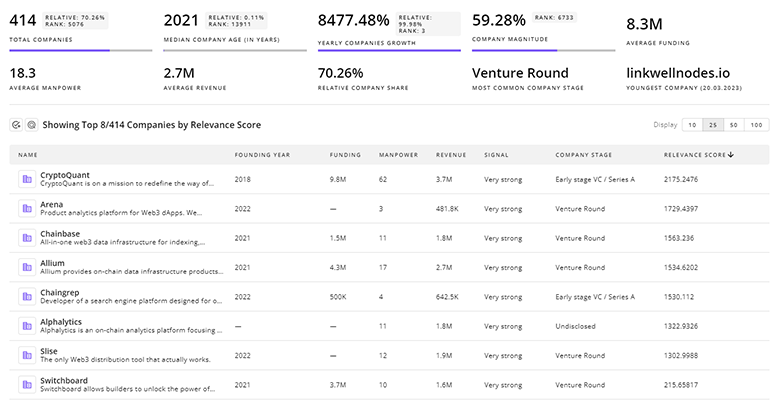
5.9K Bioinformatics Companies
Discover Bioinformatics Companies, their Funding, Manpower, Revenues, Stages, and much more
Bioinformatics Investors
TrendFeedr’s investors tool offers a detailed view of investment activities that align with specific trends and technologies. This tool features comprehensive data on 5.8K Bioinformatics investors, funding rounds, and investment trends, providing an overview of market dynamics.
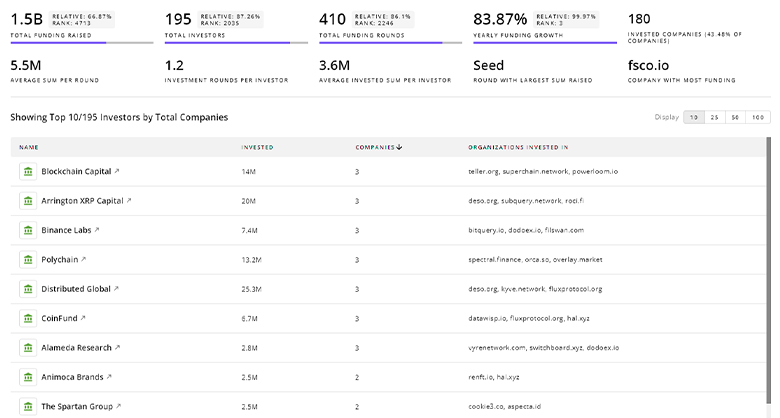
5.8K Bioinformatics Investors
Discover Bioinformatics Investors, Funding Rounds, Invested Amounts, and Funding Growth
Bioinformatics News
Stay informed and ahead of the curve with TrendFeedr’s News feature, which provides access to 10.5K Bioinformatics articles. The tool is tailored for professionals seeking to understand the historical trajectory and current momentum of changing market trends.
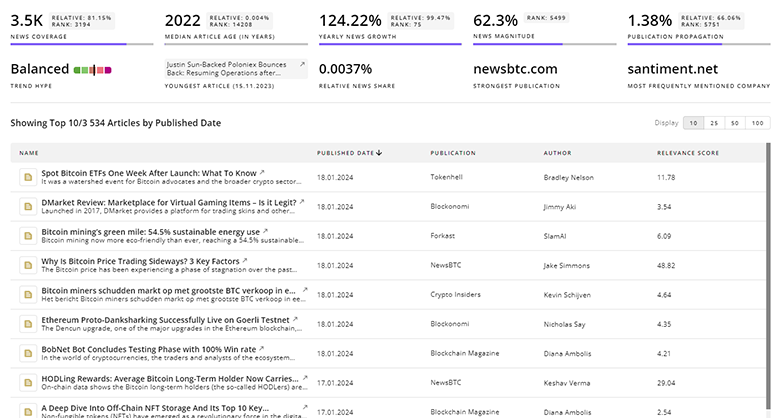
10.5K Bioinformatics News Articles
Discover Latest Bioinformatics Articles, News Magnitude, Publication Propagation, Yearly Growth, and Strongest Publications
Executive Summary
The bioinformatics landscape now demands two parallel strategies: build integrated, AI-powered platforms that capture enterprise workflows and recurring revenue, or specialize deeply in a high-value niche and integrate tightly into platform ecosystems. Market forecasts diverge widely because of different scope definitions; therefore commercial plans must select a scenario (platform-scale vs specialized services) and align metrics—ARR or per-sample margin—accordingly. Practical near-term moves that matter: standardize pipelines for reproducibility, secure federated compute for regulated data, invest in curated training datasets or partnerships to strengthen AI models, and adopt no-code interfaces to broaden the buyer base. Firms that execute these moves while maintaining rigorous data governance will convert the accelerating demand for multi-omics and AI interpretation into durable commercial advantage.
Interested in enhancing our coverage of trends and tech? We value insights from experts like you - reach out!