Biomarkers Report
: Analysis on the Market, Trends, and TechnologiesThe biomarkers sector is at a validation and commercialization inflection where investment and productization are scaling: projected market CAGR of 12.1% and a forecasted global market size of $190,810,000,000 by 2032 indicate high commercial momentum. Demand concentrates on tests and signatures that change clinical decision points (companion diagnostics, therapy monitoring, multi-cancer early detection) while regulatory and reimbursement alignment becomes the gating factor for wide clinical uptake Roots Analysis – Biomarkers Market.
This report was last updated 5 days ago. Spot an error or missing detail? Help us fix it by getting in touch!
Topic Dominance Index of Biomarkers
To identify the Dominance Index of Biomarkers in the Trend and Technology ecosystem, we look at 3 different time series: the timeline of published articles, founded companies, and global search.
Key Activities and Applications
- Clinical diagnostics for early detection and monitoring — blood-based assays, liquid biopsy, and blood-based neurodegenerative markers are moving into routine diagnostic pipelines, supporting earlier intervention and trial enrollment.
- Companion diagnostics and patient stratification — CDx development is tightly coupled to drug pipelines; growth of CDx spending and FDA/CE guidance has improved co-development economics Arizton CDx Market.
- Drug-development decision support — predictive and pharmacodynamic biomarkers increasingly de-risk trials by enabling enrichment and early efficacy readouts for targeted and immuno-oncology assets MarketResearchFuture - Biomarker Market.
- Non-invasive monitoring and point-of-care (POC) testing — multiplex POC cartridges and wearable/digital biomarker systems are converting episodic lab tests into continuous or near-patient monitoring workflows.
- Multi-omics discovery and signature validation — integrated genomics/proteomics/metabolomics pipelines are shifting value capture toward validated composite signatures rather than single analytes, with the largest near-term ROI in oncology and neurology.
Emergent Trends and Core Insights
- AI-enabled multi-omic signature discovery and interpretability — machine learning pipelines are standardizing candidate selection and reducing false leads, but clinical adoption depends on transparent, explainable models for regulators and payers GMI Insights - Biomarkers Market.
- Validation and scale are the new scarcity — many discoveries exist, but commercial value increasingly accrues to organizations that can deliver high-throughput, reproducible validation under regulatory standards; this reorients capital toward platform scale and CLIA/IVD/CE-grade workflows.
- Digital and imaging biomarkers as complementary, low-cost streams — voice, cognition, and imaging-derived biomarkers facilitate broad screening and longitudinal monitoring that feed back into molecular validation efforts MarketResearchFuture UK report.
- Decentralization of testing — cartridge-based multiplex POC devices and wearable sensors move actionable results closer to patients and clinicians, reshaping clinical pathways for chronic disease management.
- Regulatory and reimbursement variability remains the principal commercial risk — progress on harmonized CDx guidance is positive, but fragmented coverage policies create a patchwork market access landscape that slows scale PolarismarketResearch US Biomarkers Market.
Technologies and Methodologies
- Ultra-sensitive immunoassays and single-molecule platforms — attomolar immunoassay platforms and digital immunoassays materially expand detectable analytes in plasma and CSF, enabling blood-based neurology and early oncology tests Spear Bio.
- High-throughput mass spectrometry and DIA proteomics — scalable quantitative proteomics supports discovery and verification workflows that are now entering validation pipelines for clinical use Biognosys.
- Liquid biopsy (ctDNA, methylome, extracellular vesicles) — non-invasive tumor profiling and MRD monitoring continue to displace some tissue biopsies and expand surveillance use cases.
- Microfluidics and cartridge POC systems — multiplex electrochemical and hybrid biosensor cartridges compress complex assays into minutes-to-device workflows for decentralized care.
- AI/ML and causal inference analytics — advanced models move from correlation to candidate causality and predictive patient-level decision support; adoption requires reproducibility and interpretability for clinical stakeholders biotx.ai.
- Spatial biology and single-cell proteomics — tissue microenvironment profiling is becoming critical for companion diagnostics and therapy selection in oncology.
Biomarkers Funding
A total of 2.4K Biomarkers companies have received funding.
Overall, Biomarkers companies have raised $125.0B.
Companies within the Biomarkers domain have secured capital from 11.4K funding rounds.
The chart shows the funding trendline of Biomarkers companies over the last 5 years
Biomarkers Companies
- DermaBio — DermaBio combines AI modeling with non-invasive skin swab assays to predict response to biologic therapies, targeting faster, lower-cost patient selection for dermatology and immunology. The company emphasizes skin as an accessible proxy to reduce systemic testing burdens and accelerate therapy matching. This model targets a high-value clinical decision point where payers and clinicians tolerate assay costs for demonstrable treatment savings.
- Omini — Omini develops a multiplex electrochemical POC reader and single-use strips that measure 4–10 blood biomarkers from a capillary sample for chronic disease management (first focus: heart failure). The product is positioned to enable at-home monitoring comparable to a glucometer workflow, aiming to compress monitoring cycles and reduce hospital admissions.
- Panome Bio — Panome Bio offers next-generation metabolomics, proteomics and integrated multi-omics services with rapid turnaround and transparent methods; the company positions its analytics and dataset integration platform for translational discovery and biopharma validation studies. Panome's value lies in high-coverage LC/MS workflows and bespoke multi-omics reporting that accelerate signature nomination and pre-clinical verification.
- Embic Corporation — Embic Corporation provides digital cognitive biomarker batteries and proprietary scoring algorithms used at scale in cognitive screening and Alzheimer's research; its normative dataset (close to 2 million administered assessments) supports algorithm refinement and regulatory conversations. Embic focuses on low-cost, scalable cognitive endpoints that can feed clinical trials and primary-care triage workflows.
- BioMEMS Diagnostics — BioMEMS Diagnostics develops a hybrid biosensor array and disposable cartridges that deliver complex panel results in under 5 minutes, configurable for saliva, urine, or blood matrices. The platform's flexibility to accept antibodies, aptamers, and nucleic probes targets a broad set of POC assays including systemic inflammation, infectious disease panels, and concussion monitoring.
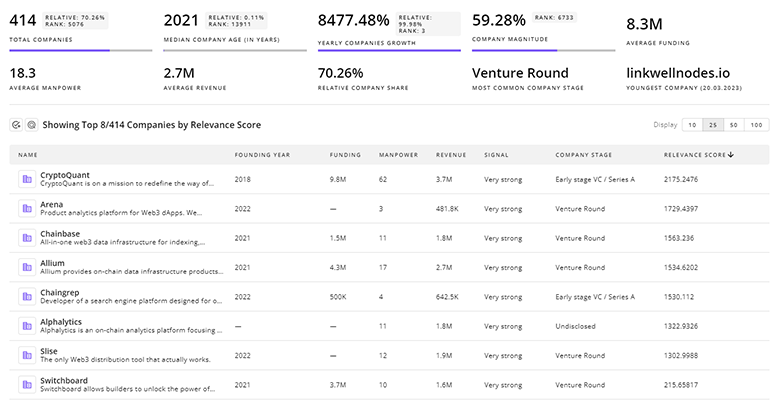
Identify and analyze 6.7K innovators and key players in Biomarkers more easily with this feature.
6.7K Biomarkers Companies
Discover Biomarkers Companies, their Funding, Manpower, Revenues, Stages, and much more
Biomarkers Investors
TrendFeedr’s investors tool offers a detailed view of investment activities that align with specific trends and technologies. This tool features comprehensive data on 9.0K Biomarkers investors, funding rounds, and investment trends, providing an overview of market dynamics.
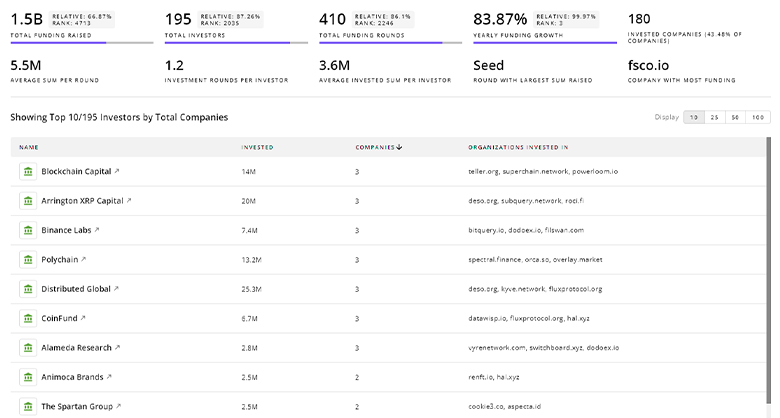
9.0K Biomarkers Investors
Discover Biomarkers Investors, Funding Rounds, Invested Amounts, and Funding Growth
Biomarkers News
Stay informed and ahead of the curve with TrendFeedr’s News feature, which provides access to 26.7K Biomarkers articles. The tool is tailored for professionals seeking to understand the historical trajectory and current momentum of changing market trends.
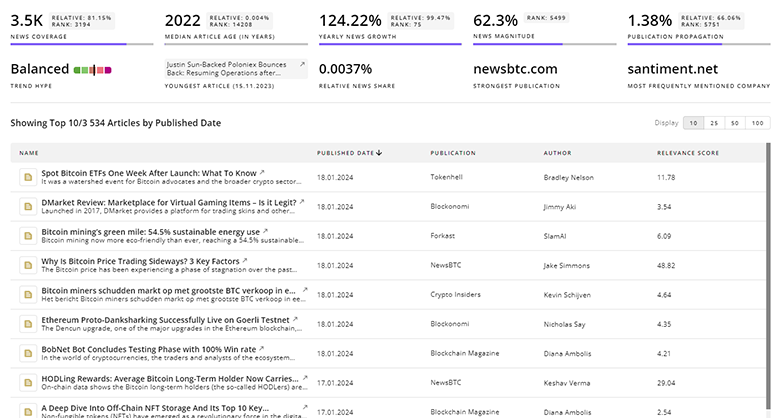
26.7K Biomarkers News Articles
Discover Latest Biomarkers Articles, News Magnitude, Publication Propagation, Yearly Growth, and Strongest Publications
Executive Summary
The biomarkers landscape is now governed by two complementary investment themes: building scalable, regulatory-grade data generation and validation infrastructure; and owning tightly validated, decision-critical biomarker signatures that change treatment or reimbursement choices. Market projections (internal trend data and independent market studies) place aggregate opportunity in the hundreds of billions over the next decade, but the path to commercial value requires demonstrable clinical utility, reproducible workflows, and clear payer coverage cases. For business leaders the strategic play is dual: invest in platforms that lower unit validation cost and time, and prioritize narrow, high-value clinical use cases (oncology therapy selection, neurology early detection, chronic disease POC monitoring) where an assay directly alters provider behavior or cost of care. Success over the next five years will favor organizations that pair rigorous analytical pipelines with pragmatic regulatory and market-access strategies.
Interested in enhancing our coverage of trends and tech? We value insights from experts like you - reach out!