
Cargo Logistics Report
: Analysis on the Market, Trends, and TechnologiesThe cargo logistics market is expanding rapidly: projected market size $349,400,000,000 in 2025 with a 9.32% CAGR to 2030, indicating both immediate capacity pressure and sizeable mid-term revenue opportunity for technology-led providers. Air freight and time-sensitive segments are growing faster than aggregate logistics demand (air freight forecasts reach $137,100,000,000 by 2030, driven by e-commerce and urgent shipments), which compounds capacity imbalances across modes and raises the value of predictive capacity allocation Air Cargo And Freight Logistics Market Size Report, 2030.
We updated this report 248 days ago. Noticed something’s off? Let’s make it right together — reach out!
Topic Dominance Index of Cargo Logistics
The Topic Dominance Index trendline combines the share of voice distributions of Cargo Logistics from 3 data sources: published articles, founded companies, and global search
Key Activities and Applications
- Integrated multimodal planning and execution — combining road, rail, sea and air to optimize cost, speed and carbon intensity; shippers and 3PLs are redesigning flows to blend long-haul rail and short-haul road legs for both cost and emissions control.
- End-to-end visibility and control-tower operations — centralized platforms that ingest telemetry, customs and schedule data to deliver predictive exceptions management; demand is strongest for high-value verticals (pharma, perishables, aerospace) where delays carry outsized cost.
- Cold chain and temperature-controlled services for life sciences and food — validated, cGMP/FDA-aligned warehousing and monitored transport for biologics and perishables; capacity investment is concentrated in APAC and the U.S. to serve pharma and e-grocery growth LifeScience Logistics.
- Project cargo and heavy-lift coordination — specialized planning, crane and transshipment capabilities for oversized equipment and infrastructure modules; these flows require bespoke asset scheduling and multi-stakeholder orchestration Project Cargo Logistics Market Analysis 2026.
- Returns and reverse logistics optimization — dedicated reverse networks and repair/refurb workflows to reduce margin leakage for e-commerce and electronics; reverse specialists are monetizing post-sale touchpoints with service revenue
Emergent Trends and Core Insights
- Platform orchestration replaces single-mode dominance — marketplaces and control towers that convert fragmented capacity into coordinated supply (price discovery + instant booking) capture margin previously held by asset owners Cargo One.
- Data standardization as a cost lever — consistent loading, handling and location master data cuts execution friction; vendors that provide a single, authoritative loading profile reduce rejections and idle time at gates
- Decarbonization shifts procurement criteria — buyers increasingly require verified emissions metrics; carriers and multimodal providers with measurable plans to lower CO2 gain tender advantage in Europe and for major OEM contracts United States Logistics Market Report, 2025-2033.
- Consolidation around technology stacks — transacting and execution platforms (booking, TMS/WMS, visibility) are the likely M&A targets as incumbents seek to hold customers inside a single workflow; digital freight marketplaces and cloud logistics platforms are high-priority acquisition targets
- Regional rebalancing and corridor resilience — nearshoring and trade-pattern shifts (notably stronger North America-Mexico links) are changing modal mix and depot placement decisions for time-sensitive goods.
Technologies and Methodologies
- AI/ML for predictive capacity and dynamic routing — machine learning models move from descriptive alerts to prescriptive re-allocation of capacity and proactive carrier re-bids, materially reducing dwell and empty-haul rates.
- Cloud-native TMS/WMS and control towers — modular, API-first platforms enable rapid integration across ERP, telematics and customs systems, lowering onboarding friction for SMEs and large shippers alike.
- IoT + edge telemetry for integrity — sensor suites (temp, shock, GPS) with edge filtering reduce false alerts and preserve bandwidth on long corridors; critical for pharma and temperature-sensitive food.
- Digital freight marketplaces and instant booking — transactional platforms convert airline/liner and carrier inventory into instantly shippable capacity, compressing procurement cycles and improving utilization
- Automation in terminals and warehouses — robotics, automated check-in, and computer vision reduce gate times and improve trailer turnaround; investments target high-volume nodes where throughput gains scale economically.
Cargo Logistics Funding
A total of 147 Cargo Logistics companies have received funding.
Overall, Cargo Logistics companies have raised $15.1B.
Companies within the Cargo Logistics domain have secured capital from 442 funding rounds.
The chart shows the funding trendline of Cargo Logistics companies over the last 5 years
Cargo Logistics Companies
- Loady — Loady standardizes loading and unloading requirements into a neutral data hub so shippers, carriers and consignees share one authoritative source; the product reduces manual data reconciliation and lowers rejections at delivery points, improving first-mile/last-mile execution speed and cutting data-management effort by an estimated 40% for adopters
- ClickLog — ClickLog provides 3D loading optimization and visualization to maximize container and truck density; its algorithms translate cargo dimensions into instant loading plans that reduce empty space and handling complexity, which directly lowers per-shipment cost for mixed consolidation loads
- Bizlog Value Chain — Bizlog focuses on reverse logistics for electronics, white goods and apparel, operating a distributed network of owned hubs across India to manage returns, refurbishment and secondary-market flows; their model mitigates revenue leakage from returns while offering retailers integrated reverse KPIs
- Agmark Logistics — Agmark dominates U.S. food-grade tank container logistics, leveraging proprietary intermodal scheduling to move bulk liquids and perishable liquids with high compliance needs; the company's asset and ISO tank footprint provides a defensible position in liquid food and biofuel logistics
- Vector Global Logistics — Vector combines project and complex-region logistics with certified social-impact credentials (B Corp profile) to serve NGOs, non-profits and private clients operating in constrained geographies; the firm monetizes mission-critical delivery expertise where standard carriers decline to operate
Gain a better understanding of 3.7K companies that drive Cargo Logistics, how mature and well-funded these companies are.
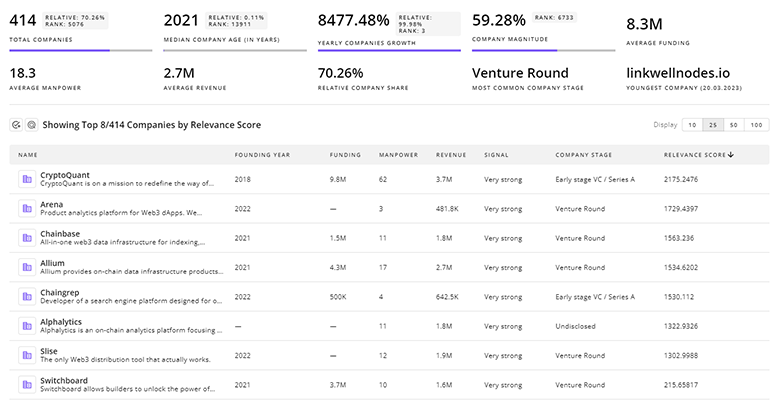
3.7K Cargo Logistics Companies
Discover Cargo Logistics Companies, their Funding, Manpower, Revenues, Stages, and much more
Cargo Logistics Investors
Gain insights into 527 Cargo Logistics investors and investment deals. TrendFeedr’s investors tool presents an overview of investment trends and activities, helping create better investment strategies and partnerships.
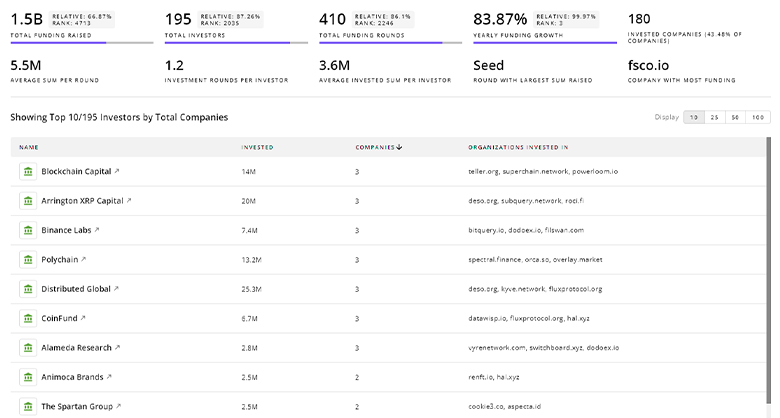
527 Cargo Logistics Investors
Discover Cargo Logistics Investors, Funding Rounds, Invested Amounts, and Funding Growth
Cargo Logistics News
Gain a competitive advantage with access to 1.4K Cargo Logistics articles with TrendFeedr's News feature. The tool offers an extensive database of articles covering recent trends and past events in Cargo Logistics. This enables innovators and market leaders to make well-informed fact-based decisions.
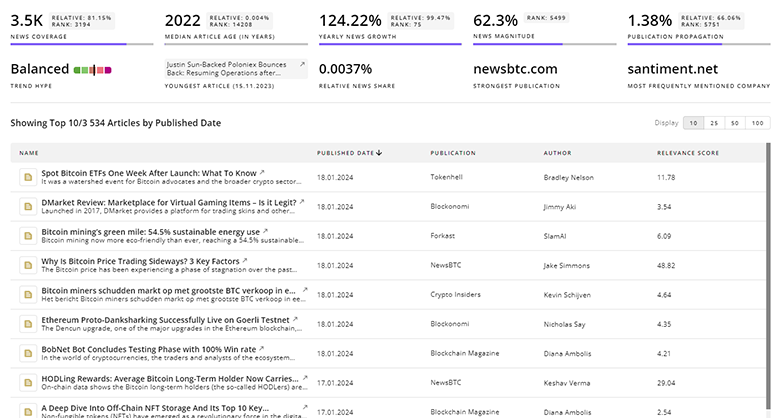
1.4K Cargo Logistics News Articles
Discover Latest Cargo Logistics Articles, News Magnitude, Publication Propagation, Yearly Growth, and Strongest Publications
Executive Summary
The cargo logistics market is moving from manual, asset-centric execution to coordinated, data-centric orchestration. Market growth and modal imbalances create immediate commercial openings for solutions that convert visibility into action: instant capacity procurement, predictive exception management, and standardized operational master data. Procurement teams will prize provable emissions and reliability metrics when awarding contracts, so firms that embed measurement into their service offering will secure premium volumes. For operators, the strategic choice narrows to two sustainable positions: invest to become the integrated orchestration layer that binds partners with APIs and marketplaces, or specialize in a high-value vertical where compliance and physical expertise create durable margins. Short-term ROI favors platform integrations and load-efficiency tools; medium-term advantage accrues to those who pair predictive analytics with verified sustainability credentials.
We seek partnerships with industry experts to deliver actionable insights into trends and tech. Interested? Let us know!