Circular Economy Report
: Analysis on the Market, Trends, and TechnologiesThe circular economy is reaching an inflection where design, traceability, and high-grade material recovery determine value capture: the market is estimated at $517,790,000,000 (2025) and is projected on strong growth paths, with formal forecasts showing double-digit expansion in the medium term. Regulatory pressure in Europe, rising resource risk, and rapid adoption of digital product passports are concentrating returns in systems that verify provenance and quality rather than in volume-only waste handling; firms that integrate lifecycle data, advanced recycling science, and service models will command the high-margin segments as secondary material markets mature gminsights – Circular Economy Solutions Market, 2025.
We updated this report 43 days ago. Noticed something’s off? Let’s make it right together — reach out!
Topic Dominance Index of Circular Economy
The Topic Dominance Index trendline combines the share of voice distributions of Circular Economy from 3 data sources: published articles, founded companies, and global search
Key Activities and Applications
- Product-as-a-Service (PaaS) — shifting revenue from one-time sales to recurring service agreements that require guaranteed take-back and component recovery, thereby aligning maintenance, refurbishment, and end-of-life flows with commercial incentives.
- Material recovery and remanufacturing — targeted recovery for high-value streams (metals, REEs, battery materials, specialty textiles) where advanced hydrometallurgy, pyro/chemical recycling, and proprietary separation processes recover input quality suitable for industrial reuse.
- Digital traceability and Digital Product Passports (DPPs) — product-level provenance and condition records that enable resale, certified recycled content, and regulatory compliance across borders.
- Second-hand platforms and omni-channel resale orchestration — retailer-grade buyback/repair/refurbish/resale systems that scale reuse economically for consumer goods (electronics, appliances, furniture, apparel).
- Decentralized microfactories and local upcycling — small, renewable-powered manufacturing cells converting low-grade plastic and community waste into construction or consumer goods to reduce transport friction and create local circular supply chains Circular Economy Manufacturing.
- Industrial symbiosis orchestration — platform-mediated exchanges that map by-product flows between firms to convert one sector's waste into another's feedstock, reducing virgin material demand and logistics cost.
Emergent Trends and Core Insights
- Digitalization as the gatekeeper of value. Digital Product Passports, DPP-linked LCAs, and ERP layers for circular channels convert low-margin material handling into high-margin data services; adoption correlates with accelerated monetization of secondary materials.
- Premiumisation of verified secondary feedstocks. Buyers of critical inputs (REEs, battery metals, engineered fibers) are willing to pay premiums for traceable, low-carbon recovered material; technologies that guarantee purity and provenance create commercial moats.
- Sector stratification: services and software outpace logistics on margin. Large operators keep scale economics in waste collection, but software platforms (circular ERPs, resale orchestration, DPP registries) capture disproportionately more margin and recurring revenue.
- Convergence of chemical and mechanical recycling for plastics. Hybrid pathways (mechanical + advanced thermochemical or depolymerization) are emerging as practical solutions for mixed and contaminated streams, closing material loops for packaging and hard-to-recycle polymers.
- Localized manufacturing and social circularity. Community-level upcycling and local microfactories reduce leakage and create inclusive revenue pools in emerging markets, addressing both environmental and social objectives.
- Policy-driven commercial timelines. EU Extended Producer Responsibility and regional recycling targets are accelerating procurement of traceability and recycling capacities; policy milestones are driving procurement cycles and capital allocation zionmarketresearch - Circular Economy Industry Perspective, 2025.
Technologies and Methodologies
- Digital Product Passports (DPPs) & Digital twins — link physical assets to immutable records for repair histories, material composition, and certified recycled content; they form the audit layer required by buyers and regulators.
- AI-enabled sorting and computer vision robotics — increase recovery rates and purity at Material Recovery Facilities (MRFs), enabling mechanical recycling to feed higher-value applications marketresearch - Growth Opportunities in the Circular Economy Market, 2024.
- Advanced chemical recycling / depolymerization — solvothermal, pyrolysis, and catalytic processes that convert complex polymers to merchantable feedstocks for petrochemical or polymer producers.
- Hydrometallurgy, magnetic separation and electrochemical extraction — scalable methods for recovering critical metals from e-waste, wastewater, and end-of-life EV batteries; these methods underpin new domestic supply chains for critical raw materials Circular Materials.
- Bioprocessing and enzymatic recycling — enzyme-based depolymerization for specific polymers (PET, some polyesters) and biological upcycling of organics into feed, materials, or platform chemicals.
- No-code circular ERPs and lifecycle automation — white-label SaaS that orchestrates buyback, repair, trade-in, and resale flows while measuring impact and revenue performance for brands LoopOS.
Circular Economy Funding
A total of 8.0K Circular Economy companies have received funding.
Overall, Circular Economy companies have raised $414.0B.
Companies within the Circular Economy domain have secured capital from 29.0K funding rounds.
The chart shows the funding trendline of Circular Economy companies over the last 5 years
Circular Economy Companies
- CircKit — An AI-driven design platform for fashion and footwear brands that generates compliant LCAs and Circular Economy Indicators at the design stage, enabling brands to choose materials and components that deliver measurable circularity before production. CircKit reduces the time and cost of product environmental assessment and helps brands meet regulatory reporting obligations while steering upstream product decisions.
- Automedi — Operator of decentralized circularity-as-a-service units that convert local plastic waste into usable products. Automedi emphasizes hyper-local recycling infrastructure and short loop manufacturing, allowing estates and municipalities to turn pollution into saleable items in minutes, improving collection economics and community engagement.
- Resourcly — B2B industrial inventory and materials exchange platform that uses AI/semantic search to match manufacturers with available secondary material and spare inventory, reducing procurement risk and unlocking immediate reuse opportunities inside industrial clusters.
- Cyclic Materials — Developer of a two-phase separation and purification technology focused on rare earth magnets and critical metals recovery from complex end-of-life streams (EV motors, electronics). The company aims at delivering feedstock purity comparable to primary supplies, enabling industrial buyers to substitute recycled critical materials at scale.
- Circular11 — Small-scale innovator that converts contaminated film and low-grade plastics into composite building materials and home goods, focusing on markets where existing recycling systems fail. By combining material science and local manufacturing, Circular11 creates demand for otherwise leaked or burned plastics and builds resilient local circular markets.
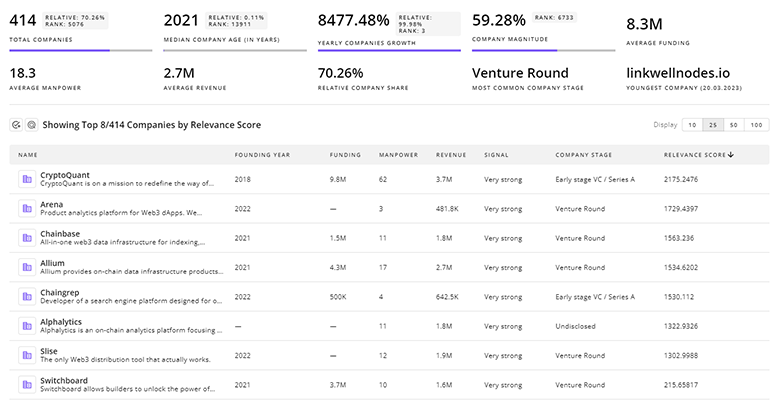
Gain a better understanding of 54.6K companies that drive Circular Economy, how mature and well-funded these companies are.
54.6K Circular Economy Companies
Discover Circular Economy Companies, their Funding, Manpower, Revenues, Stages, and much more
Circular Economy Investors
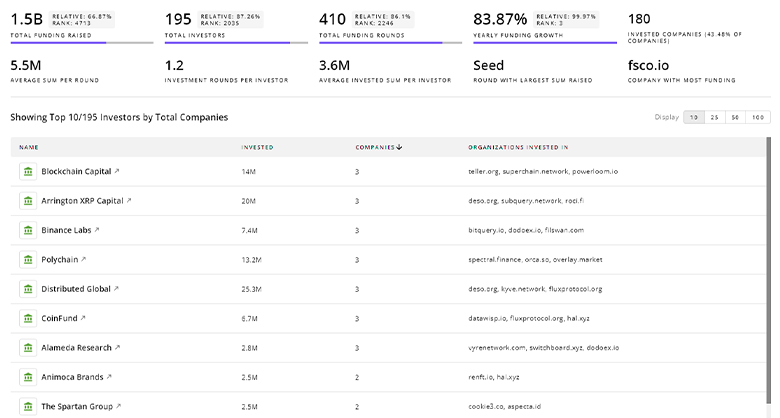
Gain insights into 20.4K Circular Economy investors and investment deals. TrendFeedr’s investors tool presents an overview of investment trends and activities, helping create better investment strategies and partnerships.
20.4K Circular Economy Investors
Discover Circular Economy Investors, Funding Rounds, Invested Amounts, and Funding Growth
Circular Economy News
Gain a competitive advantage with access to 28.1K Circular Economy articles with TrendFeedr's News feature. The tool offers an extensive database of articles covering recent trends and past events in Circular Economy. This enables innovators and market leaders to make well-informed fact-based decisions.
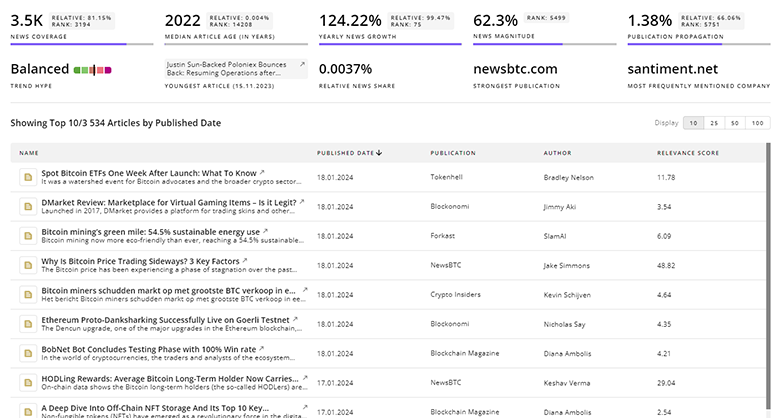
28.1K Circular Economy News Articles
Discover Latest Circular Economy Articles, News Magnitude, Publication Propagation, Yearly Growth, and Strongest Publications
Executive Summary
The circular economy is shifting from volume diversion to provenance and material quality as the primary sources of commercial value. Firms that combine advanced recovery science with digital verification and service-based business models will convert circularity into repeatable revenue. Investors should favor cross-stack plays that pair processing capacity (to raise recovery yields and feedstock quality) with platform capabilities that capture recurring data and transaction rent. Policymakers and procurement authorities will accelerate adoption through EPR and DPP mandates; companies that align product design, reverse logistics, and digitized lifecycle records will lead the next wave of scalable circular business models.
We seek partnerships with industry experts to deliver actionable insights into trends and tech. Interested? Let us know!