Climate Monitoring Report
: Analysis on the Market, Trends, and TechnologiesThe climate-monitoring ecosystem is maturing into a multi-layered data market where quality of fused signals matters more than sheer sensor counts$1.89B. Market analysis indicates centralized demand from enterprise compliance (Scope 1–3), financial risk models, and infrastructure resilience programs, while technical momentum concentrates on satellite-enabled GHG attribution, AI-enhanced fusion of heterogeneous sensors, and audit-grade MRV workflows that translate observational data into verifiable financial outputs Weather Monitoring Solution and Service Market Research Report.
We updated this report 298 days ago. Noticed something’s off? Let’s make it right together — reach out!
Topic Dominance Index of Climate Monitoring
The Topic Dominance Index trendline combines the share of voice distributions of Climate Monitoring from 3 data sources: published articles, founded companies, and global search
Key Activities and Applications
- High-resolution GHG attribution and MRV — Detecting and quantifying point sources of CH4 and CO2 for regulatory compliance, litigation risk reduction, and corporate disclosures; this activity now combines airborne spectroscopy with satellite revisit strategies and machine-learning quantification pipelines Carbon Mapper.
- Urban microclimate and infrastructure resilience — Hyperlocal temperature, surface thermal mapping, and tree/green-space monitoring inform adaptation investments for buildings, grids, and transport corridors; municipalities and asset managers use these data to prioritize hardening and insurance underwriting Terra Atmos.
- Water and flood risk operations — Continuous water-level telemetry and localized hydrology forecasting drive flood-warning systems and irrigation automation; these outputs reduce operational losses in utilities and agriculture while feeding regional disaster-response dashboards.
- Soil carbon and nature-based MRV — Remote sensing plus AI-based soil-carbon estimation enables landholders and supply chains to generate higher-integrity credits and make direct agronomic improvements that increase yields and monetize sequestration Soilwatch.
- Cold-chain and asset integrity monitoring — Continuous core-temperature solutions and validated telemetry protect regulated goods and enable automated compliance reporting across pharma and food logistics, preventing costly spoilage events and regulatory sanctions Axino.
Emergent Trends and Core Insights
- Separation of signal and insight markets. Data collection (sensors, smallsat feeds) is becoming commoditized while value concentrates with platforms that fuse sources into auditable intelligence consumed by regulators, insurers, and banks.
- Space-first verification is the competitive wedge. Dedicated constellations delivering thermal, hyperspectral, and spectroscopic products create proprietary coverage and cadence that convert into lasting commercial moats for emissions attribution and thermal-stress detection constellr.
- AI combined with physics improves trustworthiness. Physics-guided machine learning (PGML) reduces false positives and improves extrapolation across geographies, enabling models to be accepted by compliance teams and actuaries as inputs for risk models.
- Regulation is forcing adoption now. Mandates around emissions reporting and tighter air/water quality standards create non-discretionary procurement paths for enterprise monitoring platforms; vendors that can provide traceability and chain-of-custody win prioritized procurement Automated Weather Station Market 2025.
- Verifiability is replacing frequency. For many buyers, the critical question is not how often a sensor reports, but whether its output can be integrated, corrected, and legally defended in audits and disclosures.
Technologies and Methodologies
- Imaging spectroscopy and hyperspectral remote sensing for methane and CO2 hotspot mapping, paired with airborne campaigns for tactical validation.
- High-cadence thermal constellations to map surface temperature dynamics for urban heat and infrastructure stress assessments.
- IoT edge networks with low-power wide-area communications (LoRa/NB-IoT) to scale hyperlocal sensor grids for air, water, and soil metrics where connectivity and energy budgets constrain deployments.
- Physics-guided machine learning (PGML) that fuses satellite, reanalysis, and in-situ streams to produce generalizable, bias-corrected forecasts and nowcasts accepted by technical reviewers.
- Digital twin simulation of land surfaces and built assets to run scenario stress-tests that translate observational uncertainty into direct financial impact estimates for insurers and real-estate portfolios.
- Data provenance and marketplace architectures (decentralized registries and scoring) to enable commercial exchange of climate datasets with reliability scoring and monetization pathways dClimate.
Climate Monitoring Funding
A total of 65 Climate Monitoring companies have received funding.
Overall, Climate Monitoring companies have raised $1.9B.
Companies within the Climate Monitoring domain have secured capital from 267 funding rounds.
The chart shows the funding trendline of Climate Monitoring companies over the last 5 years
Climate Monitoring Companies
- Planette AI — Planette builds mid-range environmental forecasts bridging weather and climate by combining AI with physics-based models to forecast variables like temperature and rainfall from two weeks to five years ahead; this service targets enterprises needing planning horizons beyond classic weather APIs. The firm emphasizes grid-based, regional forecasts that reduce operational uncertainty for agriculture and infrastructure asset owners. Their small team and specialized model focus make them attractive to partners seeking integrated forecast inputs rather than raw observational feeds.
- Orbisens® — Orbisens supplies modular urban sensor systems designed for easy municipal deployment to support localized adaptation decisions such as heat-mitigation and drainage planning. The company's offering focuses on deployability, low maintenance, and integration with city dashboards so planners can act on hyperlocal observations. Orbisens aims to replace ad hoc campaigns with continuous urban monitoring networks that feed resilience planning.
- Hohonu — Hohonu delivers water-level monitoring and localized flood forecasting using hardware and NOAA-consistent methods to support community preparedness and emergency response. They emphasize accessible data products for smaller jurisdictions that lack hydrometric infrastructure, enabling near-real-time alerts and post-event analysis for recovery planning. Hohonu positions its products as practical operational tools rather than research outputs, improving local decision timing.
- Precipitation Inc. — Precip provides rainfall accumulation estimates without installing gauges by using high-resolution modeling and a developer-friendly API; the service targets irrigation managers, insurers, and utilities that require validated precipitation histories at specific sites. This approach reduces capex and logistics for clients that need precise rainfall inputs for automated irrigation, claims triage, or standing-water detection. The company's lightweight, software-first model enables fast scaling across regions without sensor installation.
- ecometric ltd — Ecometric uses satellite imagery and AI to estimate Soil Organic Carbon at high resolution, supporting nature-based carbon projects and supply-chain sustainability commitments. Their platform increases sampling density by orders of magnitude versus legacy methods, enabling faster MRV and higher confidence in soil-carbon credits. By translating satellite-derived signals into land-management prescriptions, they connect carbon verification with direct agronomic value.
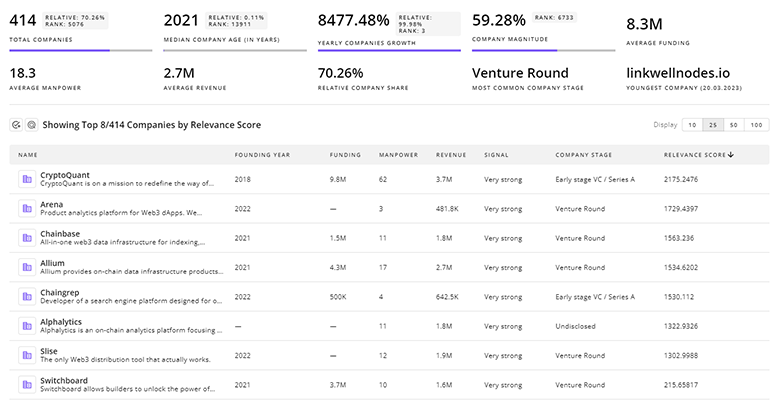
Gain a better understanding of 335 companies that drive Climate Monitoring, how mature and well-funded these companies are.
335 Climate Monitoring Companies
Discover Climate Monitoring Companies, their Funding, Manpower, Revenues, Stages, and much more
Climate Monitoring Investors
Gain insights into 288 Climate Monitoring investors and investment deals. TrendFeedr’s investors tool presents an overview of investment trends and activities, helping create better investment strategies and partnerships.
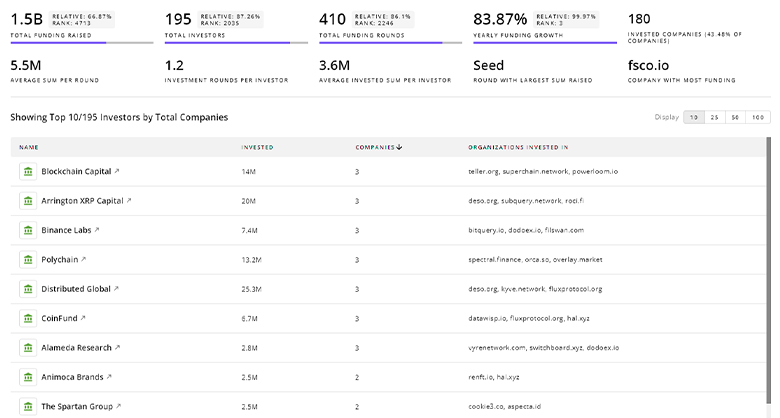
288 Climate Monitoring Investors
Discover Climate Monitoring Investors, Funding Rounds, Invested Amounts, and Funding Growth
Climate Monitoring News
Gain a competitive advantage with access to 668 Climate Monitoring articles with TrendFeedr's News feature. The tool offers an extensive database of articles covering recent trends and past events in Climate Monitoring. This enables innovators and market leaders to make well-informed fact-based decisions.
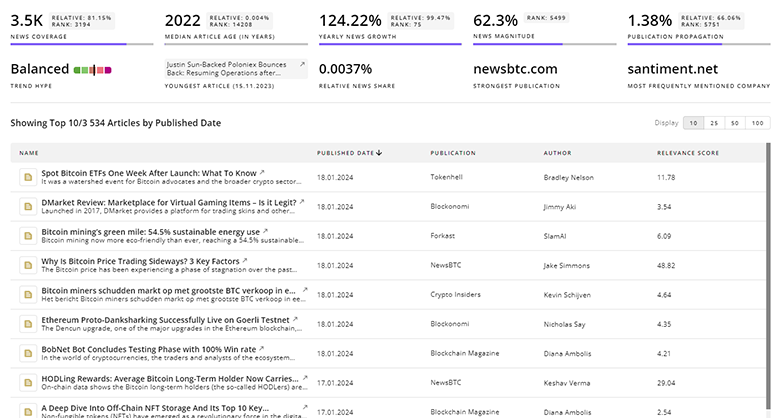
668 Climate Monitoring News Articles
Discover Latest Climate Monitoring Articles, News Magnitude, Publication Propagation, Yearly Growth, and Strongest Publications
Executive Summary
Climate monitoring has entered a phase where commercial value concentrates on trusted fusion of multi-source observations into auditable, decision-ready intelligence. Market drivers—from regulation to financial risk appetite—create immediate demand for platforms that can prove data provenance, correct sensor biases, and deliver verifiable metrics to compliance and risk functions. Strategic winners will combine proprietary data access (often via specialized satellites or validated in-situ networks), PGML for defensible modeling, and enterprise-grade data governance that converts environmental signals into legally tenable financial and operational actions. Firms that remain single-source data suppliers without integration and trust capabilities face rapid commoditization; conversely, vendors who embed climate monitoring outputs directly into purchasing, underwriting, or operations workflows will capture the high-value interfaces between measurement and money.
We seek partnerships with industry experts to deliver actionable insights into trends and tech. Interested? Let us know!