Cloud Storage Report
: Analysis on the Market, Trends, and TechnologiesThe cloud storage market is shifting from capacity to policy-driven orchestration and regional control as vendors race to convert data gravity into commercial advantage; the sector already reports a 2023 market size of $102,670,000,000 (with a forecast to $654,520,000,000 by 2032). Cost pressure from egress and API fees, rising volumes of metadata and AI training datasets, and accelerating hybrid/multi-cloud adoption are forcing three simultaneous responses: cheaper commoditized object tiers, regionally sovereign platforms, and intelligent lifecycle automation that places data according to policy, cost, and latency.
We updated this report 189 days ago. Noticed something’s off? Let’s make it right together — reach out!
Topic Dominance Index of Cloud Storage
The Topic Dominance Index trendline combines the share of voice distributions of Cloud Storage from 3 data sources: published articles, founded companies, and global search
Key Activities and Applications
- Disaster recovery and long-term archiving — Enterprises move regulatory and retention workloads into low-cost, S3-compatible archival tiers while retaining fast local caches for rapid restores; archival migration and tape-to-cloud workflows remain primary spend drivers.
- AI/ML dataset hosting and high-throughput object stores — Teams stage massive, unstructured training sets on scalable object backends and add caching layers to keep GPUs fed, making storage performance a direct contributor to ML throughput.
- Hybrid and multi-cloud abstraction (migration & virtualization) — Organizations deploy virtualization and API-translation layers to split, replicate, or migrate objects across providers to avoid vendor lock-in and to implement data locality policies
- Cold/near-line economics and tape-as-a-service — Vendors package ultra-low-cost cold tiers and dedicated media (including tape-backed offerings) as S3-compatible services to reduce archival TCO and eliminate punitive egress regimes
- Ransomware-resistant storage & immutable retention — Immutable object locks, snapshot orchestration, and built-in threat detection are being embedded in storage stacks as baseline controls for regulated customers
- Edge capture and localized caching — Low-latency ingestion for IoT and media workflows uses distributed edge caches that synchronise with central object stores to reduce round-trip delays and bandwidth costs Cloud Storage Market - Forecasts from 2025 to 2030.
Emergent Trends and Core Insights
- Sovereign and regional clouds fragment the value chain — Demand for data residency and regulatory certainty is creating profitable regional alternatives that compete on trust and predictable pricing rather than scale alone
- S3 compatibility as the interoperability hinge — Providers that deliver full S3 API compatibility reduce migration friction and become attractive drop-in alternatives for storage and backup ecosystems.
- Metadata growth outpaces raw payloads, driving search/index services — The explosion of metadata makes searchable object layers and metadata-centric services commercially necessary for rapid discovery and compliance. This shifts product roadmaps toward index-first architectures Enterprise Storage Forum – Cloud Storage Trends.
- Intelligent, policy-driven tiering reduces bill volatility — Automated lifecycle engines that move objects across hot/warm/cold classes deliver material cost savings and reduce surprise egress exposures Cloud Storage Market.
- Decentralized and DePIN-backed storage adds price and sovereignty vectors — Distributed networks and blockchain-anchored proofs of storage present a viable cost/sustainability alternative for archival and censorship-resistant use cases.
- Edge + container native integration becomes a requirement for latency-sensitive apps — Persistent volumes and cluster-aware cross-cluster storage features are emerging to support containerized AI and analytics workloads where locality matters Hybrid Cloud Storage 2025: Frost Radar Report.
Technologies and Methodologies
- S3-compatible object storage and API translation — S3 remains the lingua franca; translation and virtualization layers enable multi-cloud strategies without refactoring applications Flexify.IO.
- Erasure coding and intelligent redundancy — Erasure coding replaces full replication in many cold/capacity tiers to lower capacity overhead while preserving durability and recoverability.
- Immutable object lock and WORM retention models — Regulatory and ransomware requirements drive adoption of object immutability combined with verifiable retention policies Cloud Storage Market Insights 2025.
- NVMe-focused, near-metal protocols for performance (NVMe/TCP, NVMe-oF) — For high-IOPS and low-latency workloads (databases, AI), NVMe/TCP stacks and disaggregated software-defined storage are gaining production traction simplyblock.
- Client-side zero-knowledge and end-to-end encryption — Provider-agnostic encryption models and zero-knowledge offerings address compliance and privacy demand in regulated markets.
- AI/ML for lifecycle management and anomaly detection — ML models predict access patterns, automate tiering, and surface anomalous reads/writes tied to ransomware or misuse.
- Decentralized proofs and fragmentation (erasure + blockchain proofs) — Proof-of-storage and verifiable retrieval integrate with distributed networks to provide cost and sovereignty primitives for archival classes.
Cloud Storage Funding
A total of 775 Cloud Storage companies have received funding.
Overall, Cloud Storage companies have raised $30.4B.
Companies within the Cloud Storage domain have secured capital from 2.9K funding rounds.
The chart shows the funding trendline of Cloud Storage companies over the last 5 years
Cloud Storage Companies
Cubbit — Cubbit offers a geo-distributed S3-style architecture that lets organisations assemble sovereign, low-carbon object clouds across on-prem and edge resources; the product targets customers seeking cost reductions of up to 80% versus hyperscalers while keeping full control of data placement
Cubbit's DS3 software creates a unified data domain that runs on existing infrastructure or edge nodes, making it appealing for service providers and enterprises with stringent residency requirements.Geyser Data — Geyser Data positions a tape-backed, S3-compatible cold-data service marketed as a low-cost enterprise archive with no egress, optional air-gap, and Tier-IV hosting; it targets regulated archival and AI staging workloads that require durable, predictable archival economics
The offering is designed to replace on-prem tape management and to provide enterprises with instant S3 access plus optional physical tape returns for compliance, blending legacy assurance with cloud interfaces.Archil — Archil converts S3 buckets into high-performance, namespace-compatible volumes so analytics and AI pipelines can run without data movement; customers report multi-fold speedups for large and small file workloads, reducing both compute latency and storage egress.
The company focuses on eliminating data movement costs for ML training and HPC workflows by presenting object stores to applications as local, infinite volumes.CopenCloud — CopenCloud differentiates on energy and carbon metrics, using policy-based instant/long-term split storage to move infrequently accessed objects into extreme low-power tiers and nudging users to adopt long-term retention; the company claims large CO2 reductions via automated tiering and user transparency
This approach licenses sustainability as a commercial differentiator for storage buyers with ESG mandates and long retention portfolios.cunoFS — cunoFS exposes object stores as POSIX-compliant, high-throughput file systems so unmodified, legacy applications (genomics, financial analytics) can operate directly on object backends with predictable semantics and extreme aggregate throughput (benchmarked >10 Tbps in large clusters).
The product narrows the performance gap between file and object storage, enabling enterprises to replace expensive block systems while keeping application stacks intact.
Gain a better understanding of 8.3K companies that drive Cloud Storage, how mature and well-funded these companies are.
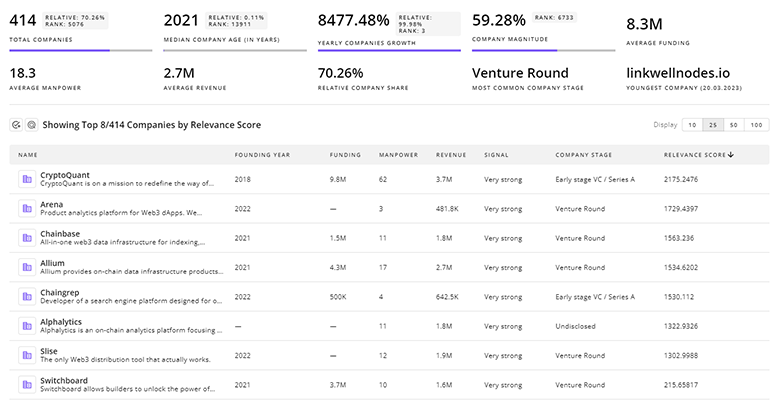
8.3K Cloud Storage Companies
Discover Cloud Storage Companies, their Funding, Manpower, Revenues, Stages, and much more
Cloud Storage Investors
Gain insights into 3.0K Cloud Storage investors and investment deals. TrendFeedr’s investors tool presents an overview of investment trends and activities, helping create better investment strategies and partnerships.
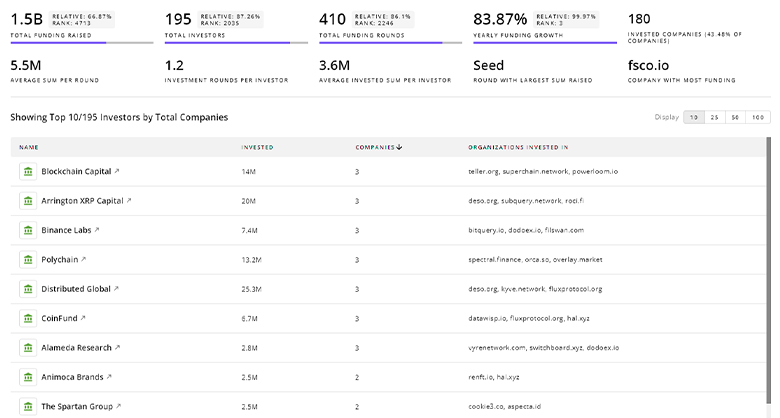
3.0K Cloud Storage Investors
Discover Cloud Storage Investors, Funding Rounds, Invested Amounts, and Funding Growth
Cloud Storage News
Gain a competitive advantage with access to 30.9K Cloud Storage articles with TrendFeedr's News feature. The tool offers an extensive database of articles covering recent trends and past events in Cloud Storage. This enables innovators and market leaders to make well-informed fact-based decisions.
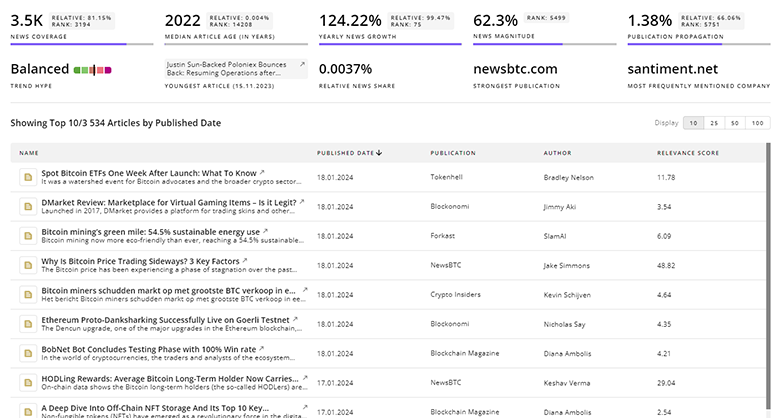
30.9K Cloud Storage News Articles
Discover Latest Cloud Storage Articles, News Magnitude, Publication Propagation, Yearly Growth, and Strongest Publications
Executive Summary
Cloud storage strategy now requires simultaneous mastery of cost mechanics, data placement policy, and regulatory alignment. Enterprises must adopt S3-native interoperability, automate lifecycle decisions with AI, and evaluate regional or decentralized alternatives where sovereignty or price predictability matter. Storage vendors that combine policy automation, verifiable immutability, and predictable pricing — while offering performant access paths for AI and analytics workloads — will secure enterprise contracts that hyperscalers cannot win on price alone. Strategic buyers should model total cost of ownership including egress/operation fees, test S3 compatibility across target vendors, and pilot edge-to-cloud patterns for latency-sensitive workloads to validate architecture decisions.
We seek partnerships with industry experts to deliver actionable insights into trends and tech. Interested? Let us know!