Computational Biology Report
: Analysis on the Market, Trends, and TechnologiesThe computational biology market shows a clear commercial inflection: USD 5,493,200,000 market value in 2021 and a sustained growth trajectory at 13.17% CAGR, driven by AI-first modeling, cloud scale, and mechanistic simulation that compress R&D timelines. Computational Biology Market, 2025-2034.
We updated this report 18 days ago. Noticed something’s off? Let’s make it right together — reach out!
Topic Dominance Index of Computational Biology
The Topic Dominance Index trendline combines the share of voice distributions of Computational Biology from 3 data sources: published articles, founded companies, and global search
Key Activities and Applications
- Drug target identification and validation using AI-driven predictive models that prioritize candidates before experimental screens, cutting costly wet-lab cycles.
- Generative molecular design (de novo proteins, peptides, antibodies) where diffusion and foundation models propose and rank novel sequences for wet-lab testing
- Digital twins for bioprocess and physiology simulation that model manufacturing runs and systemic drug responses to reduce process variability and accelerate IND readiness.
- Multi-omics integration for patient stratification that combines genomics, transcriptomics, proteomics and spatial data to define predictive biomarkers and trial-enrichment cohorts
- In-silico trial controls and synthetic cohorts used to de-risk early clinical development by benchmarking treatments against modelled natural history and historical controls.
Emergent Trends and Core Insights
- Mechanistic + ML hybrid modeling is replacing pure correlational approaches; companies that combine causal models with data-driven architectures capture premium application value.
- Platform consolidation around biology foundation models is underway, with a small number of players aiming for broad applicability across proteomics, cell programming and physiology simulation
- Spatial and single-cell modalities move to first-class status: tissue context plus single-cell resolution materially improves target selection and mechanism interpretation
- No-code interfaces and LLM-driven query layers democratize advanced analyses to domain scientists, accelerating adoption outside specialist bioinformatics teams.
- Data governance and federated learning emerge as operational constraints and commercial opportunities: protecting patient/omic data while enabling cross-institutional model training will determine who can scale validated clinical applications
Technologies and Methodologies
- Generative diffusion and foundation models for proteins: sequence + structure generation pipelines that propose optimized candidates for affinity, stability and immunogenicity.
- Digital Twins and hybrid mechanistic/ML simulators that combine first-principles kinetics with learned corrections to model process or patient responses.
- Graph neural networks and causal representation learning to model pathways, cell-cell interactions and systemic pharmacology with interpretable mechanisms
- High-performance cloud workflows and GPU acceleration for large-scale structure prediction, molecular dynamics and single-cell pipelines, enabling throughput orders of magnitude higher than traditional on-prem setups.
- Spatial omics instrumentation + informatics that preserve tissue coordinates for integrated RNA/protein maps, essential for microenvironment-aware target discovery Bruker Spatial Biology.
- Explainable AI and automated reasoning to provide evidence chains for clinical decision support and regulator scrutiny Turing Biosystems.
Computational Biology Funding
A total of 328 Computational Biology companies have received funding.
Overall, Computational Biology companies have raised $28.6B.
Companies within the Computational Biology domain have secured capital from 1.3K funding rounds.
The chart shows the funding trendline of Computational Biology companies over the last 5 years
Computational Biology Companies
- BioGeometry — BioGeometry applies generative diffusion and geometric deep learning to design programmable protein medicines, combining structural biology with a high-throughput wet-lab validation stack; the company targets macromolecular therapeutics where small improvements in stability or immunogenicity yield outsized clinical benefit. Seed/Series A funding of **$13.6M and a lean team enable rapid iteration while preserving a research-intensive approach
- Syntensor — Syntensor builds a single mechanistic model of human physiology to simulate systemic metabolic and pharmacology responses across tissues; the platform generates causal hypotheses for efficacy and toxicity that prioritize candidates before in-vivo work. Early-stage funding of **$3.5M supports a hybrid synthetic biology + systems ML roadmap aimed at preclinical de-risking
- Generable — Generable offers a cloud-native analytics database and inference API that creates analytics-ready synthetic controls and benchmarks for early oncology trials, enabling dose and trial optimization. The company's inference stack reduces trial uncertainty for small biotechs by converting diverse real-world and trial data into reproducible synthetic cohorts; seed funding of **$140K supports validation partnerships with clinical groups
- Algocell — Algocell focuses on bioprocess optimization for precision fermentation and cell culture through Digital Twins and hybrid models, delivering real-time process predictions that lower experimental iterations and manufacturing variability. By shifting validation to simulated experiments, the platform reduces scale-up risk for industrial biomanufacturers and shortens time-to-market for novel biologics
- Tamarind Bio — Tamarind Bio provides scalable, no-code web interfaces and APIs to run state-of-the-art protein design models (AlphaFold, RFdiffusion, ProteinMPNN) at industrial throughput, enabling design teams to perform parallelized binder design and developability scoring. The service model targets mid-sized biopharma that need access to advanced structural pipelines without heavy infrastructure investment; venture funding of **$14.1M supports platform scaling
Gain a better understanding of 1.1K companies that drive Computational Biology, how mature and well-funded these companies are.
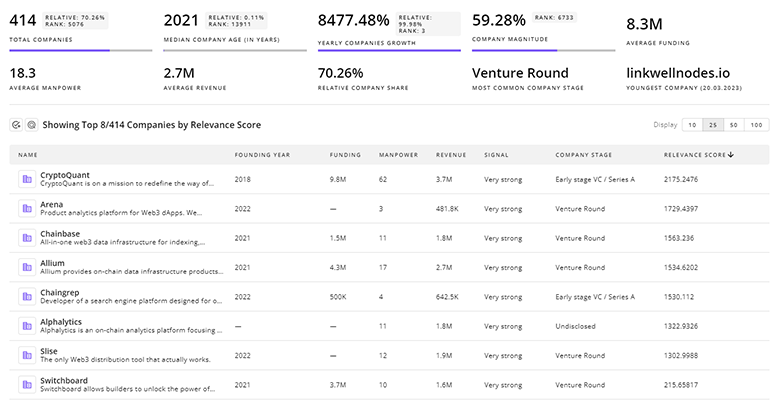
1.1K Computational Biology Companies
Discover Computational Biology Companies, their Funding, Manpower, Revenues, Stages, and much more
Computational Biology Investors
Gain insights into 1.8K Computational Biology investors and investment deals. TrendFeedr’s investors tool presents an overview of investment trends and activities, helping create better investment strategies and partnerships.
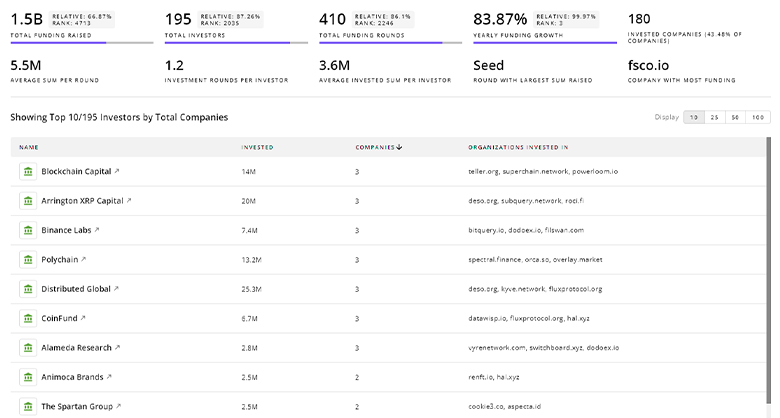
1.8K Computational Biology Investors
Discover Computational Biology Investors, Funding Rounds, Invested Amounts, and Funding Growth
Computational Biology News
Gain a competitive advantage with access to 13.6K Computational Biology articles with TrendFeedr's News feature. The tool offers an extensive database of articles covering recent trends and past events in Computational Biology. This enables innovators and market leaders to make well-informed fact-based decisions.
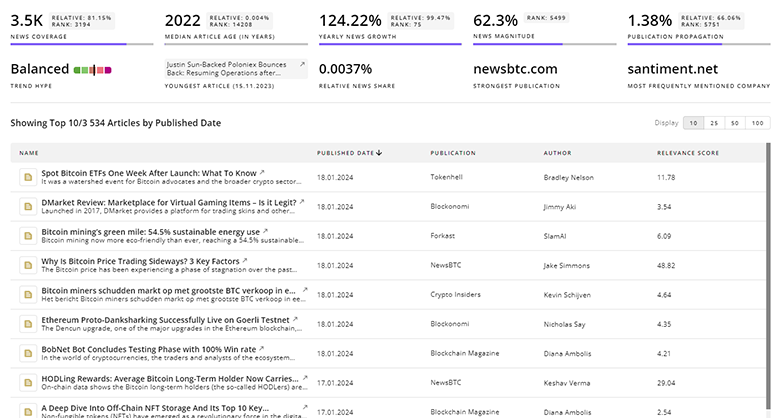
13.6K Computational Biology News Articles
Discover Latest Computational Biology Articles, News Magnitude, Publication Propagation, Yearly Growth, and Strongest Publications
Executive Summary
The computational biology sector is transitioning from large-scale data handling toward predictive engineering where the premium lies in causal, mechanistic simulation and generative design. Investors and strategic leaders should prioritize platforms that (1) integrate multi-modal omics and spatial context, (2) combine mechanistic models with ML for interpretability and regulatory readiness, and (3) deliver cloud-native workflows that scale GPU/HPC compute while preserving data governance. Organizations that align R&D and commercial models around validated in-silico de-risking—digital twins, synthetic cohorts and generative molecular engines—will shorten preclinical timelines and capture the expanding value pool as computational methods drive down late-stage failure.
We seek partnerships with industry experts to deliver actionable insights into trends and tech. Interested? Let us know!