
Construction Report
: Analysis on the Market, Trends, and TechnologiesThe construction sector sits on a pivot where factory-level production and digital workflows now determine competitive advantage, with the market sized at $2,580,000,000,000 and a projected CAGR of 4.82% that underwrites steady adoption of off-site methods and automation. Material and labor shocks in recent years have driven firms to convert schedule certainty into a financial advantage by industrialising component production and embedding BIM-centric planning into execution practices Construction industry trends 2026+.
We updated this report 232 days ago. Noticed something’s off? Let’s make it right together — reach out!
Topic Dominance Index of Construction
The Topic Dominance Index trendline combines the share of voice distributions of Construction from 3 data sources: published articles, founded companies, and global search
Key Activities and Applications
- Mass-customized modular fabrication: Producers convert design families into factory workflows that yield repeatable quality and faster on-site assembly; projects report 3–5x faster structural erection using modular steel systems compared with traditional methods ConXtech.
- BIM-led preconstruction and 4D sequencing: Teams use BIM as a single source of truth to perform clash detection, cost linking, and 4D sequencing to reduce rework and permit delays Top Construction Trends to Watch in 2026.
- Automated on-site assembly and vertical erection systems: Robotic column-lift and self-erecting frameworks replace conventional crane cycles, increasing vertical progress rates materially on tall structures
- Concrete system industrialization: Permanent and reusable formwork, UHPC components, and automated placement reduce wet-trade time and defects while improving durability [Patent Landscape Report — precision concrete].
- Off-site interior components (Digital Component Construction): Factory produced interior modules with digitized interfaces minimize trades on site, cut waste, and shorten handover windows
- Predictive maintenance and telematics for fleets and equipment: IoT sensors and predictive analytics extend machine uptime and reduce project delays in heavy civil and pavement work.
Emergent Trends and Core Insights
- Factory first, site last is replacing the traditional site-centric model: industrialised production shifts schedule risk from the field to factory throughput and logistics management.
- Material policy as procurement driver: Low-carbon concretes and engineered composites are moving from premiums to baseline requirements where regulation or financing mandates embodied-carbon metrics
- Labor scarcity is accelerating automation adoption: autonomous earthmoving and task robots are reducing site labor needs materially, while AI scheduling tools embed labour constraints into sequencing
- Digital workflow integration becomes a procurement differentiator: platforms that connect design, fabricators, and installers produce measurable investment efficiency and faster ROI for developers (investment efficiency is now a commercial lever)
- Project selection polarises by complexity and repeatability: high-redundancy assets such as data centers, hospitals, and multi-family housing adopt modular/PPVC at scale, while bespoke projects retain site-intensive workflows Americas Construction Outlook 2026.
- Supply-chain localisation becomes a resilience premium: firms front-load supplier engagement and regionalise component manufacture to mitigate tariffs and transport disruption
Technologies and Methodologies
- Building Information Modeling (BIM) as the data backbone linking design, cost, schedule, and asset data
- Digital Component Construction (DCC) that couples factory manufacturing with part-level digital tracking to enable rapid on-site assembly and traceability
- Design for Manufacture and Assembly (DfMA) / PPVC used to translate architectural intent into repeatable factory recipes and logistics packages.
- Robotics and autonomous equipment for excavation, masonry, rebar processing, and material handling to reduce repetitive site tasks and safety exposure
- 3D concrete printing and inflatable/permanent formwork for low-cost shelter, rapid foundations, and unique geometries; these methods reduce labor intensity and material waste
- Digital twins and 4D/5D scheduling that run build simulations linked to procurement and site telemetry to prevent clashes and support dynamic resequencing Construction 4.0 report.
- AI/ML for generative scheduling and risk scoring that ingests weather, labor availability, and supply forecasts to produce adaptive programmes
Construction Funding
A total of 32.4K Construction companies have received funding.
Overall, Construction companies have raised $1.1T.
Companies within the Construction domain have secured capital from 56.2K funding rounds.
The chart shows the funding trendline of Construction companies over the last 5 years
Construction Companies
- BuildFactory — BuildFactory operates an off-site construction marketplace that connects contractors to vetted fabricators and applies AI-native management tools to unite design, fabrication, and field workflows; this middleware reduces coordination loss when scaling modular programmes and targets procurement and VDC teams. BuildFactory claims to reduce procurement friction by centralising component sourcing and providing fabrication readiness data, supporting factory-first delivery models
- Falkbuilt Ltd. — Falkbuilt digitizes interior component manufacture via its Echo platform, delivering factory-made interior components that cut on-site trades and waste; the company's model emphasises precise component interfaces and acoustic/cleanroom-grade outcomes, making it attractive for healthcare and hospitality fitouts. The Echo-centric approach supports assembly workflows that reduce site disruption and landfill waste
- Constum — Constum develops mortar-extrusion 3D printing systems aimed at affordable housing and rapid shelter, and it has an MoU with a major industrial conglomerate for supply-chain access; its technology lowers formwork dependency and automates structural extrusion for repetitive wall layouts in low-cost markets
- CraneX — CraneX offers a patented column-installation and robotic lift system that assembles premanufactured floor platforms from the ground up, claiming up to 70% faster frame erection and 80% less manpower on certain projects; the method targets dense urban, high-rise programmes where crane cycles and site safety constrain schedule performance
- Automatic Construction Inc — Automatic Construction Inc commercialises inflatable formwork technology to produce cast concrete structures at a fraction (company states 1/5th) of conventional cost; the offering focuses on rapid, low-skill assembly for foundations and shelter in markets where labor is scarce and affordability mandates are acute
Gain a better understanding of 709.1K companies that drive Construction, how mature and well-funded these companies are.
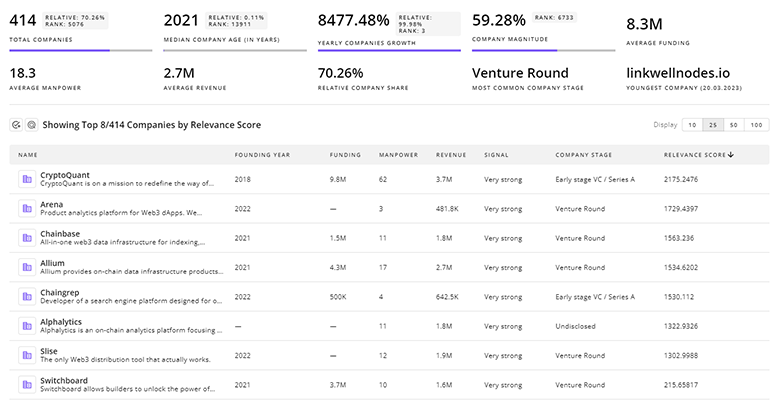
709.1K Construction Companies
Discover Construction Companies, their Funding, Manpower, Revenues, Stages, and much more
Construction Investors
Gain insights into 34.5K Construction investors and investment deals. TrendFeedr’s investors tool presents an overview of investment trends and activities, helping create better investment strategies and partnerships.
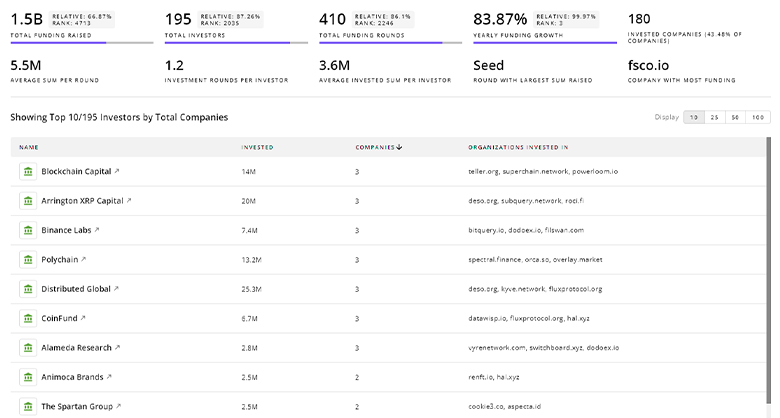
34.5K Construction Investors
Discover Construction Investors, Funding Rounds, Invested Amounts, and Funding Growth
Construction News
Gain a competitive advantage with access to 295.1K Construction articles with TrendFeedr's News feature. The tool offers an extensive database of articles covering recent trends and past events in Construction. This enables innovators and market leaders to make well-informed fact-based decisions.

295.1K Construction News Articles
Discover Latest Construction Articles, News Magnitude, Publication Propagation, Yearly Growth, and Strongest Publications
Executive Summary
Construction has entered a phase where control over component production and digital integration, not merely field execution, defines value capture. Market scale and steady CAGR provide room for both incremental automation and large platform plays, but winners will be those that combine predictable factory throughput, policy-aligned low-carbon materials, and BIM-first workflows to reduce schedule risk and convert predictability into developer value. For practitioners and investors, the strategic focus should be on securing manufacturing capacity, standardising digital handoffs between design and production, and prioritising solutions that convert labour scarcity into measurable cost and schedule advantages.
We seek partnerships with industry experts to deliver actionable insights into trends and tech. Interested? Let us know!