
Convolutional Neural Networks Report
: Analysis on the Market, Trends, and TechnologiesThe market for Convolutional Neural Networks (CNNs) is entering an implementation phase where efficiency and domain specificity determine commercial winners, supported by a projected 39.5% CAGR for the North American CNN market through 2031. Hardware acceleration and services that shorten time-to-deployment capture the largest share of near-term value, while sector-specific clinical and industrial approvals are creating high-entry barriers and predictable revenue streams researchandmarkets – North America Convolutional Neural Networks Market, 2024.
We updated this report 222 days ago. Noticed something’s off? Let’s make it right together — reach out!
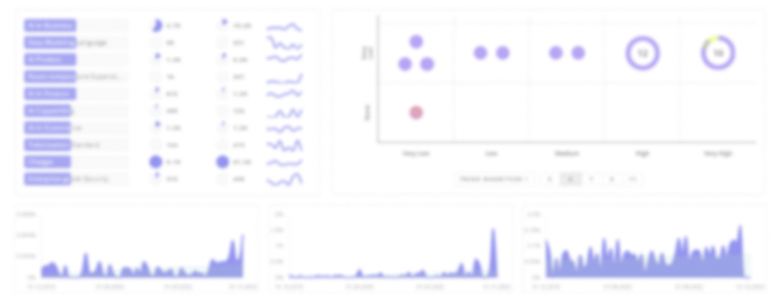
Topic Dominance Index of Convolutional Neural Networks
The Topic Dominance Index trendline combines the share of voice distributions of Convolutional Neural Networks from 3 data sources: published articles, founded companies, and global search
Key Activities and Applications
- Medical imaging and diagnostics — CNNs power segmentation, detection, and measurement workflows (MRI, CT, dermatology, ECG image interpretation). Clinical approvals and federated update flows are turning prototype models into subscription revenues for integrated hospital systems.
- Autonomous vehicles and ADAS perception stacks — real-time object detection and semantic segmentation at the sensor fusion layer remain core monetizable use cases, creating demand for edge-optimized CNN inference and specialized accelerators researchandmarkets - Convolutional Neural Networks Market, 2024.
- Industrial visual inspection and robotics — CNNs applied to conveyor inspection, assembly verification, and pose estimation reduce manual QA cost and produce measurable ROI that drives direct project procurement from manufacturers.
- Edge / TinyML deployments — running CNNs on microcontrollers and FPGAs to enable on-device inference for IoT and robotics is a distinct product market with specific toolchain and silicon requirements ComputERA.
- Smart-city and security analytics — scalable video analytics (traffic, crowd monitoring, anomaly detection) that combine on-edge filtering with cloud aggregation create recurring revenue opportunities via SaaS and managed services.
- Image enhancement and consumer-facing vision features — super-resolution, denoising, and content moderation deliver product differentiation in media and e-commerce platforms and support B2B licensing and API revenue models.
Emergent Trends and Core Insights
- Hardware-first monetization is driving strategy. The highest-value plays now tightly couple CNN topology with target accelerators (ASIC, FPGA, neuromorphic or photonic) rather than shipping generic models to cloud GPUs.
- Edge inference economics separate winners from commodity providers. Solutions that reduce inference energy by 10x–100x (via quantization, sparsity, or novel silicon) enable direct access to constrained verticals such as wearables, drones, and industrial sensors.
- Hybrid architectures increase per-instance accuracy on complex scenes. The fusion of local convolutional feature extractors with attention or global context modules lifts performance where pure CNNs previously plateaued, expanding viable use cases in medical imaging and remote sensing researchandmarkets - Europe Convolutional Neural Networks Market, 2024.
- Regulatory validation creates defensible commercial moats. FDA/CE approvals and comparable certifications convert R&D investments into repeatable hospital or industrial procurement, raising the acquisition multiples for companies that secure them.
- Service-layer monetization (training, deployment, annotation) grows faster than packaged models. Enterprises prefer turnkey integrations and managed update pipelines, producing higher margins for consulting and platform operators than for raw model sellers.
Technologies and Methodologies
- Quantization, pruning and sparsity exploitation — methods that compress weights and skip zeroed activations to reduce memory and multiply-accumulate operations, enabling microcontroller and FPGA deployment.
- Winograd and FFT-based convolution acceleration — arithmetic reduction techniques that lower multiply counts for common kernel sizes, delivering practical speedups when mapped to hardware pipelines.
- Depthwise separable and factorized convolutions — architectural factorization that cuts parameter count and computation while preserving representational power for many vision tasks.
- Neuromorphic and photonic inference engines — alternative physical substrates that reduce energy-per-inference and latency for streaming vision tasks; these approaches target extreme-edge and high-throughput robotics use cases.
- Hardware-aware NAS and compiler toolchains — automated architecture search with mixed-precision and sparsity constraints plus compiler stacks that generate accelerator-native code are now central to product roadmaps NouvAI.
- Self-supervised and label-efficient learning — pre-training strategies that lower reliance on expensive annotated datasets, enabling faster domain adaptation in enterprise verticals.
Convolutional Neural Networks Funding
A total of 198 Convolutional Neural Networks companies have received funding.
Overall, Convolutional Neural Networks companies have raised $6.9B.
Companies within the Convolutional Neural Networks domain have secured capital from 829 funding rounds.
The chart shows the funding trendline of Convolutional Neural Networks companies over the last 5 years
Convolutional Neural Networks Companies
- Look Dynamics — Small team focused on optical/photonic convolution implementations that target orders-of-magnitude energy and throughput advantages for inference. Their photonic CNN approach aims to deliver sub-millisecond image processing with substantially lower power draw, making them attractive to robotics and high-frame-rate analytics integrators. Their open-innovation stance positions them as an ingredient vendor rather than a full-stack SaaS player.
- CoLumbo AI — Clinical imaging company using U-Net–style fully convolutional networks for lumbar MRI analysis, cleared for clinical assistance in EU and US markets and sold as a radiology workflow augmentation product. The company packages segmentation, key-point detection, and automated report generation into a subscription model aimed at reducing radiologist reading time and improving throughput.
- Neuton.AI — No-code TinyML platform that automatically generates extremely compact CNN-capable models intended for microcontrollers, claiming up to 1,000x reductions in model size relative to mainstream frameworks and positioning for direct embedding in edge sensors. Their focus on automated model creation and turnkey deployment targets customers who need low-skill integration paths into resource-constrained devices. Recent M&A interest signals strategic value in TinyML toolchains.
- Silicon Perception — Builds single-chip image encoders and pose decoders for robotic perception, offering on-chip weight storage and per-row model execution to minimize latency and power for real-time robotics. They publish encoder models and Verilog to accelerate ecosystem adoption and aim to replace common feature extractors (e.g. ResNet-18) in constrained robotic stacks. Their combined hardware-compiler offering targets OEMs seeking deterministic inference performance.
Gain a better understanding of 1.0K companies that drive Convolutional Neural Networks, how mature and well-funded these companies are.
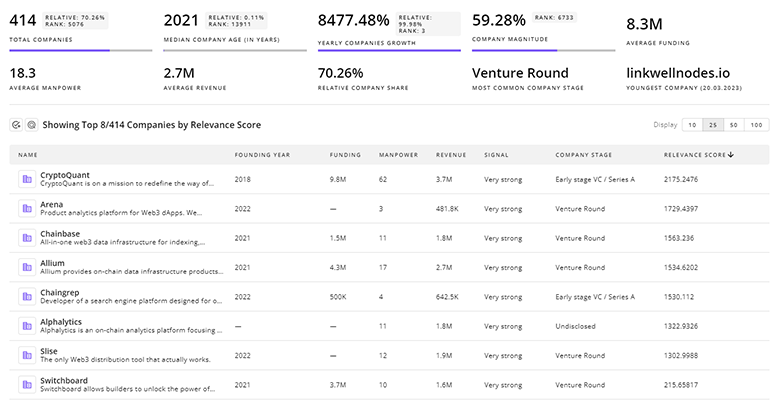
1.0K Convolutional Neural Networks Companies
Discover Convolutional Neural Networks Companies, their Funding, Manpower, Revenues, Stages, and much more
Convolutional Neural Networks Investors
Gain insights into 1.1K Convolutional Neural Networks investors and investment deals. TrendFeedr’s investors tool presents an overview of investment trends and activities, helping create better investment strategies and partnerships.
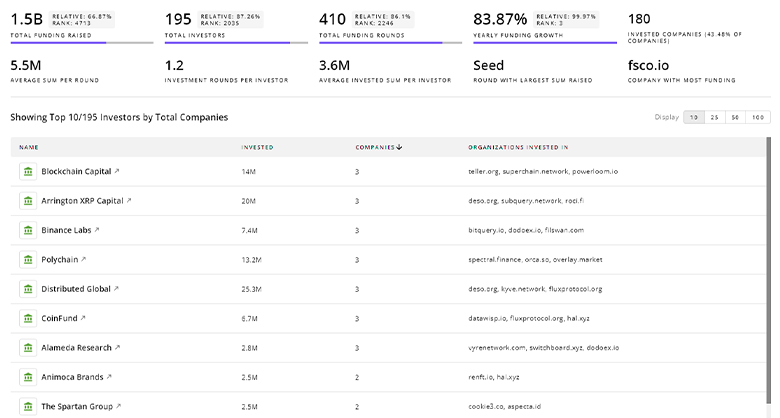
1.1K Convolutional Neural Networks Investors
Discover Convolutional Neural Networks Investors, Funding Rounds, Invested Amounts, and Funding Growth
Convolutional Neural Networks News
Gain a competitive advantage with access to 11.9K Convolutional Neural Networks articles with TrendFeedr's News feature. The tool offers an extensive database of articles covering recent trends and past events in Convolutional Neural Networks. This enables innovators and market leaders to make well-informed fact-based decisions.

11.9K Convolutional Neural Networks News Articles
Discover Latest Convolutional Neural Networks Articles, News Magnitude, Publication Propagation, Yearly Growth, and Strongest Publications
Executive Summary
CNNs have moved from academic novelty to an industrialized stack where competitive advantage accrues to organizations that align model design, data ownership, and hardware execution into a single product proposition. The market's projected 39.5% CAGR and the concentration of value in hardware-aware and domain-validated solutions indicate that buyers will prefer integrated vendors that lower total cost of ownership and shorten time to safe, auditable production. For investors and operators, the practical playbook is to prioritize (1) companies with accelerator or silicon leverage, (2) firms that convert regulatory approvals into recurring contracts, and (3) platform providers that monetize the services layer around training and maintenance rather than selling models alone.
We seek partnerships with industry experts to deliver actionable insights into trends and tech. Interested? Let us know!