
Crop Monitoring Report
: Analysis on the Market, Trends, and TechnologiesThe crop monitoring market is scaling fast: the internal trend data records an 18.1% CAGR and a forecasted market value of USD 7.97 billion by 2029, signalling strong commercial traction for platforms that convert sensing into decisions Crop Monitoring Market 2025: Detailed Insights into Market Size and Future Growth. Markets and field trials show measurable impact from combined sensing and AI workflows (water savings and yield uplifts cited across pilots), which makes the next 24 months a period of commercial sorting between sensor-aggregators and prescriptive AI players Global Crop Monitoring Market Size, Share, Trends Ag And AgriTech Market Trends For 2025-2030 From EOSDA.
We updated this report 125 days ago. Noticed something’s off? Let’s make it right together — reach out!
Topic Dominance Index of Crop Monitoring
The Topic Dominance Index trendline combines the share of voice distributions of Crop Monitoring from 3 data sources: published articles, founded companies, and global search
Key Activities and Applications
- Real-time root-zone and soil chemistry sensing to drive irrigation and fertiliser prescriptions, moving decisions from calendar-based schedules to measured plant/soil needs.
- Multispectral and hyperspectral aerial scouting for early stress and phenotyping, used for per-plot health indexing and yield forecasting at scale Pheno-Inspect.
- In-vivo plant sensors (sap flow, stem signals) that supply direct crop water-use and stress metrics for irrigation optimisation and harvest timing.
- Automated insect and pest monitoring networks tied to AI counting models to trigger targeted interventions and reduce pesticide volume scoutlabs An AI-Enabled Framework for Cacopsylla chinensis Monitoring and Population Dynamics Prediction.
- Post-harvest and storage condition monitoring to reduce loss and preserve value through real-time environmental sensors and analytics Cellar Insights.
Emergent Trends and Core Insights
- Multi-source fusion is the dominant performance lever: models that combine satellite, UAV, and in-situ soil/plant signals produce materially higher accuracy for stress detection and yield prediction Maize Classification in Arid Regions via Spatiotemporal Feature Optimization and Multi-Source Remote Sensing Integration.
- Early, pre-symptomatic detection is commercially valuable: platforms that identify micro-changes in plant physiology days before visible symptoms capture the highest willingness-to-pay from high-value horticulture and greenhouse customers Yevul Info Driving Agriculture Innovation: 3 Key Agri-Tech Trends – Cropin.
- Edge and LPWAN connectivity solutions increase addressable supply, enabling monitoring in low-bandwidth regions and reducing upkeep costs for distributed sensors CropWatch COtL Mesonet.
- Soil- and plant-level measurement is migrating from episodic lab assays to continuous, automated streams (nitrate sensors, sap-flow, acoustic ecology), which shifts value capture toward sensor-plus-analytics businesses.
- Carbon monitoring and MRV services create an adjacent revenue channel for monitoring providers; verified soil-carbon measurement becomes a commercial use-case beyond yield management Seqana.
Technologies and Methodologies
- UAV and satellite multispectral/hyperspectral imaging for NDVI, red-edge and SWIR indicators; used for high-resolution phenotyping and early-water-stress detection Cover Crop Types Influence Biomass Estimation Using UAV-Mounted Multispectral Sensors Map My Crop.
- Deep-learning computer vision for fine-grained object detection and counting (seedlings, flowers, pests) enabling automation of recurring scouting tasks A YOLOv8n-T and ByteTrack-Based Dual-Area Tracking and Counting Method for Cucumber Flowers Proofminder.
- Root-zone and microwave radiometry for sub-surface moisture mapping that informs precise irrigation maps and on-the-move sensing on turf equipment.
- Continuous nitrate and nutrient profiling via in-situ electro-optical sensors to enable real-time fertiliser management and reduce nutrient waste Soil Monitoring Market Size, Share and Trends.
- Bioacoustic and organism-activity sensing as proxy indicators for soil biological health, offering low-cost, rapid sampling alternatives to lab assays SODS: Soil Health On-Demand Sensors.
- Federated learning and on-edge inference to protect farmer data while improving model performance across heterogeneous farms StartUs Insights - Precision Agriculture Trends.
Crop Monitoring Funding
A total of 172 Crop Monitoring companies have received funding.
Overall, Crop Monitoring companies have raised $1.2B.
Companies within the Crop Monitoring domain have secured capital from 701 funding rounds.
The chart shows the funding trendline of Crop Monitoring companies over the last 5 years
Crop Monitoring Companies
DOTS, Data of The Soil
DOTS provides continuous, multi-depth nitrate readings via a patented electro-optical approach, directly addressing the common fertiliser over-application problem and enabling variable-rate nitrogen management at field scale. Their value proposition targets both environmental compliance and input-cost reduction by turning nutrient state into an actionable signal.Treetoscope
Treetoscope commercialises a sap-flow sensor that measures plant internal water use and connects these signals to AI irrigation advice; the company markets fast ROI by converting per-plant water demand into irrigation prescriptions. This in-vivo approach reduces reliance on proxy indices and is attractive for high-value orchards and vineyards.Soil Acoustics
Soil Acoustics introduces a low-cost Soil Acoustic Meter that records biological activity (earthworms, insects) and uses AI to infer soil health metrics; this method aims to substitute some lab tests with rapid field diagnostics. The company targets customers who need frequent, affordable soil-health snapshots across many plots.scoutlabs
scoutlabs builds an AI-enabled digital insect monitoring network intended to replace manual trapping and enable targeted spraying decisions; their offering reduces labour and supports lower insecticide use through remote counting and alerts. The solution suits cooperative models where monitoring scale and cost efficiency matter.
Gain a better understanding of 740 companies that drive Crop Monitoring, how mature and well-funded these companies are.
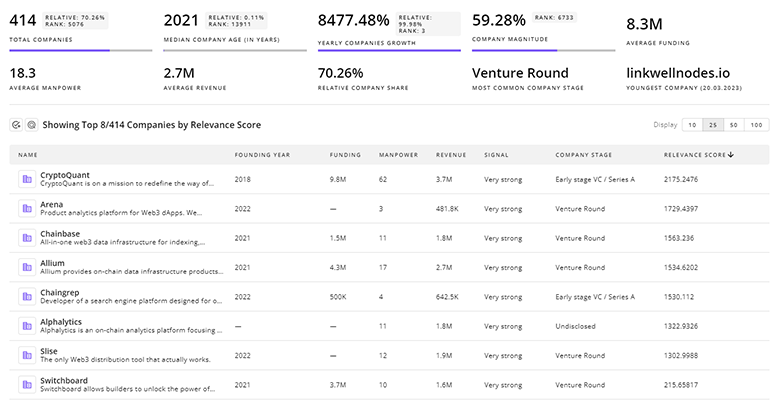
740 Crop Monitoring Companies
Discover Crop Monitoring Companies, their Funding, Manpower, Revenues, Stages, and much more
Crop Monitoring Investors
Gain insights into 682 Crop Monitoring investors and investment deals. TrendFeedr’s investors tool presents an overview of investment trends and activities, helping create better investment strategies and partnerships.
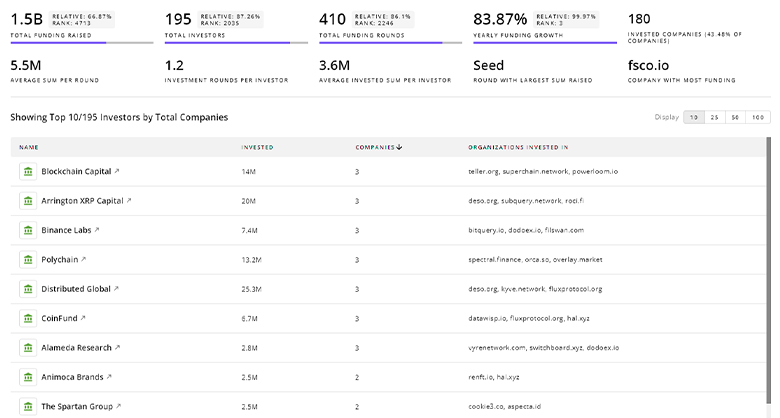
682 Crop Monitoring Investors
Discover Crop Monitoring Investors, Funding Rounds, Invested Amounts, and Funding Growth
Crop Monitoring News
Gain a competitive advantage with access to 862 Crop Monitoring articles with TrendFeedr's News feature. The tool offers an extensive database of articles covering recent trends and past events in Crop Monitoring. This enables innovators and market leaders to make well-informed fact-based decisions.
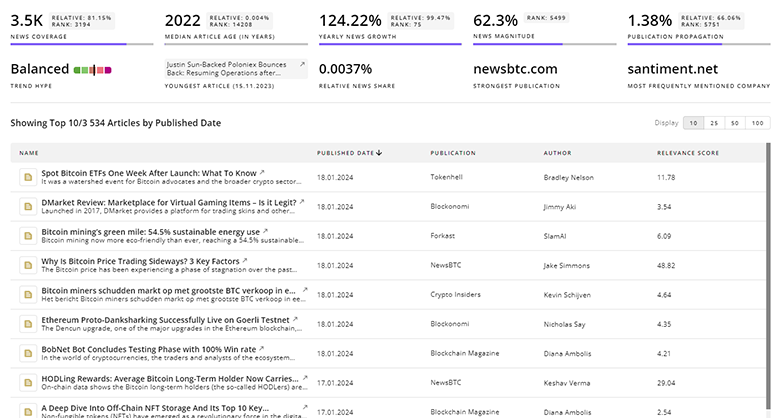
862 Crop Monitoring News Articles
Discover Latest Crop Monitoring Articles, News Magnitude, Publication Propagation, Yearly Growth, and Strongest Publications
Executive Summary
Crop monitoring now trades on its ability to convert measurements into verified economic or environmental outcomes. The strategic winners will be firms that integrate high-fidelity, in-vivo or sub-surface sensing with scalable AI workflows and auditable outputs that pay for the sensing itself. Investors should favour sensor innovators that couple validated measurement science with software platforms that prove input savings or generate verifiable MRV credits. Operators should prioritise connectivity resilience, low-maintenance hardware, and outcome-aligned commercial models to move pilots into enterprise-scale deployments.
We seek partnerships with industry experts to deliver actionable insights into trends and tech. Interested? Let us know!