Deep Reinforcement Learning Report
: Analysis on the Market, Trends, and TechnologiesThe market for Deep Reinforcement Learning is moving from experimental research toward selective commercial deployments, driven by concentrated funding and rapidly expanding news coverage; total funding into dedicated deep-RL companies reached $3.11B, reflecting meaningful investor interest in specialized stacks and vertical players. Industry forecasts for the broader reinforcement-learning market also show material upside, with a projected market size of $13.52B in 2025 and a high-single to double-digit CAGR (reported 41.5% in recent market analysis), indicating large addressable opportunities for firms that solve sample efficiency, safety, and operations challenges Reinforcement Learning Market, 2023-2032.
We updated this report 103 days ago. Noticed something’s off? Let’s make it right together — reach out!
Topic Dominance Index of Deep Reinforcement Learning
The Topic Dominance Index trendline combines the share of voice distributions of Deep Reinforcement Learning from 3 data sources: published articles, founded companies, and global search
Key Activities and Applications
- Autonomous systems policy generation: Development of continuous-control and decision policies for robotics, autonomous vehicles, and aerial platforms, using DRL variants such as policy-gradient and actor-critic families; these systems increasingly rely on sim-to-real transfer and domain randomization to move from simulation to fielded control
- Operational optimization for industrial assets: DRL agents tune complex, time-dependent systems (energy grid balancing, wind-farm dispatch, process control) to improve throughput and reduce operating cost, with documented pilots showing measurable ROI in energy and manufacturing deployments.
- LLM agent fine-tuning and alignment: Using reinforcement frameworks (RL from feedback or supervised RL hybrids) to steer large language models toward multi-step reasoning and safety constraints; new stepwise feedback approaches improve reasoning quality per unit of compute compared with pure supervised fine-tuning.
- Robotic manipulation and dexterous control: Long-horizon manipulation, grasping, and teleoperation increasingly use imitation hybridized with DRL to reduce exploration costs and accelerate training for physical systems.
- Complex combinatorial optimization and scheduling: Transformers + RL pipelines and reward-shaped objectives target job-shop scheduling, routing, and resource allocation to outperform heuristic baselines in constrained industrial settings The Future of Reinforcement Learning: Trends and Directions.
Emergent Trends and Core Insights
- Data efficiency is now the competitive moat. Startups and research groups that reduce interaction data by orders of magnitude (via model-based methods, reusing prior computation, or strong imitation priors) gain outsized advantage because compute and real-world interaction remain the dominant cost drivers Reinforcement Learning Market Size & Share, Growth Forecasts 2035.
- Integration with LLMs creates a pipeline for agentic capabilities. Supervised Reinforcement Learning and stepwise feedback are being used to teach multi-step reasoning to smaller models as an efficient path to agentic behaviors without full large-model retraining.
- Model-based planning and world models reduce sample complexity. Approaches that learn latent dynamics for planning cut interaction needs dramatically versus model-free baselines and improve long-horizon planning in physical tasks.
- Multi-agent coordination becomes a commercial vector. Applications in smart grids, fleet routing, and multi-robot logistics drive work on sparse-attention, credit assignment, and scalable coordination protocols.
- Operational tooling (RLOps) is emerging as necessary infrastructure. Enterprises require lifecycle platforms for environment management, reward design, safe deployment, and monitoring; vendor traction in RLOps correlates with enterprise adoption speed.
Technologies and Methodologies
- Policy-gradient families (PPO, DPO) and actor-critic hybrids: Continue to dominate continuous control problems; parameter-efficient fine-tuning (LoRA, PEFT) combines with these methods for cost-effective production tuning.
- Model-based RL and world models: Learn latent dynamics for planning and reduce wall-clock training time and environment interactions in long-horizon tasks.
- Supervised Reinforcement Learning (SRL) and stepwise feedback pipelines: Hybrid training that rewards intermediate steps to solve sparse-reward problems and to transfer human expertise into policies for LLM agents.
- Simulation, digital twins, and domain randomization: High-fidelity simulated environments reduce real-world trial costs; procedural world generation and randomized physics narrow the sim-to-real gap for manipulation and navigation.
- Safety wrappers and constrained-action controllers: Adding constrained solvers, verification layers, and explainability hooks around policies to meet regulatory and operational safety requirements in finance, healthcare, and mobility.
- RLOps and standardization toolkits: Platforms for reproducible environment orchestration, reward telemetry, retraining pipelines, and deployment governance accelerate enterprise rollouts and reduce operational risk.
Deep Reinforcement Learning Funding
A total of 71 Deep Reinforcement Learning companies have received funding.
Overall, Deep Reinforcement Learning companies have raised $3.1B.
Companies within the Deep Reinforcement Learning domain have secured capital from 269 funding rounds.
The chart shows the funding trendline of Deep Reinforcement Learning companies over the last 5 years
Deep Reinforcement Learning Companies
- Deepen AI
Deepen AI focuses on sensor annotation, calibration, and safety-first data tooling for robotics and automotive perception pipelines. Their offering reduces the data engineering overhead that typically slows DRL projects and improves the cost-per-useful-sample metric—an essential lever for real-world deployment in safety-critical domains. Their emphasis on the data lifecycle helps teams move from prototype to certified systems faster. - FractalBrain
FractalBrain claims algorithmic advances that materially reduce compute and data requirements for both LLM and RL workloads. The company's research stack centers on growing architectures and local learning rules to improve energy and data efficiency; these characteristics position them as a potential supplier where compute budget is a binding constraint for scale deployments. Their claims align with market emphasis on data efficiency as a differentiator. - Reinforz AI
Reinforz AI targets education management with automated content generation, grading, and personalized tutoring driven by DRL policies that adapt to classroom feedback. By applying RL to sequential pedagogical decisions, the company automates repetitive educator tasks and personalizes learning trajectories, enabling measurable time savings for institutions that adopt the platform. Their vertical focus demonstrates how RL can create immediate cost and quality improvements outside traditional robotics or finance use cases. - Delfox
Delfox develops the NERMIND platform for aerospace and defense optimization, combining domain knowledge with DRL to solve complex control problems in regulated environments. Delfox's partnerships with major contractors and its proven procurement and compliance pathways make it a practical collaborator for B2G and B2B sales cycles where safety and certification matter. Their approach illustrates how RL providers can monetize deep domain expertise rather than compete on foundational compute alone.
Gain a better understanding of 316 companies that drive Deep Reinforcement Learning, how mature and well-funded these companies are.
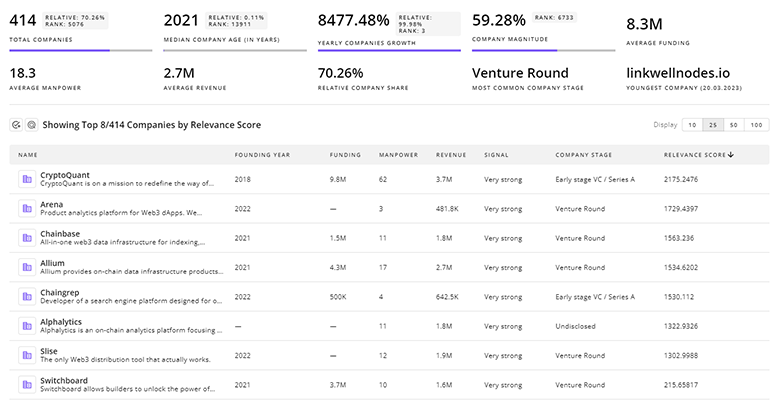
316 Deep Reinforcement Learning Companies
Discover Deep Reinforcement Learning Companies, their Funding, Manpower, Revenues, Stages, and much more
Deep Reinforcement Learning Investors
Gain insights into 399 Deep Reinforcement Learning investors and investment deals. TrendFeedr’s investors tool presents an overview of investment trends and activities, helping create better investment strategies and partnerships.
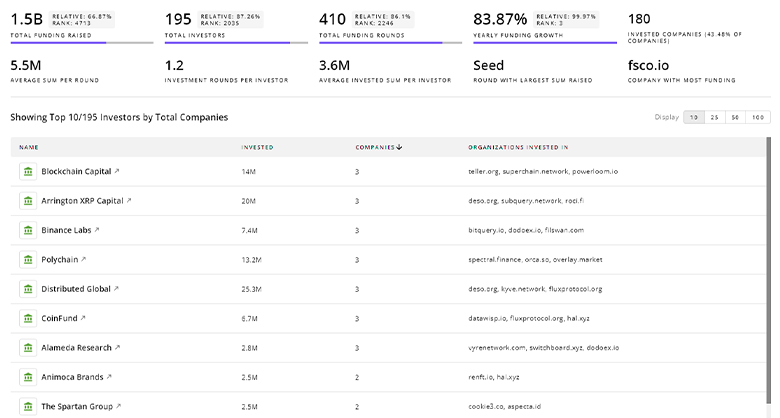
399 Deep Reinforcement Learning Investors
Discover Deep Reinforcement Learning Investors, Funding Rounds, Invested Amounts, and Funding Growth
Deep Reinforcement Learning News
Gain a competitive advantage with access to 2.5K Deep Reinforcement Learning articles with TrendFeedr's News feature. The tool offers an extensive database of articles covering recent trends and past events in Deep Reinforcement Learning. This enables innovators and market leaders to make well-informed fact-based decisions.
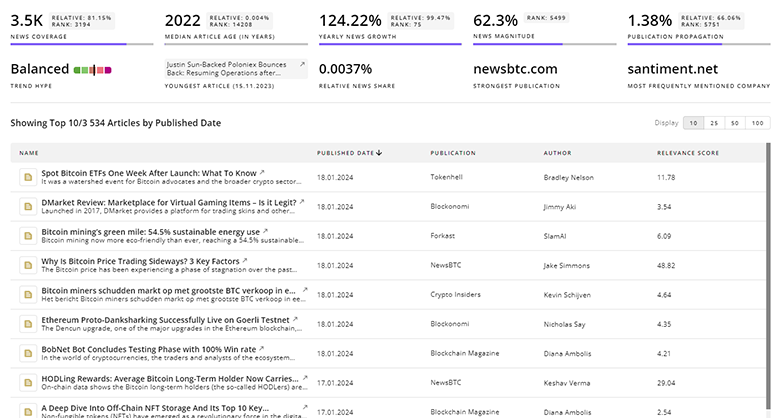
2.5K Deep Reinforcement Learning News Articles
Discover Latest Deep Reinforcement Learning Articles, News Magnitude, Publication Propagation, Yearly Growth, and Strongest Publications
Executive Summary
Deep Reinforcement Learning is at an inflection where algorithmic improvements that reduce sample and compute needs, combined with enterprise RLOps and simulation infrastructure, determine who captures commercial value. Market indicators show substantial capital and fast growth in adjacent reinforcement markets; firms that deliver measurable efficiency gains, operational governance, and safety assurances will outcompete generalist providers. Strategic focus areas for the business community include investing in simulation fidelity and transfer techniques, adopting model-based and hybrid training paradigms to cut interaction costs, and selecting RLOps partners that can certify, monitor, and retrain policies under changing conditions.
We seek partnerships with industry experts to deliver actionable insights into trends and tech. Interested? Let us know!