Deep Sea Mining Report
: Analysis on the Market, Trends, and TechnologiesThe deep sea mining opportunity now faces a defined tradeoff: escalating capital and technology readiness meet persistent environmental and governance friction. The sector’s headline growth signal is the 61.4% projected equipment CAGR identified in recent trend analysis, which coincides with $619.59M total funding across active companies and 54 funding rounds—metrics that show concentrated investor interest but limited capital depth per player. At the same time, international and scientific briefs report 18 exploration licences in the Clarion-Clipperton Fracture Zone and repeated findings that benthic disturbance and long recovery times present material regulatory and reputational barriers for commercial roll-out DEEP-SEA MINING. For business leaders the near-term imperative is clear: prioritize validated low-impact extraction stacks and defensible monitoring data if pursuing offtake or project finance, because customer and capital gating will hinge on environmental evidence and traceability precedenceresearch – Deep-Sea Mining Report, 2025.
We updated this report 304 days ago. Noticed something’s off? Let’s make it right together — reach out!
Topic Dominance Index of Deep Sea Mining
The Topic Dominance Index trendline combines the share of voice distributions of Deep Sea Mining from 3 data sources: published articles, founded companies, and global search
Key Activities and Applications
- Polymetallic nodule exploration and mapping — high-resolution AUV/ROV surveys and geochemical sampling to quantify nodules for nickel, cobalt, copper, and manganese, concentrated in zones such as the CCFZ researchandmarkets - Commercial Deep Sea Mining, 2025.
- Pilot extraction and riser/lift testing — sea trials of hydraulic suction and cutter-collector systems to validate throughput, pump reliability, and riser longevity under high abrasion and deep pressure.
- Environmental baseline and continuous monitoring — multi-year benthic and water-column baselines, plus real-time turbidity, eDNA, and plume sensors to meet permit conditions and support third-party verification.
- Selective/low-impact collection and in-situ preprocessing — systems that reduce fines generation, apply in-situ separation, or use buoyancy-assisted lifts to cut slurry volumes and energy use.
- Alternative CRM recovery from brines and desalination streams — recovery of lithium, magnesium and other trace elements via brine processing as a parallel, lower-impact pathway that leverages existing infrastructure and EU research projects SEArcularMINE.
- Regulatory engagement and social license programs — multistakeholder science programs, independent monitoring and benefit-sharing frameworks to manage ISA and national permitting risk.
Emergent Trends and Core Insights
- Capital is shifting toward deployment readiness: investors are funding later-stage technology and integrated system pilots rather than pure exploration, compressing the time horizon to pre-commercial demos and raising pressure to show environmental performance.
- Environmental data is now a commercial gating factor: permitting and offtake depend on continuous, auditable monitoring (turbidity, eDNA, deposition), so firms that integrate third-party verified sensor suites and open data platforms will capture preferential access to capital and customers.
- Technology stacks are modularizing around the riser and lift problem: reliability of multi-stage pumps, erosion-resistant risers, and slug flow mitigation determine uptime and cost-in-use more than collection mechanics alone.
- Nearshore and brine routes gain strategic appeal: projects that recover CRMs from desalination and industrial brines present fewer ecological and governance hurdles and are attracting EU and Horizon funding, offering an alternative supply channel to seabed extraction.
- Geopolitical divergence and regulatory fragmentation: some nations pursue domestic permits and EEZ projects while international authority processes evolve slowly; firms must hedge by aligning with both national pilots and multilateral monitoring expectations.
Technologies and Methodologies
- Hydraulic suction and slurry riser systems — established commercial candidate for high-throughput nodule lifting; engineering focus is on pump abrasion resistance and flexible riser fatigue life alliedmarketresearch - Marine Mining Market Report, 2025.
- Cutting/crawler collectors with distributed suction control — designs that limit substrate penetration and fines by regulating ground pressure and nozzle geometry to reduce plume generation.
- AI-driven AUV/ROV fleets for mapping and selective collection — machine vision and onboard classification enable higher hit-rates, fewer re-passes, and adaptive collector routing to minimize disturbance.
- In-situ separation and buoyancy-assisted lift — on-seabed pre-processing and gas/floatation lift reduce pumped slurry volume and energy demand, lowering surface vessel load and decreasing water column discharge.
- Real-time plume modeling and sensor fusion — arrays combining turbidity, particle sizing, current profilers, and eDNA feed closed-loop controls that adjust collector speed and pump rates to remain within permitted envelopes.
- Modular vessel and riser interoperability — standardized pump skids, control pods, and digital twins that integrate seabed trafficability, pump curves and particle distributions to optimize $/ton delivered.
Deep Sea Mining Funding
A total of 22 Deep Sea Mining companies have received funding.
Overall, Deep Sea Mining companies have raised $1.5B.
Companies within the Deep Sea Mining domain have secured capital from 67 funding rounds.
The chart shows the funding trendline of Deep Sea Mining companies over the last 5 years
Deep Sea Mining Companies
- Impossible Metals Inc. — Impossible Metals Inc. develops AI-enabled seabed robots for selective nodule harvesting and frames its offering with a science-first environmental posture; the company reports seed funding and positions AUV autonomy as its core differentiator to reduce rework and fines generation. The team emphasizes continuous environmental monitoring integrated into its collection logic, targeting battery-grade nickel and cobalt for downstream offtake. Their B-Corp positioning aims to shorten stakeholder due-diligence timelines in project permitting cycles.
- Tiburon Subsea, Inc — Tiburon Subsea, Inc builds a fleet model of high-autonomy HAUVs and a data infrastructure platform aimed at delivering continuous seabed intelligence and survey payload standardization. By packaging survey, monitoring and mission planning as a platform, Tiburon targets recurring revenue from operators who need low-latency environmental baselines and compliance reporting. Their multi-vehicle swarm approach reduces vessel days and lowers per-survey unit economics, which matters where permit renewal depends on frequent monitoring.
- DeepWater Exploration Inc. — DeepWater Exploration Inc. provides subsea computer vision and perception stacks tuned for extreme depths, enabling cheaper, scalable subsea autonomy for mapping and inspection. Their platform shortens integration time for AUV/OEM partners and improves classification accuracy for target discrimination—critical for selective harvesting strategies. They emphasize machine-learning models trained on curated seabed datasets to reduce false positives in nodule detection.
- iSeaMC GmbH — iSeaMC GmbH commercializes crawler systems and seafloor monitoring services optimized for long-duration environmental surveys. Their semi-autonomous crawlers aim to deliver cost-efficient, repeatable baseline datasets that regulators and funders require, and they position sensor-anchored products as cornerstone assets in permit applications. Their engineering focus reduces vessel dependency for monitoring campaigns.
- Sea4Value — Sea4Value is a Horizon-backed research consortium moving pilot technologies that extract trace CRMs from desalination/brine streams toward demonstration scale. Their approach targets lithium and magnesium recovery with low environmental discharge and aims to create alternative, nearshore supply that avoids seabed disturbance. For corporates and regional governments, Sea4Value offers a lower-friction path to secure trace metals while meeting social and permit constraints.
Gain a better understanding of 234 companies that drive Deep Sea Mining, how mature and well-funded these companies are.
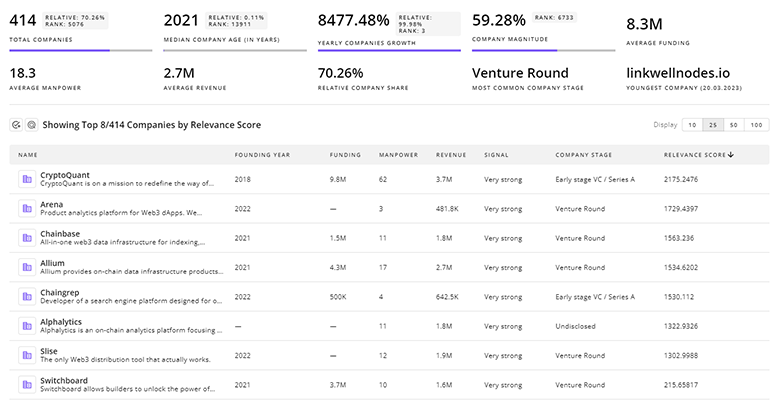
234 Deep Sea Mining Companies
Discover Deep Sea Mining Companies, their Funding, Manpower, Revenues, Stages, and much more
Deep Sea Mining Investors
Gain insights into 94 Deep Sea Mining investors and investment deals. TrendFeedr’s investors tool presents an overview of investment trends and activities, helping create better investment strategies and partnerships.
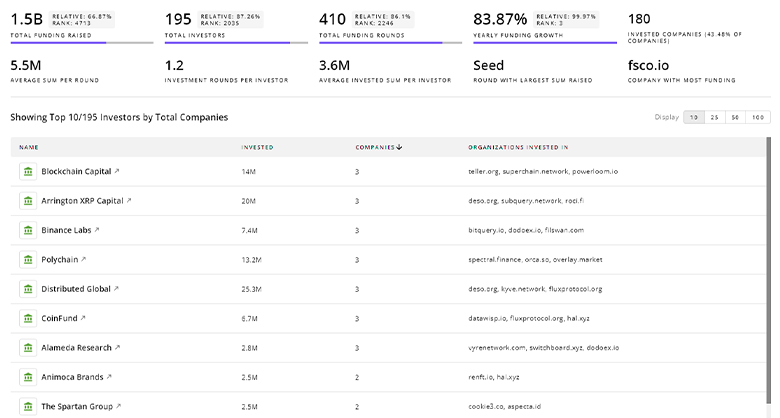
94 Deep Sea Mining Investors
Discover Deep Sea Mining Investors, Funding Rounds, Invested Amounts, and Funding Growth
Deep Sea Mining News
Gain a competitive advantage with access to 2.3K Deep Sea Mining articles with TrendFeedr's News feature. The tool offers an extensive database of articles covering recent trends and past events in Deep Sea Mining. This enables innovators and market leaders to make well-informed fact-based decisions.
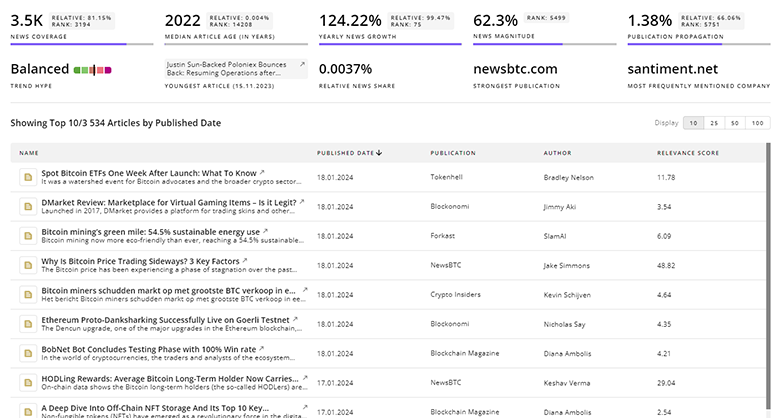
2.3K Deep Sea Mining News Articles
Discover Latest Deep Sea Mining Articles, News Magnitude, Publication Propagation, Yearly Growth, and Strongest Publications
Executive Summary
Deep sea mining combines substantial material upside for high-value battery and critical metals with uniquely stubborn environmental and governance hurdles. Commercial progress will depend on three interlocking capabilities: engineering the riser/pump column for reliable, low-fines throughput; deploying auditable, continuous environmental monitoring that satisfies third-party verifiers; and constructing commercial models that pair seabed resource access with lower-impact nearshore and brine recovery options. Firms that coordinate capital, data transparency, and demonstrable ecological performance will be the ones that attract conditional offtake, ESG-linked finance, and the regulatory permissions required to scale.
We seek partnerships with industry experts to deliver actionable insights into trends and tech. Interested? Let us know!