Digital Supply Chain Report
: Analysis on the Market, Trends, and TechnologiesThe digital supply chain market sits at a strategic inflection point: USD 19.57 billion in 2024 with a projected expansion trajectory to 2034 driven by platformization, AI, and traceability requirements. Investment and vendor activity now concentrate on three linked objectives: reduce working capital through smarter planning, extend visibility deep into multi-tier suppliers, and embed compliance/ESG measurements into transaction flows marketresearchfuture.com. The immediate commercial battleground will be firms that can convert heterogeneous operational data into prescriptive actions at scale while protecting data and enabling multi-party collaboration alliedmarketresearch.com.
We updated this report 121 days ago. Noticed something’s off? Let’s make it right together — reach out!
Topic Dominance Index of Digital Supply Chain
The Topic Dominance Index trendline combines the share of voice distributions of Digital Supply Chain from 3 data sources: published articles, founded companies, and global search
Key Activities and Applications
- AI-enabled demand planning and inventory optimization — Machine learning models ingest sales, channel and sensor data to lower safety stock and shorten lead times; commercial deployments report inventory and service-level gains when models are integrated with ERP and order-execution systems.
So what: Reducing inventory without harming fill rates directly frees cash and improves margin; firms that operationalize ML forecasts see measurable working-capital improvements.
- End-to-end traceability and provenance (QR/RFID + standards like GS1 EPCIS) — Trace systems support recalls, compliance and carbon accounting by recording immutable product events and linking them to supplier attributes technologyreview.com.
So what: Provenance reduces recall costs, accelerates regulatory reporting, and creates leverage for sustainability-sensitive buyers.
- Digital twin simulation and control-tower analytics — Virtual replicas enable scenario testing (capacity shifts, port delays, demand shocks) and feed prescriptive playbooks for planners marketresearchfuture.com.
So what: Companies convert planning time into faster, lower-risk operational changes and better capital allocation for network adjustments.
- Low-code/no-code orchestration and workflow automation — Business users assemble exception workflows and supplier onboarding pipelines, reducing time-to-value for digitization programs kpmg.com.
So what: Low-code lowers implementation cost and shortens payback, expanding adoption beyond top-tier enterprises.
- Supply chain finance and working-capital marketplaces — Fintech platforms digitize receivables, enable factoring, and reduce payment friction across trading networks.
So what: Liquidity products become a competitive tool to stabilize supplier networks and support reshoring or dual-sourcing strategies.
Emergent Trends and Core Insights
- Platformization and ecosystem-centric models — Market activity concentrates on platforms that connect planning, execution, finance and traceability functions into a single, data-consistent fabric SGTraDex.
So what: Buyers prefer integrated platforms to avoid brittle point solutions; expect consolidation pressure on niche players without deep integration capabilities.
- AI as an operational layer (forecasting, anomaly detection, prescriptive actions) — AI moves from pilot to embedded operational decisioning in control towers and planning suites technologyreview.com.
So what: AI that is tightly coupled to transactional systems creates scalable benefits; firms need data governance to realize value.
- Multi-tier visibility and standards-driven data sharing — Pressure from regulators and buyers pushes mapping beyond Tier 1 into suppliers’ suppliers using GS1 and shared exchange protocols.
So what: Firms that can cost-effectively instrument Tier-2/3 sources will materially reduce disruption exposure and improve ESG reporting accuracy.
- From visibility to prescriptive resilience — Companies now expect platforms not only to show problems but to recommend actions (alternate sourcing, expedited routing, inventory rebalancing).
So what: The value shifts to providers that close the loop: detection → recommendation → automated execution.
- Expanded emphasis on security and data sovereignty — As data exchange grows, cybersecurity and controlled data-sharing architectures become purchasing criteria csis.org.
So what: Solutions that provide federated access, encryption, and audit trails will win large enterprise contracts.
Technologies and Methodologies
- Artificial Intelligence and machine learning for forecasting, routing and prescriptive actions — Central to planning improvements and autonomy in control towers.
- Blockchain and distributed ledgers for provenance and immutable records — Applied for provenance, smart contracts and multi-party traceability where auditability is required Chainparency.
- Digital twins and simulation platforms — Used for scenario testing, capacity planning and stress-testing network changes.
- IoT and edge telemetry for real-time condition monitoring — Sensor data underpins cold-chain, asset utilization and real-time exception management PALIoT.
- Low-code orchestration and API-first data integration — Methodologies that reduce implementation friction and enable business owners to own workflows.
Digital Supply Chain Funding
A total of 449 Digital Supply Chain companies have received funding.
Overall, Digital Supply Chain companies have raised $29.8B.
Companies within the Digital Supply Chain domain have secured capital from 1.7K funding rounds.
The chart shows the funding trendline of Digital Supply Chain companies over the last 5 years
Digital Supply Chain Companies
- Flowsmart — Flowsmart offers an AI co-pilot for integrated business planning that connects ERP and e-commerce channels to drive demand-driven replenishment; the company claims typical user outcomes such as a 20% reduction in inventory holding and a 20% increase in fulfilled orders. Flowsmart’s value lies in short-cycle decisioning and seamless ERP connectors, making it a fit for mid-market manufacturers and distributors seeking measurable working-capital improvements.
- TrackVision AI — TrackVision AI provides GS1 EPCIS 2.0 and Digital Link-native traceability for product digitization, enabling recalls, regulatory compliance, and carbon footprint calculations; it targets organizations that need standards-based, multi-cloud deployment and data ownership controls. The startup’s focus on open standards reduces integration risk for enterprises that plan multi-vendor traceability projects.
- M1 NXT — M1 NXT operates a regulated digital marketplace for trade finance and international factoring, approved for sandbox testing and positioned to serve banks and corporates with working-capital tooling. Its model lowers payment friction for cross-border suppliers and integrates finance as a functional layer of the supply-chain platform stack.
- GreenSupplyChain DIH — A digital innovation hub focused on agri-food, GreenSupplyChain DIH supports small and medium participants with digitalization and circular-economy programs to meet EU sustainability directives. Its strength is in combining domain expertise (agronomy) with tech adoption pathways, which shortens the digital divide for fragmented food supply chains.
- Catena Clearing — Catena Clearing provides a universal logistics data API, standardizing ELD and fleet telemetry inputs for platforms and carriers; the company simplifies data integration and powers downstream analytics and control-tower applications. For integrators building control towers or route-optimization services, Catena reduces engineering cost and time-to-market by converting fragmented telematics into normalized streams.
Gain a better understanding of 2.3K companies that drive Digital Supply Chain, how mature and well-funded these companies are.
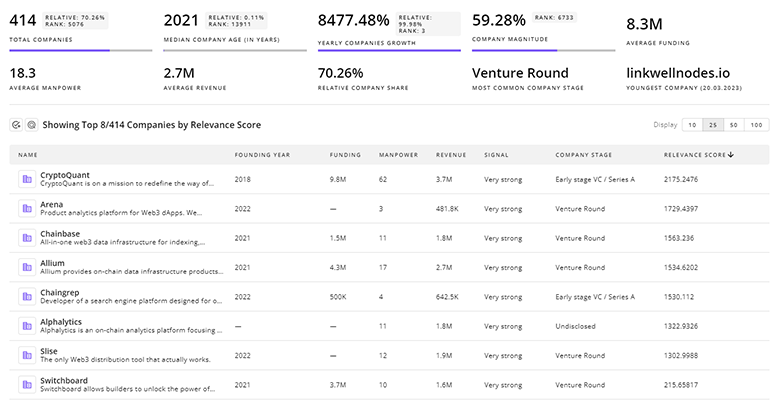
2.3K Digital Supply Chain Companies
Discover Digital Supply Chain Companies, their Funding, Manpower, Revenues, Stages, and much more
Digital Supply Chain Investors
Gain insights into 2.1K Digital Supply Chain investors and investment deals. TrendFeedr’s investors tool presents an overview of investment trends and activities, helping create better investment strategies and partnerships.
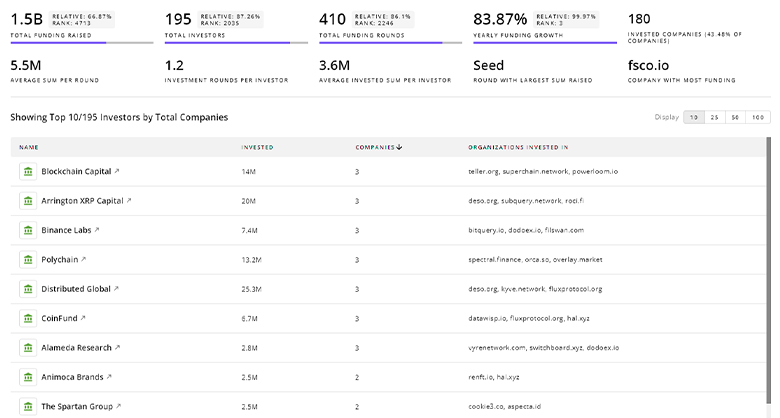
2.1K Digital Supply Chain Investors
Discover Digital Supply Chain Investors, Funding Rounds, Invested Amounts, and Funding Growth
Digital Supply Chain News
Gain a competitive advantage with access to 5.9K Digital Supply Chain articles with TrendFeedr's News feature. The tool offers an extensive database of articles covering recent trends and past events in Digital Supply Chain. This enables innovators and market leaders to make well-informed fact-based decisions.
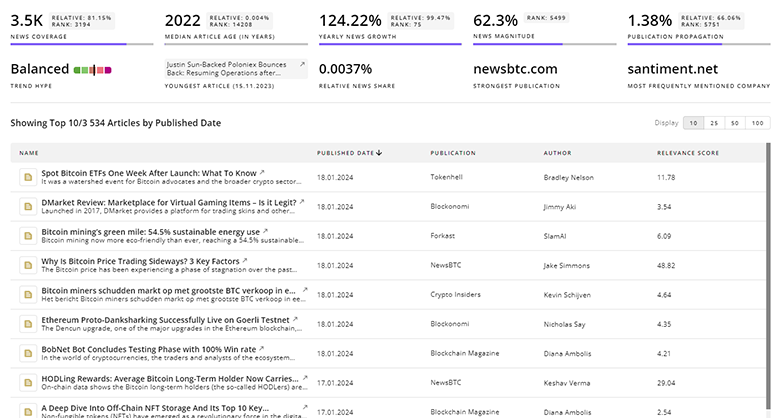
5.9K Digital Supply Chain News Articles
Discover Latest Digital Supply Chain Articles, News Magnitude, Publication Propagation, Yearly Growth, and Strongest Publications
Executive Summary
The digital supply chain market is large, growing, and settling into platform economics where data interoperability, AI-driven prescriptive actions, and multi-party trust layers determine commercial winners. Near-term opportunity clusters lie in demand sensing and inventory orchestration, multi-tier traceability for compliance and ESG reporting, and working-capital services that stabilize supplier networks. Practically, purchasers should prioritize vendors that (1) demonstrate multi-system integration with standards compliance, (2) deliver measurable financial outcomes (cash or cost), and (3) include secure data-sharing architectures that support federated access. For investors and solution architects, the next 24 months will favor companies that convert operational telemetry into real-time, executable decisions while minimizing integration overhead and safeguarding supplier data.
We seek partnerships with industry experts to deliver actionable insights into trends and tech. Interested? Let us know!