Digital Economy Report
: Analysis on the Market, Trends, and TechnologiesThe digital economy is consolidating around layered infrastructure where identity, interoperable protocols and embedded finance capture disproportionate value; the internal market assessment places U.S. annual digital output at $2.97 trillion with an estimated 7.1% CAGR, underscoring sustained demand for platform and infrastructure services. This structural shift intersects measurable environmental pressure, with ICT hardware and device lifecycles consuming hundreds of kilograms of raw materials per device and contributing up to 3.2% of global emissions, creating a simultaneous regulatory and product-design opportunity Digital Economy Trends 2024 – DCO
We updated this report 255 days ago. Noticed something’s off? Let’s make it right together — reach out!
Topic Dominance Index of Digital Economy
The Topic Dominance Index trendline combines the share of voice distributions of Digital Economy from 3 data sources: published articles, founded companies, and global search
Key Activities and Applications
- AI-driven decision platforms embedded in industry processes to automate high-value decisions and reduce cycle times; enterprises accelerate deployment inside controlled testing environments to meet emerging governance expectations
- Verifiable digital identity and KYC orchestration that turns identity into a reusable trust primitive for onboarding, payments and compliance workflows
- Composable multicloud and subscription infrastructure that supports modular product stacks and accelerates go-to-market for digital services; adoption is driven by enterprises moving from capital ownership to subscription models
- Tokenization and digital money rails (CBDC, stablecoins, digital wallets) for real-time settlement, cross-border remittances and embedded finance in platforms serving MSMEs and gig workers
- Supply-chain traceability and Digital Product Passports to meet regulatory requirements and enable product-level lifecycle accounting, linking sustainability data to commercial flows
- Edge AI and real-time retail automation (computer vision checkout, local inference) to cut labor costs and support immersive commerce use cases
Emergent Trends and Core Insights
- Governance-first AI deployment: organizations prefer regulated sandboxes and staged rollouts to reduce regulatory risk while scaling models, creating demand for audit, explainability and monitoring toolchains
- Trust as infrastructure: reusable identity and compliance layers are becoming non-optional for regulated sectors; providers that deliver high-assurance identity at scale create durable switching costs Digidentity.
- Monetization shifts from traffic to production data: value increasingly accrues to firms that package operational and sensor data into monetizable services for B2B customers rather than only consumer ad monetization DATAECONOMY.
- CBDC and sovereign rails enter deployment phase: central banks move from pilots to institutional procurement, dragging a private-sector ecosystem of platform vendors and settlement engines eCurrency.
- Regulatory sustainability constraints drive product engineering: the embodied material and emissions profile of devices (e.g. ~800 kg of raw material per 2 kg computer) forces hardware redesign, reuse and DPP adoption UNCTAD – Digital Economy Report 2024.
- Market concentration at aggregation layer: capital flows (~$35.13B in sector financing across analyzed players) favor platform incumbents while leaves specialist middleware opportunities for insurgent vendors.
Technologies and Methodologies
- Blockchain and Layer-2 privacy/rollup stacks for auditable, multi-party workflows in trade finance and tokenized assets.
- Agentic Decision Intelligence that executes contextual, continuous decisions across supply chains and finance functions, moving AI from insight to action DI Enterprise.
- MACH architecture (Modular API-first Cloud-native Headless) for commerce platforms that support omnichannel and composable product delivery for SMBs Buyience.
- Edge AI inference and lightweight accelerators to reduce latency and bandwidth in AR/VR, industrial IoT and cashierless retail Equinix – Digital Economy Predictions 2024 (GXI Report).
- Digital Product Passport (DPP) frameworks and automated LCA tooling embedded into product master data for compliance and eco-labeling
- Interoperable open networks and protocol governance (open commerce stacks, networked identity) to reduce vendor lock-in and enable multi-seller marketplaces
Digital Economy Funding
A total of 763 Digital Economy companies have received funding.
Overall, Digital Economy companies have raised $120.8B.
Companies within the Digital Economy domain have secured capital from 2.6K funding rounds.
The chart shows the funding trendline of Digital Economy companies over the last 5 years
Digital Economy Companies
- KYCDIGI — KYCDIGI provides a digital onboarding suite (DIGI-KYC, DIGI-TRANS, DIGI-SAL) targeted at banks and retail financial flows; the platform bundles AML screening, appointment-driven in-person replication and payroll card solutions to reduce compliance friction for institutions expanding remote services, making it attractive to regulators and banks in high-growth fintech markets
- DTEK.ai — DTEK.ai applies computer vision and AI to brick-and-mortar checkout and store operations; its SWIFT AI checkout stack reduces queue times and stores' labor requirements while enabling real-time analytics for pricing, shrinkage and assortment optimization, positioning it where offline retail meets digital automation
- CIRCULENS — CIRCULENS supplies AI-driven Digital Product Passport tooling that automates lifecycle and material traceability and embeds CO₂ intelligence at product level; it targets manufacturers and supply-chain leaders aiming for regulatory readiness and procurement differentiation through verified sustainability data
- Kiko Live — Kiko Live enables neighborhood retailers to digitize storefronts and operate quick commerce with low capital intensity; the company integrates cataloguing, payments and hyperlocal delivery and reports order cancellation rates under 1%, demonstrating operational resilience in high-churn quick commerce markets and active collaboration with open commerce networks.
- CHIP - Digital Finance Platform — CHIP focuses on MSME financial tooling (payments, expense, treasury and risk management) that embeds access to credit and liquidity at the point of sale; its lightweight stack reduces the integration barrier for small merchants and directly addresses the embedded finance opportunity in underserved markets
Gain a better understanding of 5.9K companies that drive Digital Economy, how mature and well-funded these companies are.
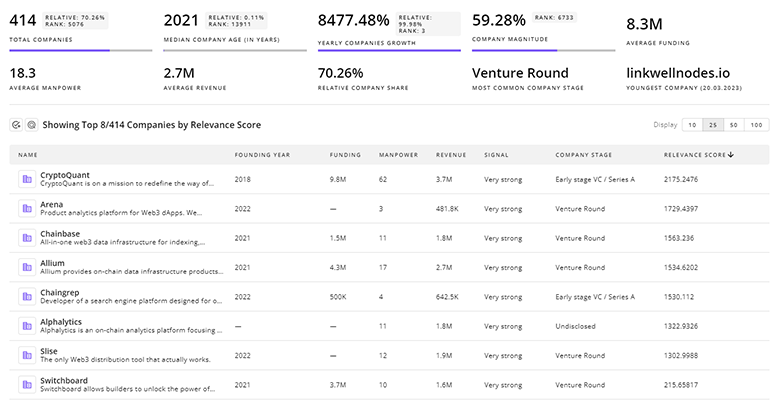
5.9K Digital Economy Companies
Discover Digital Economy Companies, their Funding, Manpower, Revenues, Stages, and much more
Digital Economy Investors
Gain insights into 3.6K Digital Economy investors and investment deals. TrendFeedr’s investors tool presents an overview of investment trends and activities, helping create better investment strategies and partnerships.
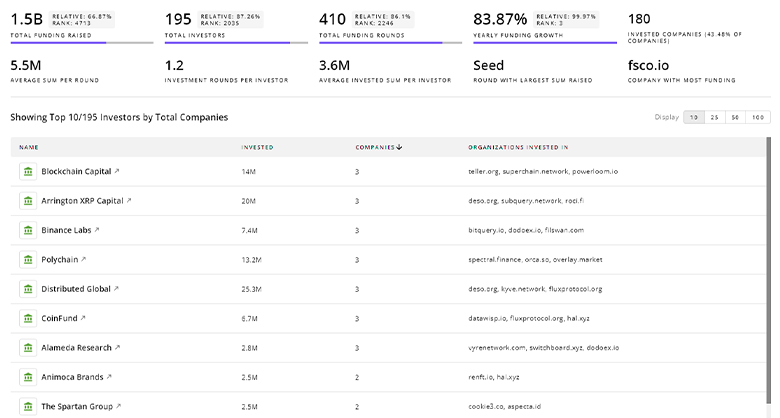
3.6K Digital Economy Investors
Discover Digital Economy Investors, Funding Rounds, Invested Amounts, and Funding Growth
Digital Economy News
Gain a competitive advantage with access to 28.6K Digital Economy articles with TrendFeedr's News feature. The tool offers an extensive database of articles covering recent trends and past events in Digital Economy. This enables innovators and market leaders to make well-informed fact-based decisions.
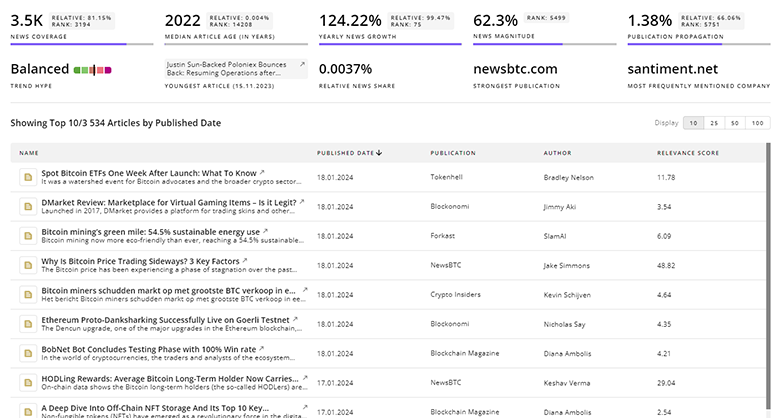
28.6K Digital Economy News Articles
Discover Latest Digital Economy Articles, News Magnitude, Publication Propagation, Yearly Growth, and Strongest Publications
Executive Summary
The digital economy is now a contest over the plumbing that connects services, data and money. Measured market signals—from $2.97 trillion of U.S. digital output and a 7.1% CAGR to declarations of 90% of Fortune 500 firms becoming digital providers—show that scale matters at the aggregation layer while specialized middleware still offers fertile commercial ground. Firms that convert trust, compliance and sustainability obligations into platform-agnostic, reusable services will capture durable value without confronting the dominant aggregators directly. Strategic priorities for the business community therefore include embedding verifiable identity, preparing for sovereign digital money rails, operationalizing product-level sustainability data and investing in low-latency, low-energy compute to protect margin as the digital economy's infrastructure accelerates.
We seek partnerships with industry experts to deliver actionable insights into trends and tech. Interested? Let us know!