
Early Warning Systems Report
: Analysis on the Market, Trends, and TechnologiesThe market for early warning systems is expanding materially and unevenly: the internal trend data shows a global market size of USD 1.72 billion in 2025 with a forecast to USD 2.15 billion by 2029 (CAGR 5.7%)—a pragmatic baseline for civil and defence procurements that prefer incremental, standards-driven upgrades rather than disruptive rip-and-replace projects. Regional forecasts and specialized segments amplify this baseline: multi-hazard platforms (flood, wildfire, seismic, health) are projected to reach USD 5.34 billion by 2033, driven by Asia-Pacific adoption and government initiatives Early Warning Systems Market Research Report 2033 – Dataintelo. The earthquake-specific niche already exceeded USD 1.55 billion in 2023 and is projected to reach roughly USD 2.5 billion by 2032, underlining persistent public-sector investment and private-sector adoption for critical infrastructure protection Earthquake Early Warning Systems Market Size – GM Insights. So what: buyers and investors should prioritise modular, interoperable platforms that fuse multi-source sensor data and embed automated response playbooks—those capabilities convert modest lead-times into measurable reductions in loss and operational disruption.
This article was last updated 387 days ago. If you find any info is missing, let us know!
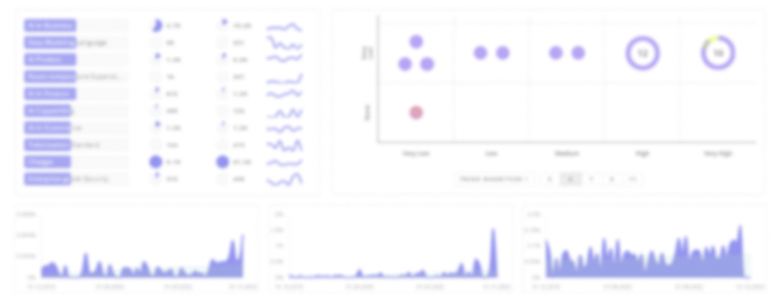
Topic Dominance Index of Early Warning Systems
The Dominance Index of Early Warning Systems looks at the evolution of the sector through a combination of multiple data sources. We analyze the distribution of news articles that mention Early Warning Systems, the timeline of newly founded companies working in this sector, and the share of voice within the global search data
Key Activities and Applications
- Integrated multi-hazard monitoring (seismic, hydrological, meteorological, fire, industrial sensors) — systems increasingly combine ground sensors, weather radar/remote sensing and distributed IoT arrays to detect and score risk in real time.
- Public mass notification and emergency communication (geo-targeted alerts, two-way acknowledgement, persistent channels) — municipal and campus deployments emphasize multi-channel delivery (cellular, broadcast, sirens, digital signage) for reach and redundancy.
- Earthquake early warning and automated hardening (EEW triggers for industrial shutdowns, train braking, utility isolation) — private operators and factories adopt on-site EEW stacks to protect equipment and business continuity.
- Wildfire and environmental ignition detection (camera + satellite + ground sensor fusion) — solutions range from edge cameras to satellite-first detection services; utilities and land managers adopt them to reduce response time and insurance losses.
- Infrastructure and asset protection (coastal/maritime surveillance, pipeline leak detection, battery thermal runaway monitoring) — radar and fiber-optic sensing protect ports and pipelines; specialized sensors guard critical assets like battery racks and data centers, Wint Water Intelligence, Li-ion Tamer.
Emergent Trends and Core Insights
- AI-first prediction stacks plus domain models: AI models now augment physics and statistical models (e.g. seismic, hydrological) to reduce false positives and extend lead times; the value is operational — fewer false alarms and prioritized responses.
- Data fusion becomes the competitive moat: providers that fuse satellites, in-situ sensors, radar, camera feeds and social signals create higher-confidence alerts; companies offering unified ingestion and lineage show stronger public/private uptake.
- Edge processing for latency-critical use cases: earthquake and industrial shutdown scenarios push compute to the edge to guarantee sub-second responses where cloud round-trip latency is unacceptable.
- Regionally driven demand divergence: Europe and North America favour regulated, standards-compliant mass-notification and radar upgrades (e.g. EECC/geo-targeting mandates), while Asia-Pacific shows fastest growth for multi-hazard platforms because of rising exposure and urbanisation.
- Public-private funding mixes scale deployments: governments underwrite sensor grids and standards while private vendors supply SaaS analytics and automated response modules—this model accelerates rollout in emerging markets.
Technologies and Methodologies
- AI and ML for pattern recognition, probabilistic forecasting and false-alarm suppression — applied across seismic, hydrology and video analytics domains.
- Edge computing + low-latency comms (including 5G backhaul) to support time-sensitive warnings (EEW, industrial automation triggers) and localized autonomous action Early Warning Radar Market Report.
- Hybrid sensor fusion (seismometers + GPS + accelerometers; camera + thermal + satellite SAR) to extend detection modalities and reduce single-sensor failure risk.
- Satellite and aerial remote sensing (constellations and UAVs) for wide-area, hard-to-reach monitoring (wildfire ignition, coastal surveillance) — these extend coverage beyond ground networks 4pi Lab.
- Secure, auditable dissemination layers (tamper-proof logs / verified receipts) to maintain trust across agencies and international responders; blockchain experimentation appears in niche pilots for provenance.
- Advanced radar and GaN-based RF systems for extended detection ranges and resilience in defence/airborne applications — naval and long-range radar upgrades accelerate procurement cycles.
Key practical implication: purchasers must evaluate vendors on three axes — detection accuracy (hit/false ratio), integration breadth (data sources & actions), and deterministic latency (edge vs cloud). Vendors excelling on all three secure the highest value multiple in public tenders and enterprise contracts.
Early Warning Systems Funding
A total of 240 Early Warning Systems companies have received funding.
Overall, Early Warning Systems companies have raised $5.1B.
Companies within the Early Warning Systems domain have secured capital from 1.0K funding rounds.
The chart shows the funding trendline of Early Warning Systems companies over the last 5 years
Early Warning Systems Companies
- Torch Systems — Builds solar-powered, AI-enabled sensor units for ultra-early wildfire detection and localised ignition monitoring. Torch focuses on low-power, widely distributed nodes that provide minute-scale alerts to utilities and municipalities; early field deployments showed meaningful reductions in response lag for urban-wildland interfaces.
- N5 Sensors, Inc. — University-spin-out specialising in wireless sensor networks for wildfire, smoke and air-quality detection with embedded AI to prioritize alerts for first responders. N5’s product targets local government and utility customers seeking 24/7 autonomous detection backed by real-time alerting.
- Robotics Cats — Machine-vision SaaS that converts surveillance cameras into early wildfire sensors and biodiversity monitors; offers a turnkey cloud service and partnerships with forestry managers to enable rapid camera-based detection and geolocation.
- Mayday.ai GmbH — AI data-fusion platform combining satellite imagery, social media, and sensor feeds to deliver contextualised disaster alerts and two-way communication for governments and commercial subscribers; strong in near-real-time situational intelligence and cross-agency dashboards.
- SeismicAI — Small specialist delivering on-site earthquake early warning stacks that integrate seismology with AI to trigger automated protective actions (industrial shutdowns, utility segmentation). SeismicAI targets critical infrastructure and industrial continuity buyers who need deterministic seconds-to-minutes of lead time.
Uncover actionable market insights on 1.3K companies driving Early Warning Systems with TrendFeedr's Companies tool.
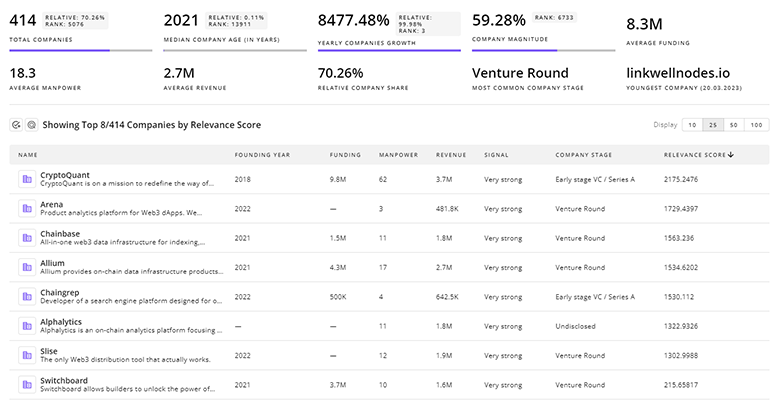
1.3K Early Warning Systems Companies
Discover Early Warning Systems Companies, their Funding, Manpower, Revenues, Stages, and much more
Early Warning Systems Investors
Get ahead with your investment strategy with insights into 1.1K Early Warning Systems investors. TrendFeedr’s investors tool is your go-to source for comprehensive analysis of investment activities and financial trends. The tool is tailored for navigating the investment world, offering insights for successful market positioning and partnerships within Early Warning Systems.
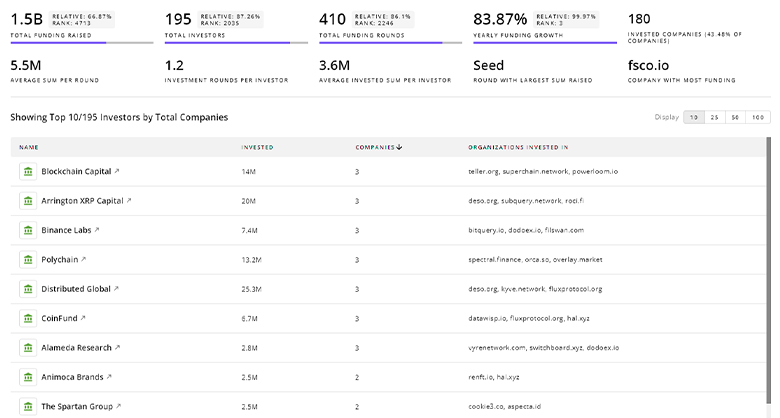
1.1K Early Warning Systems Investors
Discover Early Warning Systems Investors, Funding Rounds, Invested Amounts, and Funding Growth
Early Warning Systems News
TrendFeedr’s News feature offers access to 1.5K news articles on Early Warning Systems. The tool provides up-to-date news on trends, technologies, and companies, enabling effective trend and sentiment tracking.
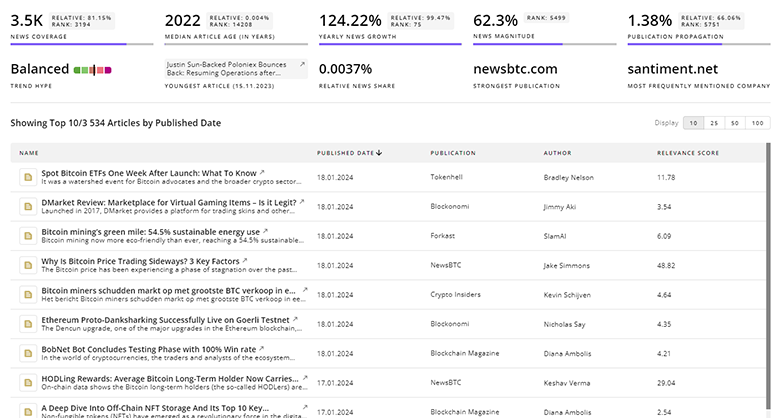
1.5K Early Warning Systems News Articles
Discover Latest Early Warning Systems Articles, News Magnitude, Publication Propagation, Yearly Growth, and Strongest Publications
Executive Summary
Early warning systems now compete as integrated risk-management platforms rather than isolated sensors. Buyers focus on three commercial outcomes: measurable reduction in human or asset loss, demonstrable decreases in downtime or claims, and low operational friction (interoperability and maintainability). Technology winners will combine mature sensor portfolios, edge-first architectures for latency-sensitive use cases, and AI models validated against domain datasets. Strategically, vendors and investors should prioritize modular platform designs that enable phased deployments (sensor → fusion → automated action) and align procurement offers with public funding cycles and regulatory mandates to accelerate adoption.
Have expertise in trends or technology? Your input can enrich our content — consider collaborating with us!