
Electronics Manufacturing Report
: Analysis on the Market, Trends, and TechnologiesThe global electronics manufacturing market registered approximately $648.04 billion in 2025 and is expected to keep expanding as manufacturers adopt AI-driven production, flexible/printed electronics, and advanced packaging to meet demand for miniaturization and higher functional density. This growth plays out against constrained component availability, rising component prices, and policy-driven onshoring that change where and how capacity scales.
This article was last updated 128 days ago. If you find any info is missing, let us know!
Topic Dominance Index of Electronics Manufacturing
The Dominance Index of Electronics Manufacturing looks at the evolution of the sector through a combination of multiple data sources. We analyze the distribution of news articles that mention Electronics Manufacturing, the timeline of newly founded companies working in this sector, and the share of voice within the global search data
Key Activities and Applications
- Rapid prototyping and new product introduction (NPI) services: short-run PCB prototyping, quick-turn PCBA, and virtual prototyping reduce time-to-market and support OEM product cycles.
So what: faster NPI converts product-development investment into earlier revenue while lowering inventory risk for OEMs. - Box-build and turnkey assembly for regulated industries: integrated box-build, system integration, and regulatory testing for medical, aerospace, and defense customers.
So what: turnkey providers capture higher margin services and lock-in long-term OEM relationships where compliance is a barrier. - High-reliability PCBA and electromechanical assembly: ruggedized boards, conformal coating, and full electromechanical integration for industrial and automotive applications.
So what: specialization here reduces failure rates and supports premium pricing in safety-critical segments. - Power-electronics module production: SiC/GaN device assembly, power-module packaging, and thermal-management subsystems for EVs and renewables.
So what: demand from electrification drives higher ASPs and pushes EMS firms toward new process capabilities. - Additive and printed electronics: 3D printed circuitry, in-mold electronics, and flexible hybrid electronics for wearables, sensors, and complex form factors.
So what: additive approaches enable novel product form factors and decentralize low-volume production. - Automated inspection, AOI/X-ray testing and digital-twin-driven production: inline quality monitoring and simulation-driven setup reduce yield loss and debugging cycles.
So what: these systems cut scrap and accelerate NPI throughput, improving margins on complex assemblies. - Supply-chain and logistics orchestration for electronics: RFID/sensor-enabled packaging, just-in-time inventory, and after-sales reverse-logistics to manage component lead-time risk.
So what: tight orchestration converts volatile supply into predictable production capacity for EMS providers.
Emergent Trends and Core Insights
- Market scale and growth trajectory: the EMS sector sits in the high hundreds of billions today and multiple forecasts point to 5–6% CAGR through the late 2020s, driven by consumer electronics, EVs, and industrial automation; Electronics Manufacturing Services - Market Share Analysis, Industry Trends & Statistics, Growth Forecasts (2025 - 2030).
So what: steady demand justifies multi-year investments in automation and capacity expansion. - AI and data-first factories: widespread rollout of predictive defect detection, predictive maintenance, and MES integration improves yields and reduces downtime; Semiconductor Manufacturing Equipment Market Forecast 2025.
So what: firms that can operationalize AI across the digital thread will compress per-unit cost and raise barrier to entry. - Advanced packaging and 3D integration: fan-out WLP, system-in-package and heterogeneous 3D stacking accelerate functional density requirements from AI and 5G use cases.
So what: EMS providers offering packaging expertise move up the value chain beyond basic assembly. - Wide-bandgap and power-semiconductor industrialization: SiC and GaN device production rise with EV and renewables demand, creating upstream CAPEX needs for MOCVD and specialized back-end.
So what: opportunity for EMS/OSAT partnerships to internalize higher-value power-module assembly. - Additive electronics and decentralized manufacturing: 3D printed electronics and in-mold electronics expand low-volume, high-complexity production and customization.
So what: nearshoring and micro-factories become commercially viable for premium or time-sensitive SKUs. - Supply-chain resiliency and policy shifts: component price inflation and political risk drive onshoring/nearshoring policies and incentive programs (e.g. CHIPS and regional PLI schemes); Electronic Manufacturing Services Market Opportunity, Growth Drivers, Industry Trend Analysis, and Forecast 2025-2034.
So what: capacity location decisions now balance cost with geopolitical risk and procurement agility. - Sustainability and circular design: biodegradable packaging, water-use reduction in fabs, and material re-use enter procurement criteria for OEMs news landscape.
So what: sustainability credentials increasingly influence partner selection in regulated verticals.
Technologies and Methodologies
- Surface Mount Technology (SMT) and selective soldering as the core high-throughput processes for assembly, combined with AOI and X-ray for inline inspection.
Business impact: baseline for volume production and quality control. - Advanced packaging: fan-out wafer-level packaging, system-in-package and heterogeneous integration for high I/O and thermal density Emerging Semiconductor Technologies in the Manufacturing Industry.
Business impact: supports AI, 5G and high-performance compute segments. - Additive manufactured electronics and In-Mold Electronics (IME): aerosol-jet, LIFT and multi-material printing for conformal and integrated assemblies 3D Electronics MarketTop 10 Electronics Industry Trends for 2025 – StartUs Insights.
Business impact: enables new product geometries and on-demand production. - Digital twin + MES + Cloud: closed-loop simulation for line setup, virtual commissioning and traceability.
Business impact: reduces ramp time and defect rates on complex assemblies. - AI/ML for defect detection and supply forecasting: computer vision for solder/join defects and time-series models for part shortages.
Business impact: cost reduction through yield improvement and fewer expedite premiums. - Wide-bandgap semiconductor processing (MOCVD, wafer fab adaptations) for SiC/GaN device flows; thermal-management and yield-optimization tooling for power devices.
Business impact: higher ASPs per unit and demand from EVs/renewables. - Blockchain-backed traceability and smart packaging: provenance for 高-value components and returns management.
Business impact: reduces counterfeit risk and supports warranty/recall workflows. - Lean, Six Sigma and regulated-QMS (ISO 9001, ISO 13485, AS9100): process controls remain essential for high-reliability verticals.
Business impact: required for entry into medical, aerospace and defense supply chains.
Electronics Manufacturing Funding
A total of 942 Electronics Manufacturing companies have received funding.
Overall, Electronics Manufacturing companies have raised $46.2B.
Companies within the Electronics Manufacturing domain have secured capital from 2.7K funding rounds.
The chart shows the funding trendline of Electronics Manufacturing companies over the last 5 years
Electronics Manufacturing Companies
- Circuitronics — Circuitronics is a Texas-based EMS provider focused on complex and ruggedized PCB assembly, rapid prototyping, electromechanical integration, and direct-fulfillment services; it runs mixed-technology SMT, wave and selective soldering, rigid-flex and HDI production and emphasizes quality systems including ISO 9001 and IPC certifications. Circuitronics' capabilities suit industrial and medical OEMs that need fast NPI and regulatory traceability.
- Melecs EWS GmbH — Melecs operates a multi-site E2MS network (Austria, Hungary, China, Mexico) and serves automotive, lighting, and white-goods OEMs with development-through-logistics services; the company's in-house test labs and high automation support medium-to-high volume, high-reliability production. Its vertically integrated offer targets OEMs seeking single-source supply and regional footprint.
- Amitech Electronics Design — Amitech provides end-to-end electronics design and PCB fabrication services, combining hardware, PCB layout and firmware for rapid productization. That design-to-build posture helps smaller OEMs outsource complex DFM and DFT tasks while shortening iteration cycles.
- American Cable and Electronics, Inc. (ACE Cables) — ACE specializes in custom cable assemblies, wire harnesses and overmolded cable runs for medical and industrial OEMs, with ISO 9001 and IPC-WHMA-620 controls and strengths in low-volume complex assemblies. The company fills a critical niche bridging PCBAs to system-level electromechanical assemblies.
- SMT Intelligence — A Canadian EMS firm with multiple automated lines, Smart EMS software integration and ISO 13485/ISO 14001 credentialing; SMT Intelligence emphasizes Industry 4.0 integration, AI-enabled inspection, and turnkey production for medical and regulated sectors. Its integrated software approach supports traceability and high-throughput, compliance-driven manufacturing.
(Each company description above is grounded in the respective company document cited.)
Uncover actionable market insights on 10.7K companies driving Electronics Manufacturing with TrendFeedr's Companies tool.
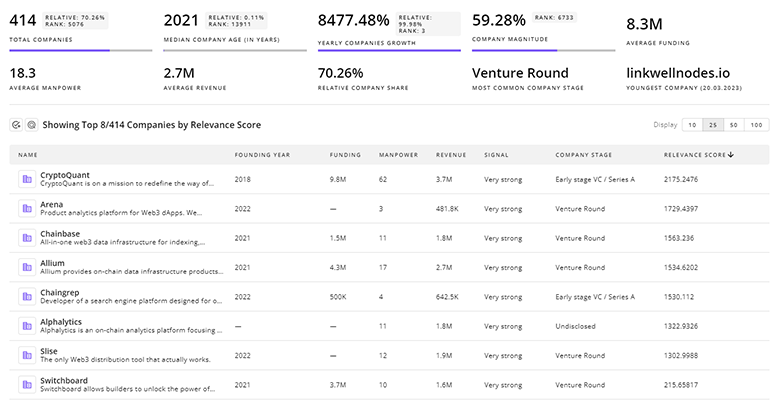
10.7K Electronics Manufacturing Companies
Discover Electronics Manufacturing Companies, their Funding, Manpower, Revenues, Stages, and much more
Electronics Manufacturing Investors
Get ahead with your investment strategy with insights into 2.6K Electronics Manufacturing investors. TrendFeedr’s investors tool is your go-to source for comprehensive analysis of investment activities and financial trends. The tool is tailored for navigating the investment world, offering insights for successful market positioning and partnerships within Electronics Manufacturing.
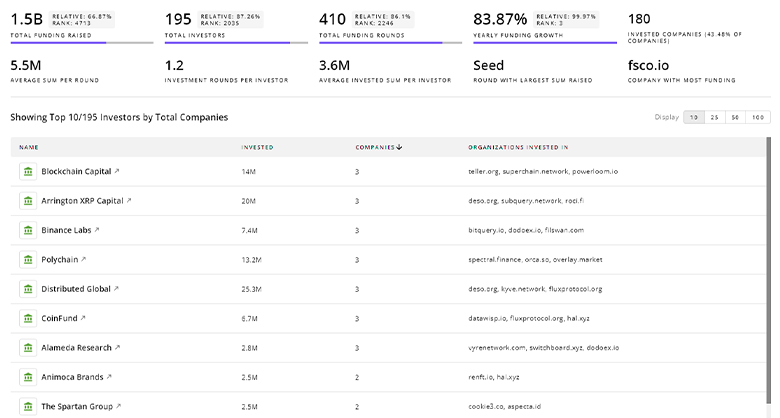
2.6K Electronics Manufacturing Investors
Discover Electronics Manufacturing Investors, Funding Rounds, Invested Amounts, and Funding Growth
Electronics Manufacturing News
TrendFeedr’s News feature offers access to 29.4K news articles on Electronics Manufacturing. The tool provides up-to-date news on trends, technologies, and companies, enabling effective trend and sentiment tracking.
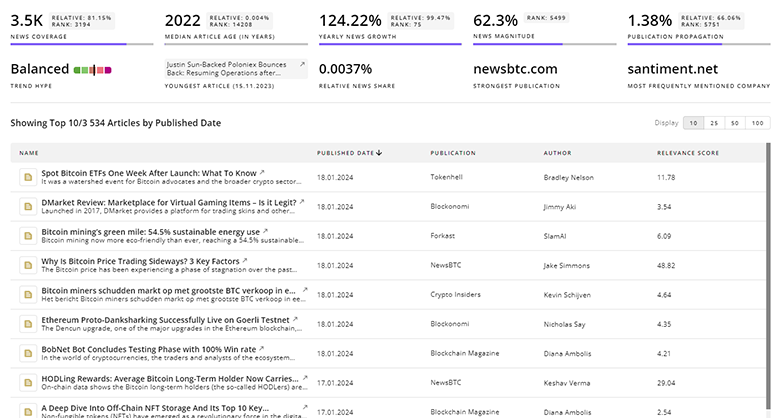
29.4K Electronics Manufacturing News Articles
Discover Latest Electronics Manufacturing Articles, News Magnitude, Publication Propagation, Yearly Growth, and Strongest Publications
Executive Summary
The electronics-manufacturing sector presents a clear commercial path: scale the digital thread, embed AI into inspection and supply orchestration, and add advanced packaging and power-electronics capabilities to capture higher margin work. Market projections cluster around mid-to-high hundreds of billions for the mid-2020s with sustained CAGR into the early 2030s; this justifies near-term capital deployment into automation, metrology, and selective onshoring where geopolitical or lead-time risk threatens customer relations. Providers that couple turnkey system integration with demonstrable regulatory compliance and traceable supply-chain practices will attract OEMs seeking to reduce program risk and accelerate time-to-market.
Have expertise in trends or technology? Your input can enrich our content — consider collaborating with us!