
Embodied AI Report
: Analysis on the Market, Trends, and TechnologiesThe embodied AI market is shifting from lab research to commercial deployments, with the internal trend data reporting a 2024 market size of USD 2.5 billion and a projected 2034 market value of USD 10.75 billion (CAGR 15.7%)—a scale that forces business models to move from point products to integrated platforms and the U.S. market alone is expected to reach about USD 1.1 billion by 2025 with sustained double-digit growth through 2034.
This article was last updated 146 days ago. If you find any info is missing, let us know!
Topic Dominance Index of Embodied AI
The Dominance Index of Embodied AI looks at the evolution of the sector through a combination of multiple data sources. We analyze the distribution of news articles that mention Embodied AI, the timeline of newly founded companies working in this sector, and the share of voice within the global search data
Key Activities and Applications
- Robotics for industrial and service work: development and deployment of humanoid, wheeled-legged, and mobile robots to perform assembly, inspection, warehousing, and last-mile delivery; these systems address labor shortages and reduce repetitive human exposure to hazardous tasks and the U.S. market report highlights robots as the leading product segment in 2025 (36.0% share) https://dimensionmarketresearch.com/report/us-embodied-ai-market/.
> So what: Companies that convert prototype mobility and manipulation into low-cost, repeatable deployments capture the fastest route to revenue in manufacturing and logistics. - Digital humans and AI avatars for customer experience and training: photorealistic, multilingual avatars that run 24/7 for customer support, education, and marketing reduce content cost and increase engagement; platforms now support real-time voice and facial animation at scale aistudios.com and anam.ai.
> So what: Enterprises can substitute expensive video production and live agents with avatar-driven, measurable interactions, shifting spend from media production to platform subscriptions. - AI companionship and persona services: consumer-facing companions and personalized virtual people provide continuous conversational engagement, emotional support, or entertainment crushon.ai.
> So what: These offerings expose sensitive regulatory and ethical risk vectors that service providers must manage via privacy, content controls, and consent mechanisms if they want sustainable monetization. - Simulation-first training and sim-to-real transfer: large-scale virtual training environments enable agents to learn perception, navigation, and manipulation before real-world deployment; this reduces prototyping costs and speeds iteration aihabitat.org and aligns with published advances in simulation methods and audio-visual training.
> So what: Simulation-first development compresses time-to-field and creates a competitive advantage for teams that can bridge sim-to-real reliably. - Data supply and human-in-the-loop data generation: large, labeled human motion, voice, and interaction datasets feed embodied models; dedicated data platforms and incentive models are emerging to supply motion and behavioral data for robot and avatar training.
> So what: Data quality and diversity become gatekeepers of product differentiation; firms that control richer, safety-focused datasets can improve performance while meeting compliance needs.
Emergent Trends and Core Insights
- Agentic and multi-agent platforms are standardizing task automation: multiple vendors provide agent orchestration and marketplaces for domain-specific AI teams, enabling modular automation across enterprise workflows nagent.ai.
> So what: Businesses should plan integration strategies that let best-of-breed agents plug into existing systems instead of betting on monolithic solutions. - Physical AI and multimodal foundation models: new “physical” foundation models fuse time-series sensor data, vision, audio, and language to reason about the physical world—this is moving embodied systems from scripted behaviours toward context-aware autonomy and multimodal research highlights the value of combining senses with language for generalization https://www.technologyreview.com/2021/02/24/1018085/multimodal-ai-vision-language.
> So what: Firms that align model architectures to multimodal inputs will reduce failure modes in edge deployments such as vehicles, factories, and care environments. - Simulation-first and evolved body-design thinking: research shows evolving body plans in simulation accelerates learning and task transfer, implying hardware design and software co-optimization will outperform isolated improvement on either axis https://www.technologyreview.com/2021/10/19/1037555/weird-virtual-creatures-evolve-bodies-ai-general-intelligence.
> So what: Investors and product teams should evaluate combined hardware/software roadmaps rather than funding only software stacks for physical tasks. - Safety, explainability, and governance rise as commercial requirements: regulatory frameworks and enterprise procurement demand explainable decisioning and certified safety for embodied systems; governance platforms are emerging to meet audit and compliance needs ethe.ai.
> So what: Demonstrable explainability and compliance reduce deployment friction and unlock procurement in regulated verticals like healthcare and defense. - Market concentration toward platformization: funding and market signals indicate movement toward integrated platforms (cloud-brains, simulation, agent orchestration) rather than many isolated point solutions; the Landscape identifies USD 6.27 billion total funding across the topic and signals a platformization endgame for winners and key component suppliers (integrators, data marketplaces, simulation providers).
> So what: Strategy choices are binary: become a platform integrator with sticky services or become an indispensable component in the platform stack.
Technologies and Methodologies
- Large Language Models and Retrieval-Augmented Generation: power high-level planning, natural-language tasking, and interactive avatars across physical and virtual embodiments.
> Business implication: LLMs provide flexible interfaces that let non-experts command robots and avatars, lowering adoption barriers. - Reinforcement Learning, Imitation Learning and Continual Learning: used for motor control, manipulation, and long-term adaptation in physical agents; continual learning supports shared experience across fleets cogitai.com.
> Business implication: Systems that can learn on-device or in fleets reduce expensive per-task engineering and improve ROI across long-run deployments. - Multimodal perception and sensor fusion: combining vision, audio, radar, tactile and inertial sensors to produce richer world models for decision-making and multimodal market analysis.
> Business implication: Sensor-stack choices materially affect cost, reliability, and the kinds of environments a product can serve. - World models, simulated physics and sim-to-real transfer: generative world models train agents in photorealistic environments and accelerate iteration while reducing field risk and simulation research https://www.technologyreview.com/2020/08/21/1007523/facebook-ai-robot-assistants-hear-and-see.
> Business implication: Companies that own or partner with high-fidelity simulators reduce deployment time and testing cost. - Edge and real-time AI (TinyML, NPUs, federated learning): on-device inference and federated approaches lower latency and preserve privacy for human-facing embodied systems https://www.rootsanalysis.com/edge-ai-market.
> Business implication: For latency-sensitive or regulated applications, on-device inference and federated updates are competitive requirements. - Formal assurance, control assurance, and explainable AI toolchains: software for safety certification, formal verification and traceable model behavior becomes part of product stacks for regulated verticals saifsystems.ai.
> Business implication: Early investment in assurance reduces regulatory and liability risk and shortens procurement cycles in healthcare and defense.
Embodied AI Funding
A total of 75 Embodied AI companies have received funding.
Overall, Embodied AI companies have raised $12.7B.
Companies within the Embodied AI domain have secured capital from 310 funding rounds.
The chart shows the funding trendline of Embodied AI companies over the last 5 years
Embodied AI Companies
- Telekinesis — Telekinesis builds a Physical AI platform that converts video demonstrations and natural-language prompts into robot motion plans, targeting automotive and aerospace manufacturing use cases; the product emphasizes rapid deployment for end-of-line tasks such as assembly validation and cable harnessing, aiming to let non-experts teach robots without code.
- Archetype AI — Archetype is developing Newton™, a foundation model that fuses multimodal temporal sensor data with language to reason about physical processes; the company positions this technology as a bridge between sensor-rich environments and higher-level decisioning for real-time operations.
- Mecka AI — Mecka focuses on generating large-scale human motion and interaction datasets that serve as training fuel for humanoid and avatar systems; it offers incentive models to recruit human contributors and provides labeled motion data tailored for robotics training.
- Bitpart.AI — Bitpart builds an NPC behaviour engine for games that simulates multi-agent memory, moods, and social interactions; its technology demonstrates how embodied agents can maintain persistent character state and social reasoning applicable to digital humans and simulation-driven training.
Uncover actionable market insights on 175 companies driving Embodied AI with TrendFeedr's Companies tool.
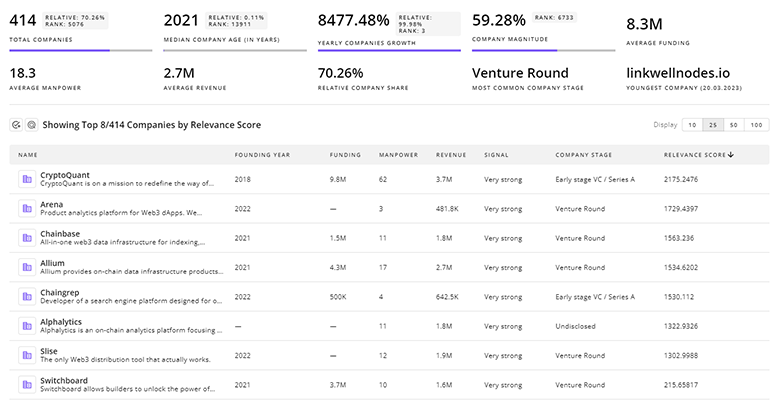
175 Embodied AI Companies
Discover Embodied AI Companies, their Funding, Manpower, Revenues, Stages, and much more
Embodied AI Investors
Get ahead with your investment strategy with insights into 688 Embodied AI investors. TrendFeedr’s investors tool is your go-to source for comprehensive analysis of investment activities and financial trends. The tool is tailored for navigating the investment world, offering insights for successful market positioning and partnerships within Embodied AI.
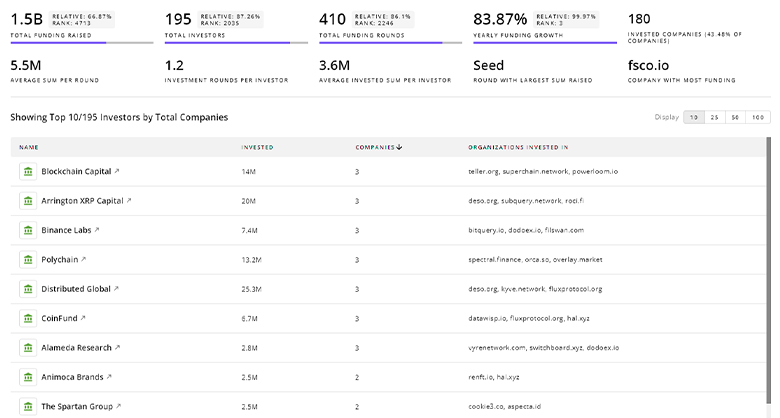
688 Embodied AI Investors
Discover Embodied AI Investors, Funding Rounds, Invested Amounts, and Funding Growth
Embodied AI News
TrendFeedr’s News feature offers access to 680 news articles on Embodied AI. The tool provides up-to-date news on trends, technologies, and companies, enabling effective trend and sentiment tracking.
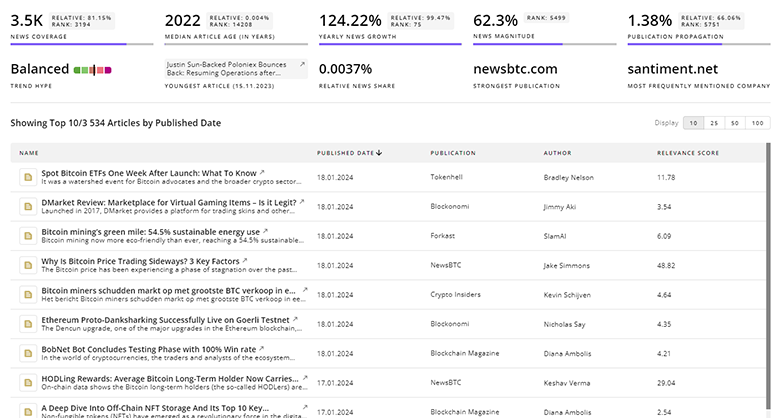
680 Embodied AI News Articles
Discover Latest Embodied AI Articles, News Magnitude, Publication Propagation, Yearly Growth, and Strongest Publications
Executive Summary
Embodied AI now costs enough and delivers enough value that business leaders must decide whether to integrate or partner. Near-term commercial winners will be teams that combine three capabilities: (1) multimodal models that reduce failure in physical environments, (2) simulation and data pipelines that compress development cycles, and (3) auditable governance to satisfy buyers in regulated sectors. Market signals show a clear move from isolated point products toward integrated platforms that bundle cloud brains, fleet learning, and assurance services. For adopters, the practical strategy is to map where embodied systems replace high-cost manual labor or require 24/7 digital presence, then select partners that provide sim-to-real proof, data access, and compliance features rather than purely experimental capabilities.
Have expertise in trends or technology? Your input can enrich our content — consider collaborating with us!