
Energy Industry Report
: Analysis on the Market, Trends, and TechnologiesThe energy system is shifting from commodity supply toward integrated clean-energy delivery, driven by rapid capital flows and policy incentives: U.S. electricity demand is projected to grow about 1.2% per year through 2050 while renewables are expected to supply roughly 55% of net generation by 2050, creating sustained demand for flexible capacity and grid services Annual Energy Outlook 2025 – U.S. Energy Information Administration. Global investment into low-carbon assets reached about US$1.9 trillion in 2024 and continues to expand into storage, hydrogen, and CCUS, even as legacy hydrocarbon operations pursue lower-emission extraction methods that require digital controls and thermal integration Energy Transition Investment Trends 2025 – BloombergNEF.
This article was last updated 129 days ago. If you find any info is missing, let us know!
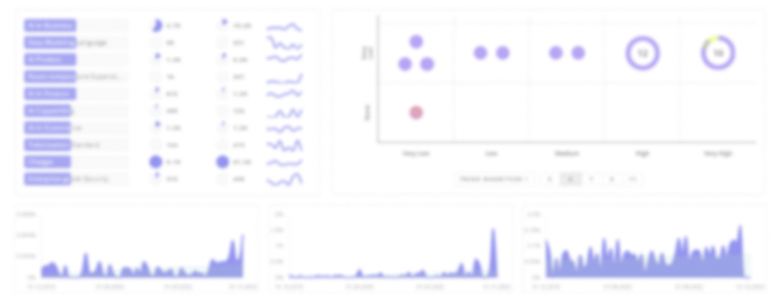
Topic Dominance Index of Energy Industry
The Dominance Index of Energy Industry looks at the evolution of the sector through a combination of multiple data sources. We analyze the distribution of news articles that mention Energy Industry, the timeline of newly founded companies working in this sector, and the share of voice within the global search data
Key Activities and Applications
- Industrial electrification and process heat replacement: deployment of large industrial heat pumps and mechanical vapor recompression to replace combustion-based heat and cut process energy by substantial percentages in heavy industry
- Grid-scale renewable buildout paired with multi-hour storage: rapid utility-scale solar and wind project delivery combined with battery energy storage to manage hourly and sub-hourly variability Ember – Global Electricity Trends.
- Decarbonized enhanced oil recovery and field repurposing: thermal and electro-thermal in-situ methods and modular steam systems co-injecting CO2 to raise recovery while lowering surface emissions, enabling legacy assets to remain productive under tighter emissions regimes
- Large-scale green fuels production: hub-scale projects coupling cheap diurnal solar and nocturnal wind resource profiles to electrolysis and synthesis plants for green hydrogen and derivatives
- Digital integration and investment tokenization: digital twins, common-data platforms and AI underwriting that coordinate project design, operations, and capital formation (including fractionalized energy assets) to reduce execution risk and broaden investor access FutureOn Energia.
Emergent Trends and Core Insights
- Renewables-led capacity growth is changing dispatch economics: solar PV and wind are the marginal supply drivers in many markets, forcing investment toward storage, curtailment management, and flexible demand Deloitte – 2026 Renewable Energy Industry Outlook
- Capital reallocation into flexibility and low-carbon fuels: investors routed ~US$1.9 trillion to low-carbon sectors in 2024, with storage and hydrogen receiving outsized year-on-year growth, shifting where new project returns concentrate
- Legacy hydrocarbon operations adapt rather than exit: technology portfolios emphasize emission-reduced recovery, modular CCUS, and field repurposing to preserve asset value under tighter regulation and permit timelines
- Grid reliability becomes a commercial product: because renewable penetration raises intermittency, investments in resilient distribution, microgrids and long-duration storage translate into measurable avoided-outage value and new utility business lines
- Skills and supply-chain friction set deployment cadence: workforce skill gaps and constrained mineral/manufacturing paths (for batteries and electrolysers) are measurable bottlenecks that lengthen project timelines despite abundant capital The top 6 trends shaping the energy sector in 2025 – RSM US.
Technologies and Methodologies
- Advanced industrial heat electrification: high-temperature heat pumps and integrated heat-recovery systems that materially cut process fuel use and enable electrified industrial sites
- Long-duration thermal and chemical storage: electro-thermal reservoirs and flow-battery architectures that shift renewable electrons into dispatchable heat or chemical carriers for hours to days.
- Digital twins and common data platforms: geospatially accurate digital models that compress engineering cycles, support large hub projects (hydrogen/ammonia) and reduce capex execution risk
- Low-emission hydrocarbon recovery methods: direct contact steam generation and co-injection techniques that raise recovery factors and sequester part of reservoir CO2 to lower field-level carbon intensity
- Asset fractionalization and AI underwriting: platforms that package energy projects into smaller investable units with AI risk models, broadening capital sources and smoothing financing cycles
Energy Industry Funding
A total of 18.4K Energy Industry companies have received funding.
Overall, Energy Industry companies have raised $2.5T.
Companies within the Energy Industry domain have secured capital from 56.7K funding rounds.
The chart shows the funding trendline of Energy Industry companies over the last 5 years
Energy Industry Companies
- Energy Integration Inc. LLC — Energy Integration Inc. LLC reduces industrial fossil-heat consumption with large-scale heat pump and energy-recovery systems capable of cutting process energy requirements substantially; the company targets high-temperature industrial sites where retrofitting is otherwise cost-prohibitive and emphasizes modular deployment for rapid on-site impact.
- GERI (General Energy Recovery Inc.) — GERI commercializes a Direct Contact Steam Generation (DCSG) method that co-injects steam with combustion exhaust gases to raise heavy-oil recovery while sequestering a portion of CO2 downhole, offering operators a lower-carbon thermal EOR option that fits standard well leases and reduces land disturbance.
- Blue Horizon EcoEnergy LLC — Blue Horizon focuses on repurposing depleted oil and gas infrastructure to deliver local clean power using existing wellstock and ESP retrofits, presenting a low-capex route to monetize stranded assets while meeting local reliability needs.
- All Energy Pty Ltd — All Energy uses digital twin and advanced process modelling to de-risk green hydrogen, ammonia and biomass projects through scenario testing and techno-economic benchmarking, enabling financers and developers to shorten decision cycles on multi-GW projects.
- InterContinental Energy — InterContinental Energy develops very large hub projects that pair daytime solar with nighttime wind to produce low-cost green hydrogen at scale, positioning itself to supply industrial clusters and export markets that require predictable, low-cost green molecules.
Uncover actionable market insights on 221.4K companies driving Energy Industry with TrendFeedr's Companies tool.
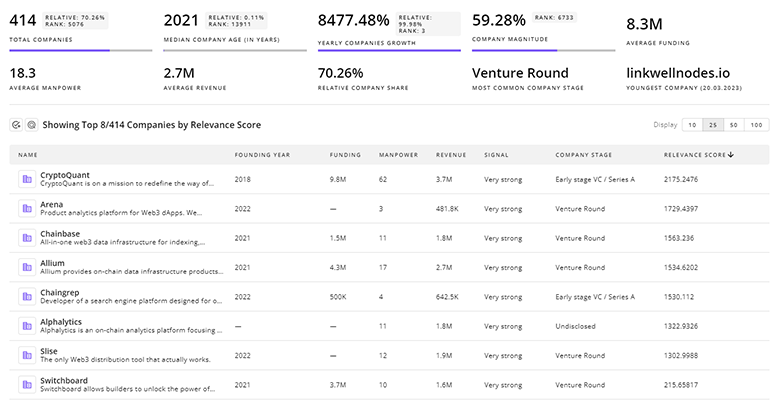
221.4K Energy Industry Companies
Discover Energy Industry Companies, their Funding, Manpower, Revenues, Stages, and much more
Energy Industry Investors
Get ahead with your investment strategy with insights into 34.6K Energy Industry investors. TrendFeedr’s investors tool is your go-to source for comprehensive analysis of investment activities and financial trends. The tool is tailored for navigating the investment world, offering insights for successful market positioning and partnerships within Energy Industry.
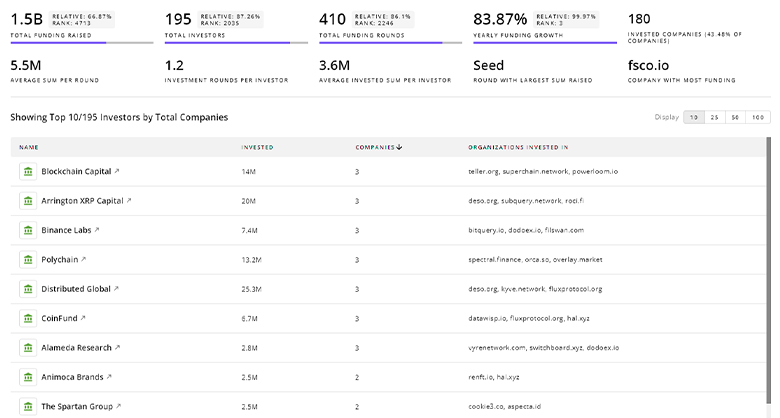
34.6K Energy Industry Investors
Discover Energy Industry Investors, Funding Rounds, Invested Amounts, and Funding Growth
Energy Industry News
TrendFeedr’s News feature offers access to 227.8K news articles on Energy Industry. The tool provides up-to-date news on trends, technologies, and companies, enabling effective trend and sentiment tracking.
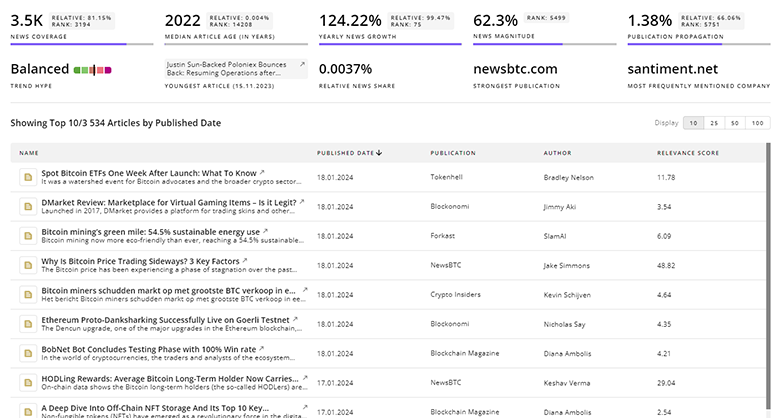
227.8K Energy Industry News Articles
Discover Latest Energy Industry Articles, News Magnitude, Publication Propagation, Yearly Growth, and Strongest Publications
Executive Summary
The immediate commercial battlefield in energy is integration: converting abundant but variable renewable electrons into firm, valuable services (heat, hydrogen, grid capacity, and low-carbon fuels) requires coordinated capital, industrial retrofits, and digital control layers. Financial flows are already favoring flexibility and synthesis—storage, electrolyzers, and CCUS receive accelerating funding—so firms that combine execution certainty (digital twins, common data platforms), asset repurposing strategies, and local supply-chain depth will capture the highest margins. Legacy hydrocarbon players can preserve asset value by adopting lower-emission recovery methods and by partnering with niche technology providers that deliver measurable near-term carbon intensity reductions. Addressing workforce skill shifts and securing critical-minerals and manufacturing routes remain the operational constraints that will determine which projects move from contract to commercial operation on schedule.
Have expertise in trends or technology? Your input can enrich our content — consider collaborating with us!