
Extended Reality Report
: Analysis on the Market, Trends, and TechnologiesThe Extended Reality market is at an inflection point: enterprise adoption and composable spatial data pipelines are driving a high-growth trajectory with a Market CAGR of 28.3% (base 2025) that underpins near-term commercial decisions. Market forecasts vary by scenario, but the consistent signal across reports and internal trend data is that industrial digital twins, remote visual assistance, and AI-generated spatial content will capture the largest immediate value pools.
This article was last updated 70 days ago. If you find any info is missing, let us know!
Topic Dominance Index of Extended Reality
The Dominance Index of Extended Reality looks at the evolution of the sector through a combination of multiple data sources. We analyze the distribution of news articles that mention Extended Reality, the timeline of newly founded companies working in this sector, and the share of voice within the global search data
Key Activities and Applications
- Industrial digital twinning & operations — Building browser-optimized, high-fidelity 3D reality models for asset information, pre-planning and maintenance delivers immediate operational uplift in asset-heavy sectors; practitioners include Twinverse.
- Remote visual assistance for field service — Live AR-guided workflows reduce expert travel and accelerate mean-time-to-repair; established vendors show scale in global deployments XMReality.
- Immersive training and simulation — XR-based cognitive-motor and high-risk scenario training replaces costly physical mockups and shortens certification timelines; small studios and specialized integrators lead implementation Elm Park Labs, Inc..
- Phygital retail and experiential marketing — Appless, cinematic AR activations increase engagement and measurable drive-to-store conversion for luxury brands via smartphone delivery The Overlap Factory.
- Engineering-grade field overlays — "Engineering grade" AR that aligns BIM/CAD to as-built conditions reduces rework on complex builds and enforces design intent on site XYZ Reality.
Emergent Trends and Core Insights
- Aggregated forecasts diverge, but consensus shows sustained double-digit growth; conservative projections put the market in the low-hundreds of billions by 2030 while aggressive scenarios reach into the trillions, reflecting differing assumptions about device adoption and software monetization Extended Reality Market Size, Share & Statistics 2025-2032 – Fortune Business Insights.
- AI-native spatial content is shifting cost curves: generative models plus procedural environments lower asset creation time and enable recurring content subscriptions rather than one-off builds Extended Reality Software/Services Market Size – ABI Research.
- Spatial data (precise geo-anchored layers and persistent maps) emerges as a defensible infrastructure asset; platforms that own accurate, persistent anchors will control downstream monetization of overlays and commerce Arcona.
- Low-latency networks and edge rendering convert mobile devices into viable XR endpoints for many enterprise scenarios; this makes cloud-streamed XR a practical route to scale before lightweight headsets reach price/comfort parity.
- Barriers that still determine winners: hardware comfort/weight, content discoverability, and privacy/regulatory management; vendors that pair UX improvements in optics with platform business models will take share.
Technologies and Methodologies
- Light-field and SoftOptics displays to remove vergence-accommodation conflict and extend comfortable wear time; notable work comes from CREAL on light-field optics.
- Volumetric capture and large-scale photogrammetry to produce photorealistic VR/AR environments and digital twins that are shareable across workflows realities.io.
- Foveated rendering and perceptual optimization to reduce device compute and power needs while preserving perceived visual fidelity.
- Cloud-XR / edge rendering pipelines that stream interactive frames to lightweight endpoints, enabling device-agnostic experiences and centralized asset control.
- Open standards and cross-platform runtimes (OpenXR and equivalent schemas) to reduce fragmentation and enable multi-device participation across phones, tablets, and HMDs.
Extended Reality Funding
A total of 905 Extended Reality companies have received funding.
Overall, Extended Reality companies have raised $22.9B.
Companies within the Extended Reality domain have secured capital from 3.6K funding rounds.
The chart shows the funding trendline of Extended Reality companies over the last 5 years
Extended Reality Companies
- Twinverse — Twinverse offers an industrial metaverse solution built on browser-optimized 3D reality models for asset information management, planning and collaborative training. Its product focuses on map accuracy and low onboarding friction so field teams can access contextually anchored information without heavy training. This approach targets operations and maintenance workflows where immediate time savings and reduced travel produce measurable ROI.
- CREAL — CREAL develops a light-field AR display that preserves natural focus cues and continuous depth resolution, directly addressing the visual comfort limit that constrains long sessions in AR. The company positions its optics as an enabler for extended professional use cases where sustained attention and clarity matter. This device-level differentiation targets enterprise pilots that require long wear times and clinical or engineering accuracy.
- EVOQ — EVOQ operates as a spatial computing studio combining generative AI, LLMs and digital twins to produce serious gaming and enterprise simulation content. They focus on end-to-end production, reducing the gap between data sources and immersive scenarios, and positioning themselves as partners for defense, industrial automation and complex training contracts.
- Over the Reality — Over the Reality builds a geo-referenced spatial layer driven by community mapping and tokenized land parcels (OVRLands), enabling persistent, location-anchored AR experiences at scale. Their model emphasizes data capture and persistent ownership of spatial domains, offering an alternate moat to hardware-centric plays by owning layered spatial datasets.
- Reality Editor — Reality Editor translates IoT and connected-object functionality into an editable AR control layer that surfaces invisible device capabilities for end users. The tool focuses on low-friction manipulation of device relationships through camera-based editing, positioning it as an interface layer between physical systems and XR control surfaces.
Uncover actionable market insights on 5.4K companies driving Extended Reality with TrendFeedr's Companies tool.
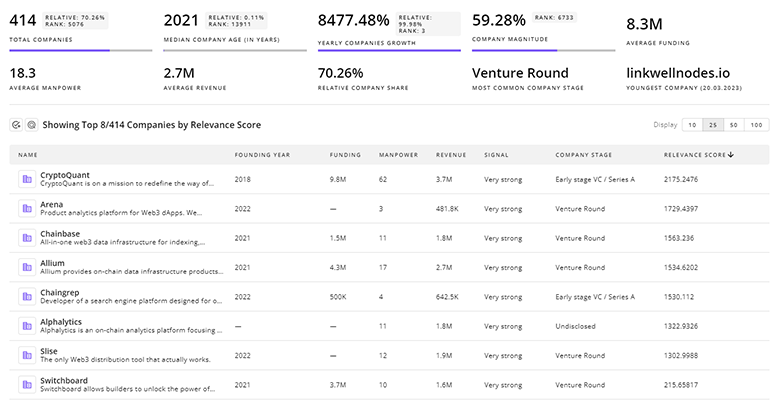
5.4K Extended Reality Companies
Discover Extended Reality Companies, their Funding, Manpower, Revenues, Stages, and much more
Extended Reality Investors
Get ahead with your investment strategy with insights into 3.5K Extended Reality investors. TrendFeedr’s investors tool is your go-to source for comprehensive analysis of investment activities and financial trends. The tool is tailored for navigating the investment world, offering insights for successful market positioning and partnerships within Extended Reality.
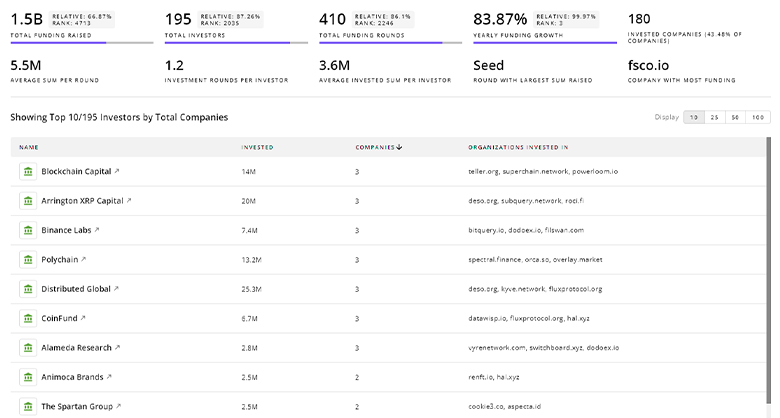
3.5K Extended Reality Investors
Discover Extended Reality Investors, Funding Rounds, Invested Amounts, and Funding Growth
Extended Reality News
TrendFeedr’s News feature offers access to 15.3K news articles on Extended Reality. The tool provides up-to-date news on trends, technologies, and companies, enabling effective trend and sentiment tracking.

15.3K Extended Reality News Articles
Discover Latest Extended Reality Articles, News Magnitude, Publication Propagation, Yearly Growth, and Strongest Publications
Executive Summary
Strategic value in Extended Reality shifts from novelty to infrastructure: ownership of persistent spatial anchors, the ability to stream high-fidelity experiences to commodity endpoints, and AI-assisted content pipelines will define winners. Enterprises should prioritize pilots that map directly to measurable KPIs (reduced travel, fewer reworks, faster onboarding) and build or partner for spatial data assets rather than betting exclusively on headset proliferation. Firms that combine optical and perceptual improvements with platform strategies for content scale will convert current investment into sustained revenue.
Have expertise in trends or technology? Your input can enrich our content — consider collaborating with us!