Fitness Tracking Report
: Analysis on the Market, Trends, and TechnologiesThe fitness-tracking market is at a strategic inflection where sensor fidelity and analytics determine commercial winners: global market data records a $59,100,000,000 market in 2024 and a 18.2% CAGR projection that drives a $161,000,000,000 target by 2030. Consumer demand has shifted from passive activity logging to actionable, physiology-driven coaching, and competition now favors platforms that can both aggregate diverse signals and embed high-fidelity measurement modules into enterprise and professional workflows.
This article was last updated 39 days ago. If you find any info is missing, let us know!
Topic Dominance Index of Fitness Tracking
The Dominance Index of Fitness Tracking looks at the evolution of the sector through a combination of multiple data sources. We analyze the distribution of news articles that mention Fitness Tracking, the timeline of newly founded companies working in this sector, and the share of voice within the global search data
Key Activities and Applications
- Step and distance tracking as an engagement anchor for mass consumers; this remains the most common entry metric used in onboarding and corporate programs.
- Heart-rate and ECG monitoring for risk screening and exercise intensity control; devices increasingly add clinical-grade modules to support preventive use cases.
- Sleep and recovery analysis used to tune daily training load and wellbeing coaching, now a primary subscription feature set for many platforms.
- Metabolic and glucose monitoring (CGM integration) for personalized nutrition and metabolic fitness pathways; this couples wearables and biomarker platforms to deliver diet-sensitive coaching Ultrahuman Ring.
- Automated strength and rep counting / form analysis for strength athletes and gyms, converting workouts into quantifiable performance data that feeds adaptive programming.
- Enterprise wellness and insurer integration where trackers supply verifiable activity and biometric streams to corporate programs and risk models, shifting monetization from device one-offs to B2B subscriptions FITPASS.
- Remote rehabilitation and physiotherapy monitoring that uses markerless or wearable motion capture to deliver clinician-grade adherence and progression metrics.
Emergent Trends and Core Insights
- From activity logs to physiological intelligence: Market participants now prize metrics that show how the body responds (cardiac output, glucose response, recovery readiness), not only what the body did; this drives premium feature tiers and institutional contracts Wearable Fitness Tracker Market | Future Market Insights.
- Platform vs ingredient dynamic: Large aggregator platforms seek to own user relationships and will acquire or integrate specialist measurement providers; small tech vendors must secure B2B embed contracts to avoid commoditization Fitness Tracker Market 2025: Detailed Insights into Market Size and Future Growth.
- Computer vision as a low-friction sensor: Markerless motion analysis enables form feedback without new hardware, lowering adoption barriers for home fitness and tele-rehab FittyAI.
- Hyper-verticalization: Niche trackers (football, HYROX, VBT) build trust with specialist users by delivering domain-specific KPIs that general platforms cannot replicate quickly Tracktics football tracker.
- Data provenance and verification is emerging as a monetizable requirement where incentives (insurance, corporate rewards) depend on authenticated streams rather than self-reported metrics.
- User retention remains a gating constraint: high abandonment statistics and the need for coaching or social reinforcement make engagement features (adaptive coaching, gamified challenges) central to long-term monetization Feasibility of Using a Commercial Fitness Tracker.
Technologies and Methodologies
- Multi-sensor fusion (PPG + IMU + temperature + SpO₂ + ECG) to improve signal validity across activities and body types, enabling clinical-adjacent use cases.
- Edge AI for on-device inference to reduce latency, preserve privacy, and deliver realtime coaching without constant cloud reliance.
- Computer vision / markerless pose estimation for rep counting, form correction, and tele-rehab; scales across devices using only a phone camera.
- Non-invasive biochemical sensing (skin spectroscopy, fNIRS, CGM integration) to surface metabolic and glucose metrics that historically required lab testing Body M3canix.
- API-first B2B integrations and data normalization layers that enable platforms to ingest specialist signals (VBT, CGM, motion capture) and present consolidated insights to end users and enterprise clients HYBRD.
- AI-driven personalized programming that adapts load and nutrition recommendations to real-time biometrics and historical response curves, improving adherence and outcomes when paired with human coaching or social accountability.
Fitness Tracking Funding
A total of 302 Fitness Tracking companies have received funding.
Overall, Fitness Tracking companies have raised $11.0B.
Companies within the Fitness Tracking domain have secured capital from 1.1K funding rounds.
The chart shows the funding trendline of Fitness Tracking companies over the last 5 years
Fitness Tracking Companies
WurQ — WurQ tracks 70+ movements to deliver functional training analytics that go beyond heart rate and calories; it targets exercise modalities where form and workload sequencing matter for outcomes. The company packages movement summaries for coaches and providers to optimize load and reduce injury risk, and it emphasizes partnerships with research and sports institutions to validate metrics. WurQ focuses on embedding its movement analytics into performance workflows rather than competing on consumer distribution.
Train Fitness — Train Fitness uses Apple Watch motion signals and proprietary Neural Kinetic Profiling™ to provide automatic exercise detection and rep counting, removing manual logging friction for strength trainees. The startup targets users who want reliable strength metrics without additional hardware and sells into ecosystems that value automated tracking for coaching programs. Train Fitness follows a product strategy centered on high-precision event detection and simple consumer UX.
Kemtai — Kemtai delivers FDA-listed, CE-marked computer vision software for rehabilitation and MSK applications that analyzes 111 body points and supports more than 2,000 exercise variations. It positions itself as a clinical-grade remote care tool for physiotherapists and health providers, offering automated assessments and adherence analytics that extend clinician reach into patient homes. Regulatory certifications and healthcare partnerships serve as the company's primary barrier against commoditization.
OnTracx — OnTracx focuses on injury-free running via wearable load tracking that operates outside lab settings, offering progressive load plans and biomechanical monitoring for runners and rehabilitation programs. The company pitches directly to sports medicine providers and insurers by quantifying external and internal load to reduce re-injury risk and accelerate return-to-run workflows. OnTracx frames its product as a prevention and outcomes tool for clinicians and elite/serious recreational runners alike.
Uncover actionable market insights on 2.6K companies driving Fitness Tracking with TrendFeedr's Companies tool.
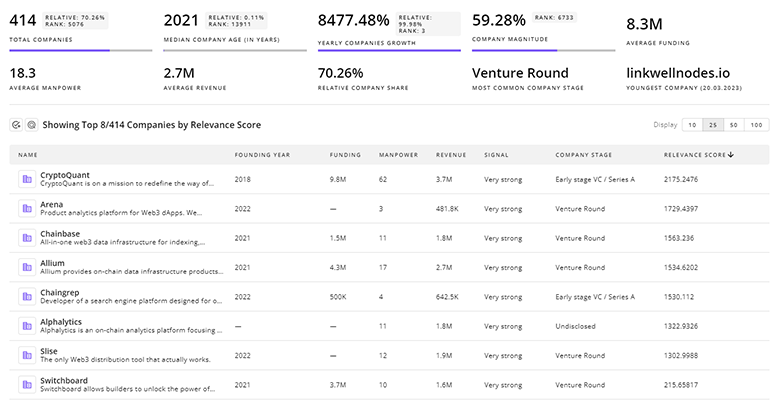
2.6K Fitness Tracking Companies
Discover Fitness Tracking Companies, their Funding, Manpower, Revenues, Stages, and much more
Fitness Tracking Investors
Get ahead with your investment strategy with insights into 1.3K Fitness Tracking investors. TrendFeedr’s investors tool is your go-to source for comprehensive analysis of investment activities and financial trends. The tool is tailored for navigating the investment world, offering insights for successful market positioning and partnerships within Fitness Tracking.
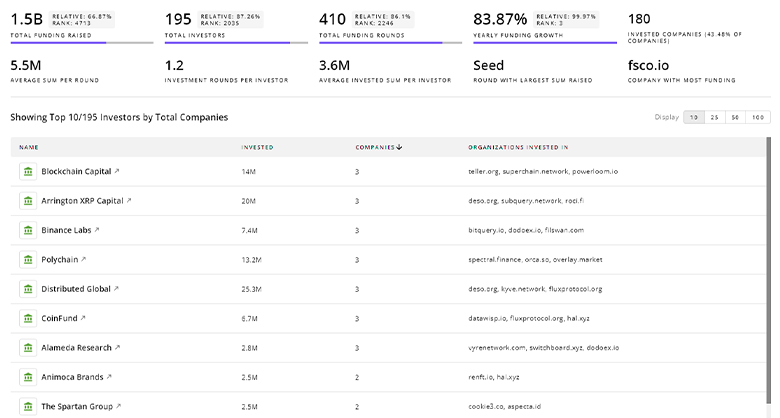
1.3K Fitness Tracking Investors
Discover Fitness Tracking Investors, Funding Rounds, Invested Amounts, and Funding Growth
Fitness Tracking News
TrendFeedr’s News feature offers access to 6.7K news articles on Fitness Tracking. The tool provides up-to-date news on trends, technologies, and companies, enabling effective trend and sentiment tracking.
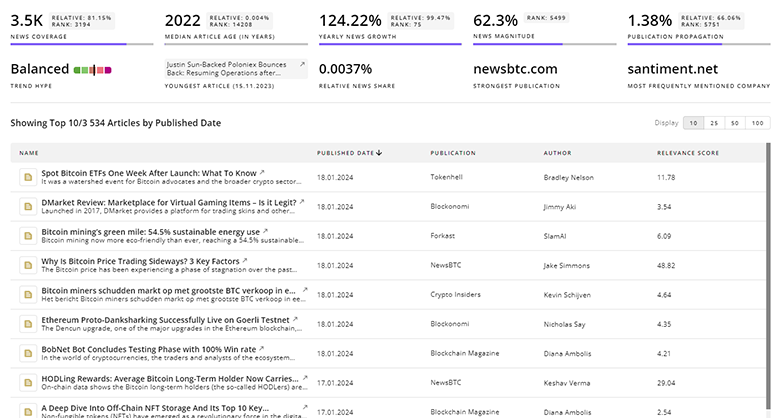
6.7K Fitness Tracking News Articles
Discover Latest Fitness Tracking Articles, News Magnitude, Publication Propagation, Yearly Growth, and Strongest Publications
Executive Summary
The fitness-tracking market has shifted from simple activity dashboards to a layered industry where measurement fidelity, interpretive analytics, and verified data streams determine commercial value. Market data shows strong top-line expansion and high CAGR expectations, but monetization now depends on delivering credible, clinically relevant signals and embedding those signals into enterprise value chains. Firms that act as platform owners will pursue acquisitions and integrations to consolidate user relationships; specialist vendors must pursue defensible B2B routes into clinical, insurance, or elite sports channels where accuracy commands premium pricing. For product and investment strategies, prioritize validated sensing, low-friction deployment (computer vision or seamless wearables), and contractual pathways into institutional buyers that pay for verified outcomes.
Have expertise in trends or technology? Your input can enrich our content — consider collaborating with us!