Freight Technology Report
: Analysis on the Market, Trends, and TechnologiesThe freight technology landscape is accelerating toward platform orchestration and measurable cost/efficiency outcomes: investment into FreightTech rose from $118M to $3B annually between 2014 and 2019, signaling a structural shift from point tools to integrated systems that capture enterprise value through data and automation. This report synthesizes market sizing, patent activity, and company-level signals to show that the highest-value opportunities sit at the intersection of AI-driven automation, real-time visibility, and capacity-utilization products that reduce empty miles and administrative overhead.
This article was last updated 240 days ago. If you find any info is missing, let us know!
Topic Dominance Index of Freight Technology
The Dominance Index of Freight Technology looks at the evolution of the sector through a combination of multiple data sources. We analyze the distribution of news articles that mention Freight Technology, the timeline of newly founded companies working in this sector, and the share of voice within the global search data
Key Activities and Applications
- Rate procurement automation and white-label quoting — Forwarders are digitizing rate catalogs and instant quoting to shorten sales cycles and remove manual rate lookups; this activity addresses immediate revenue friction points for small and medium forwarders.
- Shared Truckload and consolidation marketplaces — Platforms that pool LTL shipments into truckload equivalents increase utilization and reduce per-shipment CO2 and cost, a model that has attracted significant funding and adoption in regional markets.
- Container lifecycle and multimodal visibility — Full-lifecycle container tracking and low-latency container state data (booking through empty return) enable proactive exception management and detention avoidance across ocean-road interchanges Gnosis Freight.
- Document and invoice automation for forwarders and brokers — AI document extraction and invoice validation cut manual processing time materially; implementations report multi-hour savings per shipment when replacing manual entry workflows.
- No-code/low-code connectivity (iPaaS) for legacy systems — Self-service EDI/API connectors reduce integration lead times and unlock data for optimization engines without heavy IT projects.
- Predictive routing and load optimization — Machine learning models applied to historical flows and real-time telemetry yield lower fuel and transit times through dynamic consolidation and routing adjustments.
- Digital freight marketplaces and booking — Instant quoting and booking portals continue to replace manual broker interactions, improving transparency and shortening tender cycles Freightos.
Emergent Trends and Core Insights
- AI as an operational multiplier rather than a feature — Investment flows favor companies that embed AI into back-office automation and execution orchestration (pricing engines, document ops, predictive ETAs) rather than firms that only offer matching layers.
- Visibility is maturing from passive tracking to active intervention — The industry is moving from simple position feeds to predictive, low-latency workflows that trigger re-plans, tendering, or carrier settlement automatically (real-time container telemetry and smart contracts are examples) Digital Freight Management Market | Future Market Insights.
- Sustainability metrics are monetizing capacity optimization — Buyers increasingly expect verifiable CO2 data attached to routing and consolidation options; platforms that can quantify avoided emissions command pricing leverage with enterprise shippers Flock Freight.
- Platform-ization and consolidation pressure — Market research projects rapid FTMS and TMS growth (CAGRs in the high single to low double digits), driving incumbents and well-funded challengers to acquire complementary specialists rather than build modular capabilities in-house Freight Transport Management Market Size & Share, 2025.
- Regional regulatory and data-sovereignty friction is a developing constraint for cross-border orchestration; firms that bake compliant, auditable data-exchange models into their architecture reduce long-term integration risk.
- Hardware + software convergence for tracking — Falling tracker unit costs and multi-network GNSS/cellular-satellite hybrids expand tracking coverage, enabling new commercial propositions around condition-sensitive and general cargo monitoring.
Technologies and Methodologies
- AI/ML for pricing, demand forecasting, and orchestration — Productionized models perform dynamic pricing, carrier matching, route consolidation, and exception prioritization; value accrues when models link to execution APIs and finance/payment rails.
- IoT telematics and smart tags — Multi-protocol sensors (GNSS + cellular + satellite) and disposable smart labels enable scalable asset tracking, temperature control, and tamper detection for ocean, road, and air flows Trailer-Cargo Tracking insights.
- No-code integration platforms (iPaaS) — Self-service connectivity tools shorten the time to ingest carrier and ERP data, removing the integration bottleneck for smaller forwarders and enabling rapid partner onboarding 1Logtech Inc.
- Blockchain and smart-contract settlements — Targeted use cases (document provenance, automated release on proof-of-delivery) improve auditability and reduce reconciliation cost where multi-party trust is weak Freight Digitization Market analysis.
- Edge and hybrid-cloud architectures — Edge compute for sensor pre-processing combined with cloud orchestration reduces latency for decisioning while keeping cost predictable for scale.
- API-first marketplaces and composable TMS patterns — Modular APIs enable platforms to embed best-of-breed specialist services (document automation, CO2 accounting, last-mile routing) as pluggable components, accelerating adoption in enterprise environments Freight Management System market forecasts.
Freight Technology Funding
A total of 2.1K Freight Technology companies have received funding.
Overall, Freight Technology companies have raised $179.6B.
Companies within the Freight Technology domain have secured capital from 5.2K funding rounds.
The chart shows the funding trendline of Freight Technology companies over the last 5 years
Freight Technology Companies
- freightmate Ai
freightmate Ai focuses on automating document workflows and invoice validation for forwarders and customs brokers, using LLMs and extraction pipelines to remove repetitive tasks from operations teams. The product targets high-volume desks where manual entry dominates margin erosion; early customers report measurable time savings per shipment that translate directly to lowered cost-to-serve. - FLETEC
FLETEC provides an AI assistant for container and chassis fleet maintenance by detecting incorrect repair estimates and surfacing risk signals in real time. The add-on design integrates without heavy IT lift, enabling fleet operators to reduce outage and repair leakage while keeping existing operational systems intact. - Bitfreighter
Bitfreighter delivers scalable EDI and API integration services that automate quoting, load building, and billing workflows; its LiveQuote engine produces live truckload pricing to brokers and shippers, addressing a core operational inefficiency in manual quoting and patchwork integrations. - CargoFL
CargoFL offers a cloud-based transport ERP and AI microservices orchestration platform tailored to truckers and shippers, combining dispatch automation, consolidation, and real-time ERP integration to reduce empty miles and improve cash conversion for regional fleets. - TradeLink
TradeLink targets time-window and yard orchestration with a simple, partner-connected time-slot management product that eliminates ramp downtime and reduces driver waiting hours; it emphasizes operational adoption by making partner connectivity low-friction and user-centric.
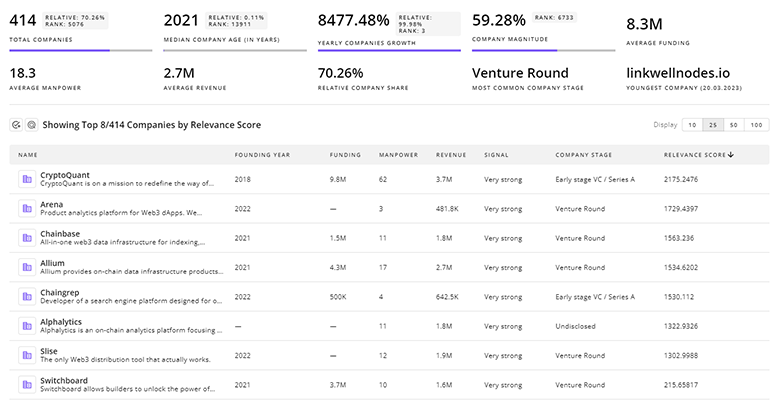
Uncover actionable market insights on 42.7K companies driving Freight Technology with TrendFeedr's Companies tool.
42.7K Freight Technology Companies
Discover Freight Technology Companies, their Funding, Manpower, Revenues, Stages, and much more
Freight Technology Investors
Get ahead with your investment strategy with insights into 5.7K Freight Technology investors. TrendFeedr’s investors tool is your go-to source for comprehensive analysis of investment activities and financial trends. The tool is tailored for navigating the investment world, offering insights for successful market positioning and partnerships within Freight Technology.
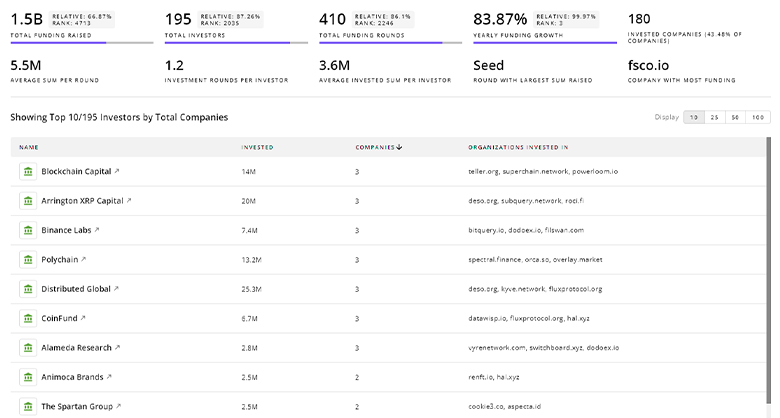
5.7K Freight Technology Investors
Discover Freight Technology Investors, Funding Rounds, Invested Amounts, and Funding Growth
Freight Technology News
TrendFeedr’s News feature offers access to 71.6K news articles on Freight Technology. The tool provides up-to-date news on trends, technologies, and companies, enabling effective trend and sentiment tracking.
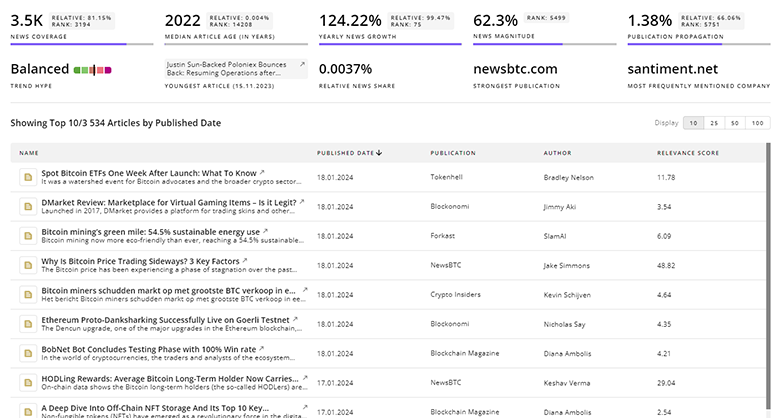
71.6K Freight Technology News Articles
Discover Latest Freight Technology Articles, News Magnitude, Publication Propagation, Yearly Growth, and Strongest Publications
Executive Summary
Freight technology has left basic digitization behind and is now a competitive battleground for platforms that can orchestrate multi-party workflows, integrate high-quality telemetry, and convert operational automation into measurable margin improvements. Firms that combine enterprise-grade API integration, AI applied to execution (not only matching), and verifiable sustainability metrics will capture premium relationships with shippers and carriers. For niche players, survival depends on either achieving deep vertical specialization with defensible operational IP or embedding as indispensable infrastructure through standard APIs and low-friction integrations. Strategic investors and buyers should prioritize assets that demonstrably reduce empty miles, automate compliance/document flows, or unlock new utilization economics at network scale.
Have expertise in trends or technology? Your input can enrich our content — consider collaborating with us!