Generative Adversarial Network Report
: Analysis on the Market, Trends, and TechnologiesThe GAN market is entering a decisive industrial phase: market data projects growth from $15.6 billion in 2025 to $186 billion by 2035, a 28.13% CAGR that signals commercial scaling beyond lab prototypes. Recent market studies and regional forecasts confirm cloud dominance and modality concentration in image/text generation, while investor flows and corporate R&D are reallocating capital toward privacy-aware synthetic data, operational cost reduction, and verifiable output Generative Adversarial Networks Market.
We updated this report 250 days ago. Missing information? Contact us to add your insights.
Topic Dominance Index of Generative Adversarial Network
The Topic Dominance Index combines the distribution of news articles that mention Generative Adversarial Network, the timeline of newly founded companies working within this sector, and the share of voice within the global search data
Key Activities and Applications
- Synthetic data generation for regulated industries. Enterprises use GANs to produce high-fidelity synthetic datasets for model training in healthcare and finance, reducing privacy exposure while maintaining model performance.
- Image and video content creation for media and e-commerce. GAN pipelines power product imaging, virtual try-ons, and short-form marketing assets, with image generation holding a large share of revenue in current forecasts.
- Data augmentation for machine perception. Teams apply GANs to correct class imbalance for object detection, medical imaging labels, and autonomous vehicle training sets to raise downstream accuracy metrics.
- Adversarial testing and defensive use of discriminators. Organizations generate adversarial examples to harden classifiers and to test fraud or intrusion detection systems, shifting part of GAN value from pure generation to security validation.
- Molecular and simulation synthesis. GAN variants are being adapted to propose molecular geometries and to accelerate simulation fidelity for manufacturing and materials research, shortening discovery timelines.
Emergent Trends and Core Insights
- Shift from generic models to verticalized stacks. Market analysis shows buyers prefer domain-tuned GANs (healthcare, finance, retail) that embed compliance and provenance features rather than general-purpose generators.
- Cloud-first deployments with an on-premises tail. Cloud captures the majority of deployment share, while on-premises demand persists for data-sensitive use cases requiring stricter control.
- Security as a product lever. Startups are commercializing GAN-driven attack simulation and detection, turning adversarial techniques into enterprise security tools.
- Operational cost optimization is now strategic. Providers that meaningfully reduce inference and fine-tuning costs create durable moats; cost arbitrage is a primary investor focus in infrastructure plays.
- Hybrid architectures emerge. Research and product roadmaps increasingly combine adversarial models with diffusion and retrieval systems to improve output fidelity and traceability.
Technologies and Methodologies
- Conditional GANs for controlled, attribute-aware generation and targeted augmentation.
- CycleGAN for unpaired image-to-image translation in style transfer and domain adaptation.
- StyleGAN / StyleGAN2 families for high-resolution photorealistic image synthesis used in avatar and catalogue pipelines.
- Wasserstein GANs (WGAN) with gradient penalties to reduce training instability and mode collapse in low-data regimes.
- Federated and decentralized GAN training enabling synthetic data creation across silos without centralizing raw records, supporting compliance requirements.
- Integration with Retrieval-Augmented Generation (RAG) and verification layers to ground outputs and reduce hallucination risk in enterprise contexts.
- Mixed-precision and model compression techniques for on-device inference enabling AR/VR and mobile use cases.
Generative Adversarial Network Funding
A total of 66 Generative Adversarial Network companies have received funding.
Overall, Generative Adversarial Network companies have raised $4.3B.
Companies within the Generative Adversarial Network domain have secured capital from 304 funding rounds.
The chart shows the funding trendline of Generative Adversarial Network companies over the last 5 years
Generative Adversarial Network Companies
- AetherLab — AetherLab positions itself as a ProductOps platform that governs agentic and generative models with audit logs and multimodal guardrails, enabling enterprises to align outputs with product logic and brand rules. The company targets compliance-sensitive rollouts where traceability is required and emphasizes deployment controls that keep inference behavior auditable.
- The MachineGenes Group — The MachineGenes Group applies adversarial paradigms to digital twins and dynamic system simulation, claiming explainable and lightweight models that operate on edge devices with tiny first-party datasets. Their approach aims to replace black-box ANN solutions in mission-critical control and simulation workflows.
- ForGen AI — ForGen AI focuses on efficiency research and modular RAG protocols (LoRA, low-rank adaptation, gradient accumulation) to accelerate fine-tuning and domain customization for technical and enterprise text/image tasks. The firm emphasizes integration patterns that let customers apply advanced tuning without prohibitive compute.
- NeuroPixel.AI — NeuroPixel.AI concentrates on photorealistic synthetic humans for fashion e-commerce and catalogue automation, providing high-quality synthetic imagery for virtual try-on and marketing pipelines with measurable cost and time reductions in photo production.
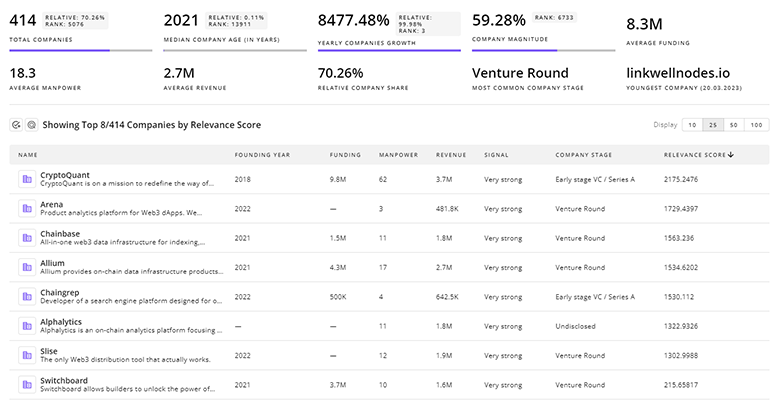
Gain a competitive edge with access to 387 Generative Adversarial Network companies.
387 Generative Adversarial Network Companies
Discover Generative Adversarial Network Companies, their Funding, Manpower, Revenues, Stages, and much more
Generative Adversarial Network Investors
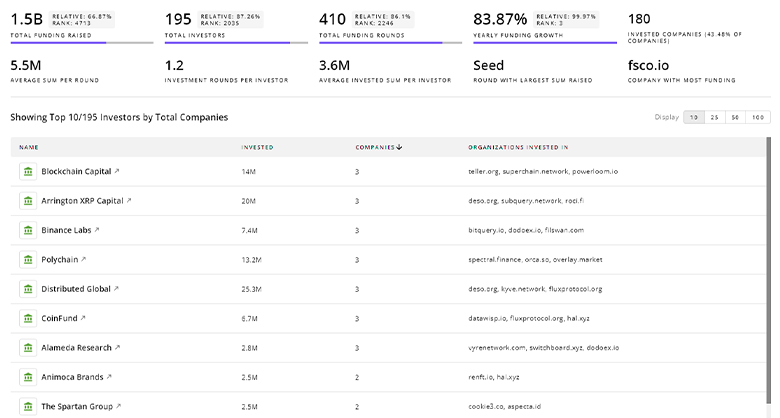
Leverage TrendFeedr’s sophisticated investment intelligence into 501 Generative Adversarial Network investors. It covers funding rounds, investor activity, and key financial metrics in Generative Adversarial Network. investors tool is ideal for business strategists and investment experts as it offers crucial insights needed to seize investment opportunities.
501 Generative Adversarial Network Investors
Discover Generative Adversarial Network Investors, Funding Rounds, Invested Amounts, and Funding Growth
Generative Adversarial Network News
TrendFeedr’s News feature provides a historical overview and current momentum of Generative Adversarial Network by analyzing 1.8K news articles. This tool allows market analysts and strategists to align with latest market developments.
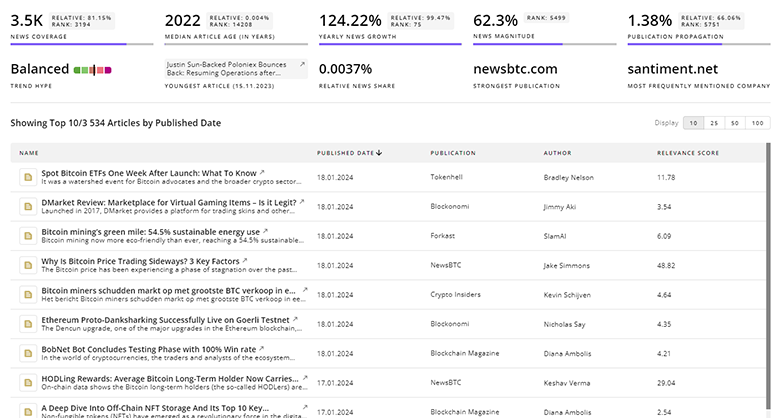
1.8K Generative Adversarial Network News Articles
Discover Latest Generative Adversarial Network Articles, News Magnitude, Publication Propagation, Yearly Growth, and Strongest Publications
Executive Summary
Generative adversarial networks have moved from research novelty to operational technology where cost, governance, and vertical fit determine commercial winners. Market projections and patent activity indicate sustained investment, but the commercialization path requires solving training stability, inference cost, and verifiable provenance. Stakeholders should prioritize three practical vectors: integrate verifiability into inference pipelines, buy or build cost-efficient serving stacks, and adopt domain-tuned GAN variants that embed compliance controls. The firms that combine domain expertise, demonstrable auditability, and lower total cost of ownership will capture the most durable enterprise value.
Interested in contributing your expertise on trends and tech? We’d love to hear from you.