
Green Infrastructure Report
: Analysis on the Market, Trends, and TechnologiesThe green infrastructure market shows clear commercial momentum with a projected internal CAGR of 16.5% and a 2029 market projection of $4.53 billion from the internal green infrastructure dataset, signaling rapid revenue expansion for firms that convert ecological services into measurable assets. External market studies report complementary but lower global forecasts — for example a 12% CAGR to 2033 and a $150 billion target used in several market summaries HTF Market Insights – Green Infrastructure Market Size, Share Growth & Forecast. The data imply a gap between focused product segments (high internal CAGR) and broad-market aggregates (larger but slower-growing total markets), creating tactical opportunities for specialist suppliers, circular-material innovators, and data-driven asset platforms to capture above-market returns now.
We updated this report 320 days ago. Missing information? Contact us to add your insights.
Topic Dominance Index of Green Infrastructure
The Topic Dominance Index combines the distribution of news articles that mention Green Infrastructure, the timeline of newly founded companies working within this sector, and the share of voice within the global search data
Key Activities and Applications
- Urban stormwater control using permeable pavements, bioswales, green roofs and on-site retention that reduce runoff and relieve combined sewer systems Stormwater Green Infrastructure Market – ResearchAndMarkets.
- Urban greening and pocket forests to cool microclimates, increase canopy equity and deliver visible community benefits at low spatial cost Global Status Report for Buildings and Construction 2024/25.
- Circular-material substitution: converting waste streams (plastics, tyres, agricultural residues, excavation spoil) into pavement matrices, soil media and building panels to cut embodied carbon and landfill load.
- Integrating energy and water recovery inside buildings (waste-heat capture, hydropower-from-tanks) to treat buildings as productive nodes in urban resource systems Green Vigor Limited.
- Measurement-as-a-service and performance contracting: sensors and dashboards that convert greenery into contractable service levels (canopy performance, runoff volume avoided, biodiversity indices) to enable pay-for-performance financing.
Emergent Trends and Core Insights
- Investment bifurcation: concentrated project capital sits alongside many small innovators. Internal data show large aggregate funding but low median round size, creating scale inefficiencies that favour platform aggregators or vertically integrated constructors that internalize circular-material supply chains.
- Water-control engineering dominates technical IP and productization efforts; stormwater components and permeable pavement technologies lead practical deployments and procurement priority for municipalities.
- Assetization of nature: firms are packaging planted areas and restored soils as verifiable, tradable ecosystem assets using geospatial measurement, AI and distributed ledgers to give investors auditable returns The Green Projects.
- Demand tailwinds from regulation and procurement: public incentives, building codes and targeted retrofit programs create predictable project pipelines; stormwater- and green-roof mandates accelerate retrofit economics in North America and Europe Green Roof Market – IMARC Group.
- Operations gap: field maintenance, clogging of permeable surfaces, and long-term vegetation health remain under-addressed; this produces recurring OPEX risk and a commercial opening for predictive-maintenance platforms.
Technologies and Methodologies
- Modular, load-bearing permeable pavement systems that accept recycled tyre aggregates and scale from plazas to parking lots, reducing runoff while diverting waste tyres from landfill.
- Bioreceptive concretes and plantable composites that permit mosses and small plants to colonize facades and surfaces for pollutant removal and passive cooling Greenment.
- IoT sensor arrays, edge analytics and performance dashboards for live monitoring of canopy health, substrate moisture and run-off capture, enabling performance contracting and measurable service delivery.
- Engineered growing media derived from agricultural residues and processed construction waste to reduce substrate weight and embodied carbon compared with traditional mineral mixes Eco Materials LLC.
- System-level modelling (hydrology, thermal, biodiversity) combined with GIS suitability mapping to prioritize sites where small interventions deliver outsized system benefits and permit rigorous cost-benefit justification Sustainable Infrastructure Hub.
Green Infrastructure Funding
A total of 162 Green Infrastructure companies have received funding.
Overall, Green Infrastructure companies have raised $10.7B.
Companies within the Green Infrastructure domain have secured capital from 327 funding rounds.
The chart shows the funding trendline of Green Infrastructure companies over the last 5 years
Green Infrastructure Companies
- Leaf Island — Leaf Island designs modular, biophysics-driven green/blue infrastructure modules intended to reinstate ecosystem functions on streets and coastlines. The company emphasizes scalable fabrication and replicable product lines that allow cities to deploy vegetation modules quickly across dense urban sites.
- Stabilogreen — Stabilogreen converts plastic waste into engineering products for ground stabilization and construction applications, reducing landfill pressure while delivering permeable structural layers; the firm reports multi-million-euro revenue scale and positions waste diversion as a core value driver.
- Biome / Build — Biome engineers construction materials from agricultural residues (rice straw, bagasse) and commercializes board products that replace timber and reduce embodied emissions; the company benefits from government-backed R&D support and targets upstream material substitution in building supply chains.
- Porous Lane — Porous Lane manufactures high-performance permeable pavements that repurpose waste tyres to produce durable, flood-mitigating surfaces suited for carparks and pedestrian areas; the company completed real-scale trials in Australia and has raised venture-scale capital to expand production.
- Respyre — Respyre develops bioreceptive concrete and façade systems that host moss and other low-maintenance plants to provide passive air filtration and acoustic dampening; the approach reduces maintenance overhead and converts building envelopes into functional ecological filters.
Gain a competitive edge with access to 1.3K Green Infrastructure companies.
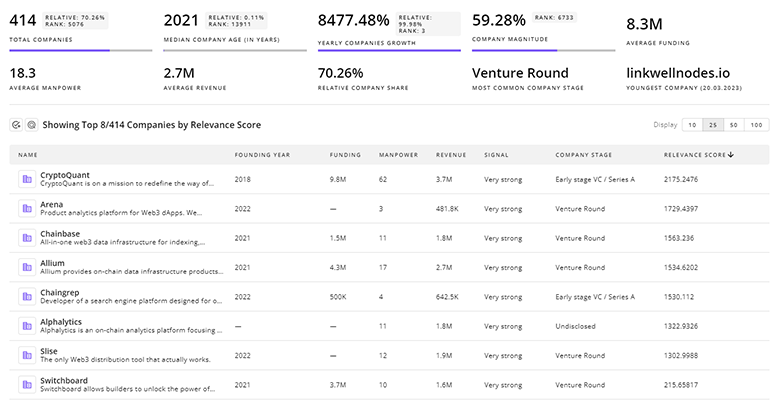
1.3K Green Infrastructure Companies
Discover Green Infrastructure Companies, their Funding, Manpower, Revenues, Stages, and much more
Green Infrastructure Investors
Leverage TrendFeedr’s sophisticated investment intelligence into 310 Green Infrastructure investors. It covers funding rounds, investor activity, and key financial metrics in Green Infrastructure. investors tool is ideal for business strategists and investment experts as it offers crucial insights needed to seize investment opportunities.
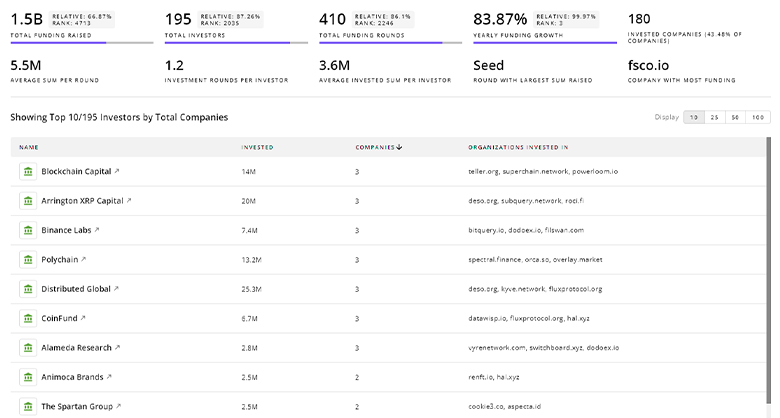
310 Green Infrastructure Investors
Discover Green Infrastructure Investors, Funding Rounds, Invested Amounts, and Funding Growth
Green Infrastructure News
TrendFeedr’s News feature provides a historical overview and current momentum of Green Infrastructure by analyzing 3.4K news articles. This tool allows market analysts and strategists to align with latest market developments.

3.4K Green Infrastructure News Articles
Discover Latest Green Infrastructure Articles, News Magnitude, Publication Propagation, Yearly Growth, and Strongest Publications
Executive Summary
Green infrastructure has shifted from a discretionary amenity to a procurement priority where measurable resilience and lifecycle economics determine project selection. Two commercial levers matter most: first, integrating circular-material supply chains into construction workflow to remove the premium on green options; second, converting ecological performance into verifiable, contractable metrics that enable pay-for-performance finance. Firms that combine engineered water-control components, low-carbon substrates from waste streams, and real-time performance management will capture the highest-margin opportunities as municipalities scale retrofit and new-build programs. Investors should prioritize platform businesses that aggregate distributed projects and suppliers that internalize material upcycling, since these business models close the capital-to-scale gap evident across the current landscape.
Interested in contributing your expertise on trends and tech? We’d love to hear from you.