Image Recognition Report
: Analysis on the Market, Trends, and TechnologiesThe global image recognition market is in rapid growth and strategic re-segmentation: it stood at $27,764,000,000 in 2020 and is projected to reach $73,344,000,000 by 2026, reflecting an elevated adoption pace for enterprise and edge deployments. Market forecasters show a range of trajectories—short-term estimates place the market between $53.3B (2023) and $57.36B (2025), while multi-year projections span from $109.236B by 2030 to $212B+ in the early 2030s—indicating persistent high demand but notable variance by source and scope grandviewresearch – Image Recognition Market towardsict – Image Recognition Market. These figures reflect accelerating technology adoption (edge inference, synthetic training, multi-modal fusion) and concentrated investment into identity, retail automation, and industrial inspection—creating a two-track market where scale platforms compete with narrowly focused, high-assurance solutions.
The last update of this report was 26 days ago. If you spot incomplete or incorrect info, please let us know.
Topic Dominance Index of Image Recognition
The Topic Dominance Index analyzes the time series distribution of published articles, founded companies, and global search data to identify the trajectory of Image Recognition relative to all known Trends and Technologies.
Key Activities and Applications
- Biometric identity and authentication: facial, iris, and multi-modal verification remain core revenue generators for government and finance deployments; facial recognition alone is forecasted as a major technology segment with high CAGR expectations Iris Recognition Market Report.
- Retail execution and shelf intelligence: automated planogram compliance, out-of-stock detection, and SKU recognition drive measurable in-store ROI by replacing manual audits and supporting rapid SKU onboarding.
- Industrial visual inspection and traceability: high-speed anomaly detection and mark-free part identification reduce recall risk and increase throughput in manufacturing lines.
- Behavioral video analytics and safety: event and intent detection (violence, weapon detection, crowd anomalies) add operational value in campuses, transit hubs, and critical infrastructure viisights.
- Medical imaging and diagnostics: automated segmentation and disease-specific biomarkers accelerate diagnostic pipelines and clinical workflows, expanding telemedicine capabilities.
- Authenticity and deepfake detection: as generative media proliferates, image-authenticity verification becomes essential for identity workflows, content moderation, and legal evidence chains identifAI Labs.
Emergent Trends and Core Insights
- Synthetic data and digital twins as growth multipliers: synthetic training pipelines materially shorten product onboarding and reduce reliance on costly, privacy-sensitive labeled sets; some vendors assert production rollouts in weeks rather than months by using synthetic catalogs Neurolabs.
- Edge inference and device-first deployments: sub-second latency, data sovereignty, and connectivity variability push inference to the edge for retail, industrial inspection, and access control—creating product differentiation for on-device offerings.
- Authenticity defenses enter core security stacks: detection of synthetic imagery and liveness verification become required features for any identity product that serves regulated customers.
- Sensor and representation diversity: polarization imaging, thermal/IR fusion, and event-based sensors extend performance under adverse lighting and weather, unlocking surveillance and automotive applications once constrained by classic RGB limitations.
- Shift from identification to interpretation: value accrues to systems that infer context and behavior (what a person is doing and why), not merely who or what is present—this is where higher margins and defensibility appear.
- Regulatory and privacy dynamics continue to shape commercial choices: strict regimes (EU, certain U.S. states) accelerate demand for on-premise or privacy-first pipelines and multi-modal verification that reduces single-modality exposure.
Technologies and Methodologies
- Convolutional Neural Networks (CNNs) and Vision Transformers (ViT) — the backbone feature extractors for classification and detection tasks; many commercial pipelines hybridize these models for throughput and accuracy gains.
- Synthetic data generation & domain randomization — used to build comprehensive SKU and scene coverage without expensive field labeling; firms report faster rollout and higher resilience to packaging changes.
- Edge-optimized inference stacks (quantization, pruning, lightweight backbones) — enable offline, on-device recognition with millisecond responses for retail and access control.
- Dynamic Vision Sensors (event cameras) and polarimetric imaging — hardware advances that reduce data bandwidth and improve detection in low-photon or high-motion scenarios, cutting downstream compute requirements.
- Multi-modal fusion and semantic gating — combining visual, infrared, depth, and temporal cues while using coarse semantic classifiers to enable selective processing (reducing compute by deactivating irrelevant modules). This pattern appears in recent patent activity and engineering roadmaps.
- Verification toolchains for synthetic content — detectors and provenance checks that operate alongside traditional recognition to provide a confidence layer against generative attacks.
Image Recognition Funding
A total of 554 Image Recognition companies have received funding.
Overall, Image Recognition companies have raised $13.7B.
Companies within the Image Recognition domain have secured capital from 2.3K funding rounds.
The chart shows the funding trendline of Image Recognition companies over the last 5 years
Image Recognition Companies
- Facia — Facia provides facial biometrics with deepfake detection and 3D liveness capabilities for finance and onboarding workflows. Its product mix targets regulated sectors that require high-assurance identity verification, and the vendor supports both cloud and on-premise integrations with an explicit privacy focus.
- Detagto — Detagto offers a mark-free part identification method ("IRIS technology") that uses inherent surface micro-structure as a fingerprint to track individual components at production speeds exceeding 150 parts per minute per camera
- PEKAT VISION — PEKAT VISION delivers an AI-based automated visual inspection platform for manufacturing, emphasizing proprietary anomaly detection to raise yield and reduce manual inspection costs; the company positions software as an industrial replacement for slow manual QA.
- Frenel Imaging — Frenel Imaging applies polarimetric thermal imaging combined with ML to extract subsurface and material cues, improving classification under fog, smoke, or low-visibility conditions—this approach targets perimeter protection and specialized industrial sensing use cases.
- SmartLook — SmartLook focuses on offline, on-device shelf recognition for CPG field teams, claiming near-instant inference without cloud dependency and annotation precision rates of 99.96%, which enables reliable retail execution in connectivity-challenged markets.
TrendFeedr’s Companies tool is an exhaustive resource for in-depth analysis of 2.6K Image Recognition companies.
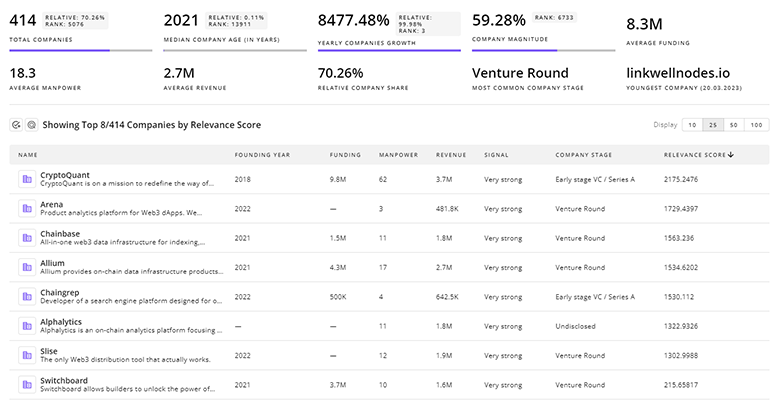
2.6K Image Recognition Companies
Discover Image Recognition Companies, their Funding, Manpower, Revenues, Stages, and much more
Image Recognition Investors
The TrendFeedr’s investors tool features data on 2.6K investors and funding activities within Image Recognition. This tool makes it easier to analyze complex investment patterns and assess market potential with thorough and up-to-date financial insights.
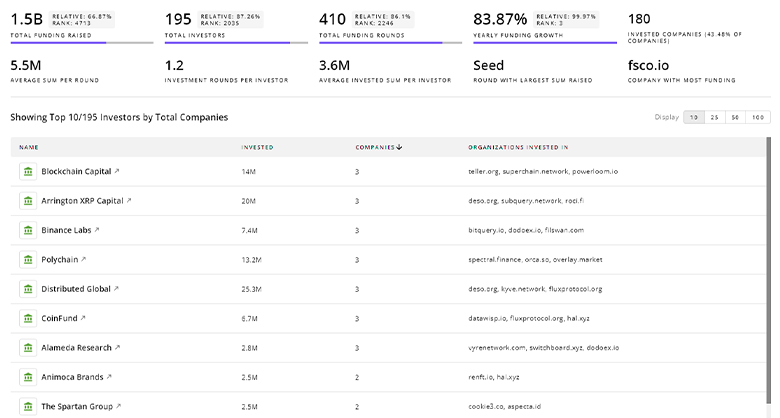
2.6K Image Recognition Investors
Discover Image Recognition Investors, Funding Rounds, Invested Amounts, and Funding Growth
Image Recognition News
Stay ahead of the curve with Trendfeedr’s News feature. The tool provides access to 6.3K Image Recognition. Navigate the current business landscape with historical and current Image Recognition data at your fingertips.

6.3K Image Recognition News Articles
Discover Latest Image Recognition Articles, News Magnitude, Publication Propagation, Yearly Growth, and Strongest Publications
Executive Summary
Image recognition has moved from a race for raw accuracy to a battle over operational context, data provenance, and deployment topology. Businesses should assess whether their use case requires scale and catalog breadth (favoring platform providers) or high-assurance, domain-specific intelligence (favoring verticalized vendors). Short to medium term, invest in edge-first inference, synthetic training pipelines, and authenticity verification to maintain regulatory compliance and reduce time-to-value. Firms that combine defensible data (unique sensors or synthetic catalogs), low-latency deployments, and clear compliance postures will capture the premium segments that generalist vision APIs cannot sustain.
If you’re an expert in trends or emerging tech, we invite you to contribute to our insights.