
Industrial Processes Report
: Analysis on the Market, Trends, and TechnologiesThe industrial processes sector is shifting from incremental efficiency to system-level redesign driven by data, circular feedstocks, and decarbonization; the internal data shows 133,598 articles on this topic, indicating large attention and heterogeneous activity across firms and geographies. Automation adoption already covers core production-process management in many plants (55% report mostly or fully automated production-process management), yet large manual gaps remain in functions such as quoting and estimating (32% manual), creating clear, monetizable opportunities for workflow intelligence and operator-assist systems. At the same time, technology and policy pressures push heavy industries to treat waste as feedstock (multiple patent filings emphasize solid-waste, waste-gas, and syngas reuse) and to integrate electrification and hydrogen pathways into process heat and reduction steps.
The last update of this report was 87 days ago. If you spot incomplete or incorrect info, please let us know.
Topic Dominance Index of Industrial Processes
The Topic Dominance Index analyzes the time series distribution of published articles, founded companies, and global search data to identify the trajectory of Industrial Processes relative to all known Trends and Technologies.
Key Activities and Applications
- Real-time process sensing and continuous monitoring (VOC, composition, temperature) to reduce safety incidents and enable closed-loop control; monitoring adoption rises as manufacturers add in-line analytics to replace slow lab sampling Industrial Filtration Market Outlook 2025 to 2035.
- Predictive maintenance and anomaly detection using edge analytics to limit unplanned downtime and compensate for labor shortages; cheaper sensors and falling sensor prices accelerate rollouts.
- Waste valorization and feedstock substitution: converting metallurgical dust, MSW, and organic residues into synthesis gas, hydrogen, or carbon-rich reductants for metalmaking and chemical loops, reducing Scope 1 emissions and raw-material costs.
- Electrification of process heat and adoption of induction or electric reactors for high-efficiency thermal steps, enabling flexible scheduling with grid-price arbitrage.
- Digital twin and scheduling for energy arbitrage and multi-feedstock flexibility: real-time digital twins enable shifting energy-intense operations to low-price intervals and rapid switch between raw material grades.
Emergent Trends and Core Insights
- Dark/few-operator plants plus automation islands: a measurable share of new plant builds target very high autonomy and night-shift-light staffing, enabled by edge control and matured sensor stacks Trends That Will Transform the Industrial Landscape in 2025 - LeverX.
- Hydrogen and internal syngas production as strategic decarbonization routes: companies exploit process off-gases and gasification of wastes to produce hydrogen or H2/CO blends for on-site reduction and heating, reducing dependence on externally produced green electricity Industrial waste can be used for clean hydrogen production.
- Observability as competitive moat: firms that reach >95% operational data fidelity create persistent advantages in predictive control and regulatory reporting; this drives large CAPEX allocations to data infrastructure and digital twins.
- Process intensification and modular reactors shorten deployment cycles: microreactors and intensified units reduce capex and site footprint while enabling faster product changeovers, favoring nimble entrants and captive chemical producers Processes, Vol. 13, Pages 3496: Analysis of Process Intensification Impact on Circular Economy in Levulinic Acid Purification Schemes.
- Regulatory tightening and market pull for emission control and filtration: industrial emission control and advanced filtration markets are forecast to grow materially as regulators tighten limits and require monitoring and real-time reporting Industrial Emission Control System Market Research Report.
Technologies and Methodologies
- Edge-native sensor fusion (spectroscopy + mass spec + fast gas sensors) for sub-second composition feedback that supports closed-loop control and PAT (process analytical technology) for chemical and specialty manufacturers.
- Induction and electric-reactor heating for high conversion efficiency (>85% reported for some inductively heated designs) and compact footprints, enabling replacement of fossil burners in many process steps Electric Reactor Could Cut Industrial Emissions.
- Pyrolysis/gasification modules integrated with DRI and metallurgical flows to convert complex wastes into H2/CO reductants or FT liquids; these chemical-recycling blocks become strategic feedstock assets rather than disposal costs.
- Physics-informed ML and hybrid digital twins (PINNs + first-principles) that reduce data needs while giving fast, explainable process models for control decisions Manufacturing and Technology Trends for North America in 2025.
- Membrane and advanced gas-separation units (H2-selective membranes) to produce high-purity reducing gases on-site and recycle byproduct streams into upstream units.
Industrial Processes Funding
A total of 38.7K Industrial Processes companies have received funding.
Overall, Industrial Processes companies have raised $1.4T.
Companies within the Industrial Processes domain have secured capital from 94.7K funding rounds.
The chart shows the funding trendline of Industrial Processes companies over the last 5 years
Industrial Processes Companies
- Indeep Solutions — A sensor and in-line analytics specialist that integrates fast spectroscopy and edge analytics for continuous composition monitoring in chemical and pulp operations. The company targets latency-sensitive control loops where lab sampling creates long corrective delays; its product set is sold as hardware plus SaaS analytics for compliance and process control.
- Sprana — Provider of ML-based anomaly detection and predictive-maintenance orchestration aimed at mid-tier heavy-industry sites. Sprana emphasizes low-code OT connectors and federated model deployment at the plant edge, reducing integrator time in retrofits of legacy PLC estates.
- Tecsense — Niche supplier of rugged, multi-parameter field nodes (gas, particulate, temperature, vibration) with built-in local inference for petrochemical and metal plants; positions its offering as an affordable path to >90% data fidelity for routine control and regulatory telemetry.
TrendFeedr’s Companies tool is an exhaustive resource for in-depth analysis of 573.3K Industrial Processes companies.
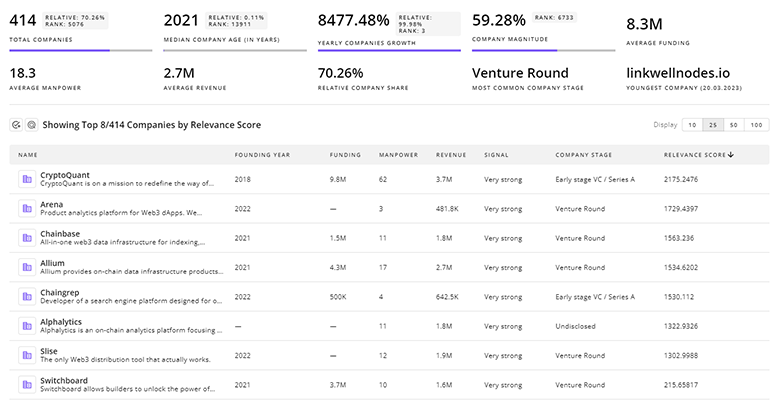
573.3K Industrial Processes Companies
Discover Industrial Processes Companies, their Funding, Manpower, Revenues, Stages, and much more
Industrial Processes Investors
The TrendFeedr’s investors tool features data on 55.9K investors and funding activities within Industrial Processes. This tool makes it easier to analyze complex investment patterns and assess market potential with thorough and up-to-date financial insights.
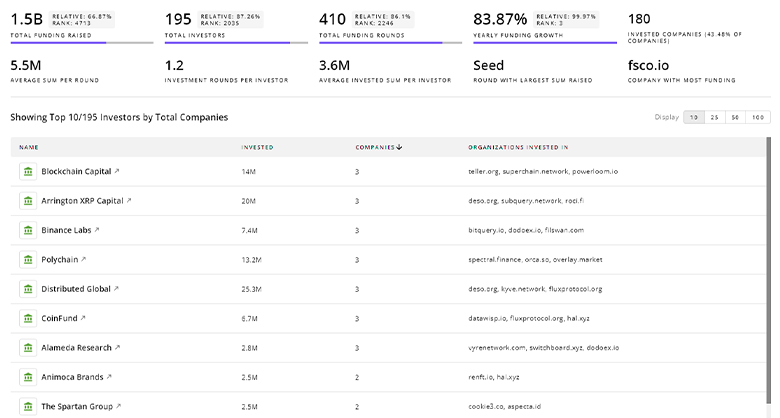
55.9K Industrial Processes Investors
Discover Industrial Processes Investors, Funding Rounds, Invested Amounts, and Funding Growth
Industrial Processes News
Stay ahead of the curve with Trendfeedr’s News feature. The tool provides access to 137.6K Industrial Processes. Navigate the current business landscape with historical and current Industrial Processes data at your fingertips.
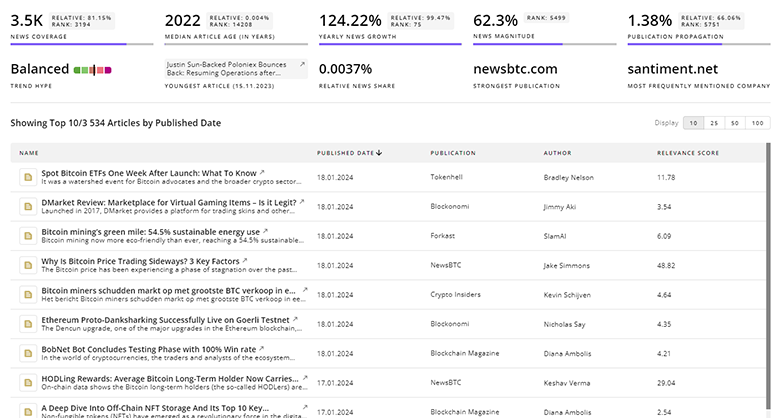
137.6K Industrial Processes News Articles
Discover Latest Industrial Processes Articles, News Magnitude, Publication Propagation, Yearly Growth, and Strongest Publications
Executive Summary
Industrial process leaders will earn durable advantage by converting waste liabilities into feedstock value, and by treating data fidelity and feedstock flexibility as strategic assets. Short-term bets that deliver measurable ROI include (1) sensor-to-edge deployments that close the manual-data gap, (2) pilot pyrolysis/gasification modules integrated with DRI or chemical loops to displace fossil reductants, and (3) digital twin projects scoped to energy arbitrage and multi-feedstock scheduling. Procurement teams should price solutions by measured operational outcomes (yield uplift, downtime avoided, energy cost savings) rather than by feature lists; R&D and deployment budgets should prioritize physically integrated pilots (sensor + control + feedstock module) because the technical moat now sits at process interfaces rather than inside single pieces of equipment.
If you’re an expert in trends or emerging tech, we invite you to contribute to our insights.