
Liquid Nitrogen Report
: Analysis on the Market, Trends, and TechnologiesThe liquid nitrogen market sits at a clear inflection point: global demand is steady and shifting from pure commodity delivery toward localized, application-driven supply—total market revenue reached USD 20.4 billion in 2024 and is projected to reach USD 32.0 billion by 2033 at an expected CAGR of 4.89%, reflecting rising use in cryopreservation, semiconductor cooling, and industrial quenching. The strategic implication is straightforward: firms that reduce distribution cost, guarantee ultra-high purity, and deliver deterministic on-site supply will capture the highest margin growth as end users prioritize supply continuity, purity, and carbon intensity.
Our latest update of this report was 346 days ago. If you found a mistake or missing information, tell us!
Topic Dominance Index of Liquid Nitrogen
The Topic Dominance Index evaluates Liquid Nitrogen's significance by analyzing data on the distribution of news articles that mention Liquid Nitrogen, the timeline of newly founded companies working in this sector, and global search trends
Key Activities and Applications
Cryopreservation and biobanking — LN2 is the standard for long-term storage of cells, tissues, vaccines and stem-cell stocks; scale and purity requirements are rising as biobanks and cell-therapy manufacturers expand capacity, increasing demand for secured supply chains and monitored storage systems.
So what: Buyers pay premiums for validated medical-grade LN2 and monitoring services; sellers that combine generation + validated cold-chain monitoring realize higher lifetime customer value.
Semiconductor and electronics cooling — LN2 supports rapid thermal cycling, chamber purge and ultra-low temperature tests in advanced node fabs; demand follows wafer-fab expansions in Asia and Korea.
So what: Electronic-grade purity and jitter-free delivery windows create opportunity for on-site, ultra-pure generation units and premium service contracts.
Metal treatment, quenching and precision machining — LN2 enables shrink-fit assemblies and cryogenic tempering to improve hardness and tolerances, particularly in aerospace and automotive supply chains.
So what: Large industrial users prefer tonnage storage or on-site tonnage generation to cut logistics and boil-off cost.
Food processing and rapid freezing — flash-freezing preserves quality and opens distribution channels for higher-value frozen products; the food segment remains one of the fastest growing end uses grandviewresearch.com.
So what: Smaller, distributed packaging customers demand microdosing and cylinder solutions; suppliers that offer modular filling and dosing systems win share.
Industrial inerting, pipeline freezing and specialty utilities — LN2 supports inert atmospheres, freeze-plugging of lines, and precise temperature control in chemical processing.
So what: Episodic but mission-critical uses drive demand for rapid-response logistics and trained service teams; these services generate recurring revenue beyond product sales.
Emergent Trends and Core Insights
On-site and modular generation accelerates adoption — customers shift from frequent bulk deliveries to PSA/membrane or compact cryogenic generators to reduce logistics costs and guarantee purity and uptime.
So what: Equipment vendors that bundle financing, maintenance and performance SLAs will outcompete pure commodity suppliers.
Precision dosing and microdosing systems — microdosing for packaging and lab-scale applications reduces LN2 consumption and enables new product formats (single-serve foods, lab reagents).
So what: Pricing moves from $/L to $/effective-dose; providers that instrument dosing reduce customer consumption and lock in long-term service revenue.
Integration of IoT and remote monitoring — sensors for level, temperature, boil-off and leak detection become standard for pharma and biobanking customers.
So what: Data enables predictive refills and reduces catastrophic inventory loss; analytics and telematics become sellable features.
Energy-efficiency and use of waste cold energy — co-locating LN2 production with LNG or waste-cold sources improves energy intensity and lowers cost per liter [Patent and industry filings summarized in the corpus show methods using LNG cold energy].
So what: New plant designs and partnerships with LNG/logistics players reduce operating cost and carbon footprint; this influences project payback and plant siting.
Regional demand tilt to Asia-Pacific — volume growth concentrates in APAC because of electronics, food processing and pharmaceuticals build-out.
So what: Established suppliers must expand depot and tonnage storage in APAC; local on-site generation vendors find large addressable markets.
Technologies and Methodologies
Cryogenic distillation (ASU + liquefaction) — remains the primary industrial route for high-purity LN2 and dominates large-scale supply.
Significance: Best for tonnage customers; capital-intensive but lowest unit cost at scale.
Pressure Swing Adsorption (PSA) and membrane generation — compact, lower CAPEX systems enable on-site gaseous nitrogen; paired with small-scale liquefiers they deliver local LN2 gminsights.com.
Significance: Economics favor medium users who trade fuel/energy for reduced logistics.
Tonnage-scale insulated storage and vacuum-jacketed piping — advances reduce boil-off and enable multi-day buffering between liquefaction and point-of-use.
Significance: Operational savings compound for 24/7 industrial users.
Precise dosing hardware and cryogenic valves/nozzles — engineered microdosing systems improve safety and reduce consumption in packaging and lab applications marketresearch.com.
Significance: Allows service providers to convert small volume customers into long-term accounts.
IoT, telemetry and cloud monitoring — remote alarms, predictive refill scheduling and regulatory compliance logging are emerging as value-added services for medical and biotech clients researchandmarkets.com.
Significance: Differentiates suppliers on reliability and reduces customers' operational risk.
Liquid Nitrogen Funding
A total of 85 Liquid Nitrogen companies have received funding.
Overall, Liquid Nitrogen companies have raised $2.2B.
Companies within the Liquid Nitrogen domain have secured capital from 234 funding rounds.
The chart shows the funding trendline of Liquid Nitrogen companies over the last 5 years
Liquid Nitrogen Companies
- Noblegen Cryogenics — Offers compact on-site LN2 generators targeted at research labs and small biotechs; product designs emphasize rapid install and low footprint. The company positions itself on serviceability and lab safety integration, addressing customers that cannot tolerate delivery gaps.
- NITROCRETE — Applies LN2 in concrete cooling to control set temperatures for high-strength pours; their automated dosing systems enable predictable thermal profiles on large pours and reduce cracking risk. This application converts LN2 from a niche tool into a process control lever for certain construction projects.
- SpectraCryo — Produces specialty insulated dewars and vacuum-jacketed piping with integrated sensors for large-scale biobanks; focus is on minimizing boil-off and compliant logging for regulated customers. Their product strategy sells both hardware and telemetry subscriptions.
- NitrexGas — Mid-market LN2 supplier that bundles modular tonnage tanks and short-term leasing for manufacturers with seasonal peaks; offers rapid swap programs and localized logistics to lower total cost of ownership for regional industrial users.
- 4Cryo — Developer of precision LN2 microdosing systems and automated filling lines for food-packaging and single-serve consumer products; their systems reduce LN2 consumption per SKU and shorten changeover times, attractive for co-packers scaling niche frozen foods.
Explore comprehensive profiles of 1.1K companies shaping the future of Liquid Nitrogen with TrendFeedr's Companies feature.
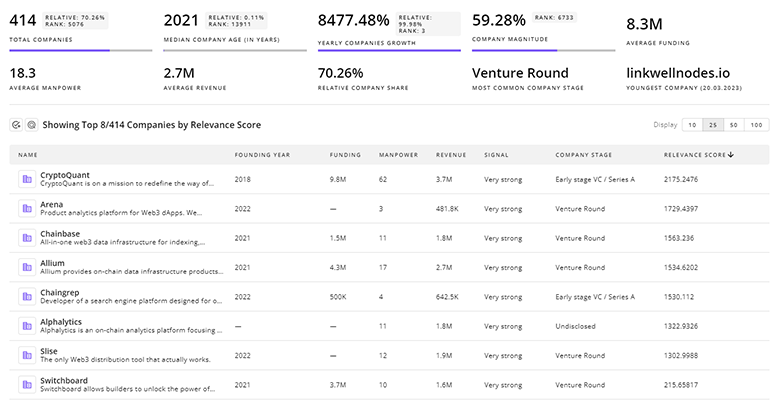
1.1K Liquid Nitrogen Companies
Discover Liquid Nitrogen Companies, their Funding, Manpower, Revenues, Stages, and much more
Liquid Nitrogen Investors
TrendFeedr’s Investors tool allows you to explore detailed investment activities and trends based on 206 Liquid Nitrogen investors. This tool provides an in-depth analysis of funding rounds and market dynamics to make informed investment decisions.
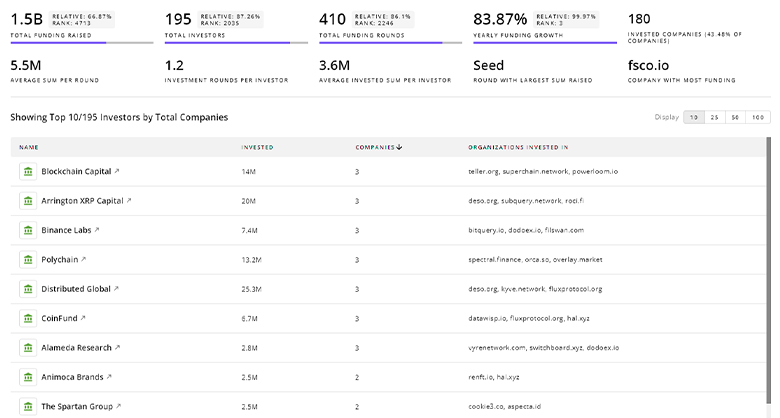
206 Liquid Nitrogen Investors
Discover Liquid Nitrogen Investors, Funding Rounds, Invested Amounts, and Funding Growth
Liquid Nitrogen News
Stay updated with TrendFeedr’s News feature, which offers you access to 3.4K Liquid Nitrogen articles. This tool provides you with a comprehensive understanding of the historical and current trends shaping the market.
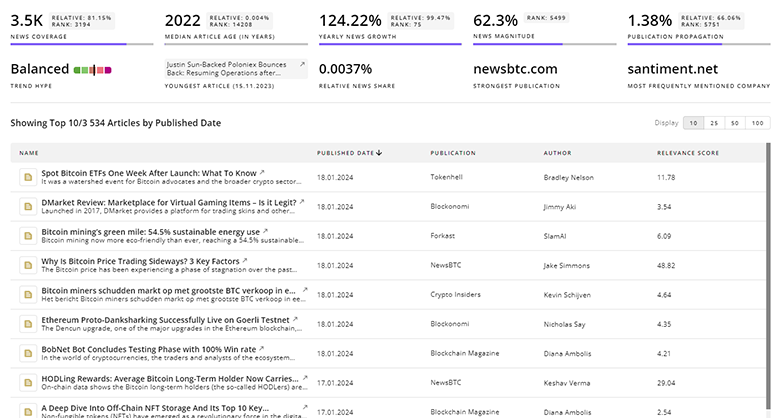
3.4K Liquid Nitrogen News Articles
Discover Latest Liquid Nitrogen Articles, News Magnitude, Publication Propagation, Yearly Growth, and Strongest Publications
Executive Summary
Liquid nitrogen demand will expand as medical, electronics and food sectors require larger volumes and higher reliability. The salient commercial play is service-led supply: on-site generation, instrumented storage, and dosing systems convert a commodity into a managed utility with recurring revenue and stickiness. Firms should prioritize three moves now — (1) segment customers by volume/purity to select on-site versus bulk economics, (2) bundle telemetry and SLAs for regulated users to capture premium margins, and (3) form partnerships to tap waste-cold or renewable energy to reduce operating cost and accelerate plant payback. These steps convert projected market growth into defensible commercial positions.
We’re keen to partner with subject matter experts to enrich our coverage. Think you can help? Let us know.