Machine Learning Cybersecurity Report
: Analysis on the Market, Trends, and TechnologiesThe machine learning cybersecurity market sits at a clear inflection: the internal trend data values the market at USD 26.29 billion in 2024 and projects a strong compound annual growth rate of 19.5 percent, implying aggressive expansion through the decade. Market intelligence from independent research aligns with rapid growth assumptions and highlights widespread enterprise adoption for anomaly detection, malware detection, and automated response—use cases that dominate vendor road maps and buyer spend decisions market_us – 2024 marketresearchfuture – 2025.
We last updated this report 361 days ago. Tell us if you find something’s not quite right!
Topic Dominance Index of Machine Learning Cybersecurity
To gauge the impact of Machine Learning Cybersecurity, the Topic Dominance Index integrates time series data from three key sources: published articles, number of newly founded startups in the sector, and global search popularity.
Key Activities and Applications
- Behavioral and anomaly detection: continuous profiling of users, endpoints, and services to surface deviations that signal insider threats or lateral movement statista – 2024.
- Automated incident investigation and response: agentic and orchestration systems that triage alerts, collect evidence, and execute containment actions to reduce mean-time-to-detect and mean-time-to-respond technologyreview – 2022.
- Predictive threat intelligence and predictive blocking: models that identify malicious infrastructure, campaigns, and compromise indicators before operational impact marketresearchfuture – 2025 thebusinessresearchcompany – 2025.
- ML-driven vulnerability discovery and prioritized remediation: automated SAST/DAST triage and predictive vulnerability scoring to focus engineering effort on exploitable issues ml4cyber.com.
- AI model protection and governance: detection of data poisoning, inference attacks, and model-extraction attempts plus policy layers to govern LLM/GenAI usage inside enterprises HiddenLayer PromptArmor.
Emergent Trends and Core Insights
- Edge and embedded ML for low-latency detection: organizations deploy lightweight models on IoT and gateway devices to reduce telemetry volume and detect local compromise faster.
- Platform consolidation around AI stacks: buyers favor integrated platforms that combine detection, XDR/XPR telemetry, SOAR automation, and AI-model governance; single-function vendors must prove deep integration value or partner tightly with platform providers Deep Instinct.
- Adversarial-threat escalation and defensive hardening: adversarial examples, data poisoning, and model probing force vendors to include adversarial testing, honeypots, and continuous model validation in product road maps.
- LLM and generative AI as both tool and attack vector: enterprises adopt LLMs for security automation and reporting while new vendor categories emerge to detect prompt injection, data exfiltration, and unsafe model behavior.
- Federated and privacy-preserving training for cross-organization threat models: federated approaches enable shared detection capabilities without exposing raw telemetry, important for regulated industries and multi-tenant MSSPs.
Technologies and Methodologies
- Deep neural networks for file, binary, and telemetry classification: deep learning enables detection of novel malware patterns and zero-day signals in raw inputs technologyreview – 2022.
- Unsupervised and self-supervised anomaly detection: these methods expose unknown threats without labeled attack data and reduce reliance on signatures.
- Graph neural networks and knowledge graphs: graph analytics link identity, process, and network events to reveal lateral movement and coordinated campaigns cybermonic.com.
- Federated learning and differential privacy: enable cross-tenant model improvements for MSSPs and consortia while limiting sensitive data exposure.
- Adversarial testing, continuous model evaluation, and ML-specific MLOps: integrate adversarial example generation, poisoning detection, and automated retraining into CI/CD for secure model lifecycle management.
Machine Learning Cybersecurity Funding
A total of 397 Machine Learning Cybersecurity companies have received funding.
Overall, Machine Learning Cybersecurity companies have raised $29.9B.
Companies within the Machine Learning Cybersecurity domain have secured capital from 1.2K funding rounds.
The chart shows the funding trendline of Machine Learning Cybersecurity companies over the last 5 years
Machine Learning Cybersecurity Companies
- CounterShadow — CounterShadow builds an agentic AI platform that autonomously triages, investigates, and responds to alerts in seconds, delivering SOC automation that reduces human investigation loads and alert backlog; the product targets MSSPs and enterprises that need fast, autonomous triage.
- Computed Future — Computed Future focuses on predictive attack-path modeling for cloud and endpoint workloads, using behavioral patterns to identify likely attacker tactics before they execute; the company emphasizes early warning and context-driven prioritization for security teams.
- Salem Cyber — Salem offers an AI-based virtual analyst that runs large-scale, tiered investigations across noisy alert sets to surface true incidents; the offering increases SOC throughput and recovers detections that would otherwise remain uninvestigated.
- SecLytics — SecLytics delivers patented predictive intelligence that feeds SIEM and enforcement points with preemptive blocking decisions, enabling a proactive first line of defense against newly activated malicious infrastructure.
- Pinewheel Labs — Pinewheel applies LLMs and advanced NLP to automated penetration testing and red-team workflows, offering an AI-assisted pentest copilot that accelerates vulnerability discovery and produces ready-to-act remediation insights for security teams.
Enhance your understanding of market leadership and innovation patterns in your business domain.
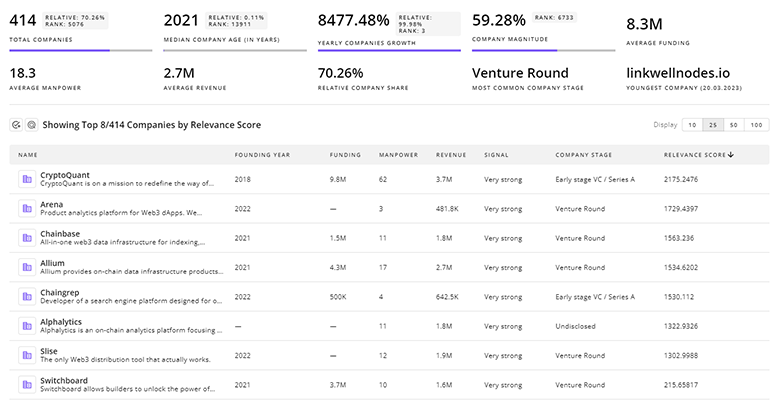
3.6K Machine Learning Cybersecurity Companies
Discover Machine Learning Cybersecurity Companies, their Funding, Manpower, Revenues, Stages, and much more
Machine Learning Cybersecurity Investors
TrendFeedr’s Investors tool offers comprehensive insights into 1.3K Machine Learning Cybersecurity investors by examining funding patterns and investment trends. This enables you to strategize effectively and identify opportunities in the Machine Learning Cybersecurity sector.
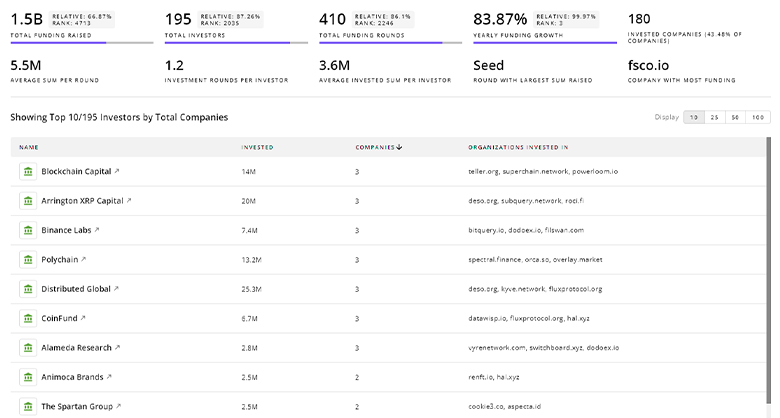
1.3K Machine Learning Cybersecurity Investors
Discover Machine Learning Cybersecurity Investors, Funding Rounds, Invested Amounts, and Funding Growth
Machine Learning Cybersecurity News
TrendFeedr’s News feature provides access to 4.0K Machine Learning Cybersecurity articles. This extensive database covers both historical and recent developments, enabling innovators and leaders to stay informed.
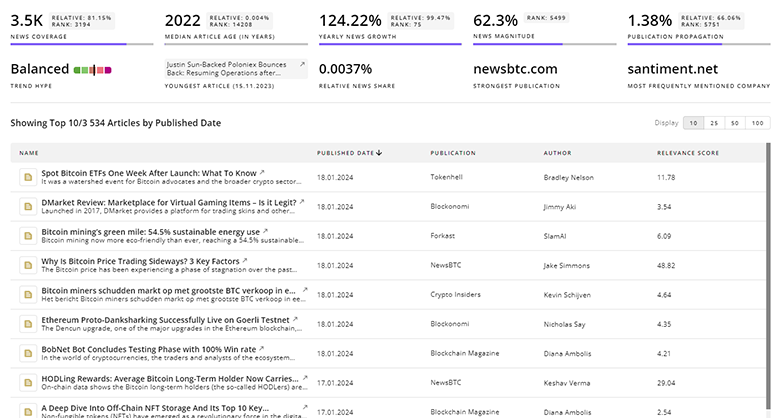
4.0K Machine Learning Cybersecurity News Articles
Discover Latest Machine Learning Cybersecurity Articles, News Magnitude, Publication Propagation, Yearly Growth, and Strongest Publications
Executive Summary
Adoption of machine learning in cybersecurity will continue to expand quickly, driven by measurable business needs: faster detection, lower false positives, and scaled incident response. The internal market projection (USD 26.29 billion in 2024 with a 19.5 percent CAGR) signals a buyer shift toward AI-first security investments that combine predictive intelligence, SOC automation, and model governance. Strategic winners will either deliver integrated AI platforms that reduce operational complexity for security teams or supply tightly focused AI components that embed into those platforms via well-documented APIs. Defenders must treat protections for their own ML assets as a core security domain—embedding adversarial testing and continuous evaluation into MLOps—and adopt privacy-preserving collaboration models (for example federated learning) to broaden detection capabilities without exposing sensitive telemetry. The commercial opportunity favors providers that can prove measurable reductions in detection latency and analyst load while demonstrating resilient model behavior under adversarial conditions.
We value collaboration with industry professionals to offer even better insights. Interested in contributing? Get in touch!