
Noise Reducer Report
: Analysis on the Market, Trends, and TechnologiesThe noise reducer market sits at a measurable inflection where software intelligence and targeted materials both capture value; market analysis shows a 5.0% baseline CAGR for noise-mitigation systems that frames near-term budget planning for buyers and suppliers. Software-first segments are already driving outsized unit economics—enterprise voice AI vendors process enormous volumes (one provider reports 75 billion minutes processed per month) and drive clear contact-center metrics—while hardware and passive markets continue to deliver high-percentage attenuation in regulated settings (windows and enclosures reporting 75–95% reduction). Parallel market studies confirm the scale split: industrial noise control accounted for roughly USD 2.31 billion in 2025 and is tracking incremental growth, while online audio denoising software was estimated at USD 563 million in 2024 with an 8.1% CAGR projected to 2032 Fortune Business Insights – Industrial Noise Control Market. The strategic imperative is clear: firms that embed low-latency, low-power acoustic intelligence into devices, cloud platforms, or regulatory workflows will capture the recurring revenue and data moats that commodity materials cannot sustain.
We last updated this report 260 days ago. Tell us if you find something’s not quite right!
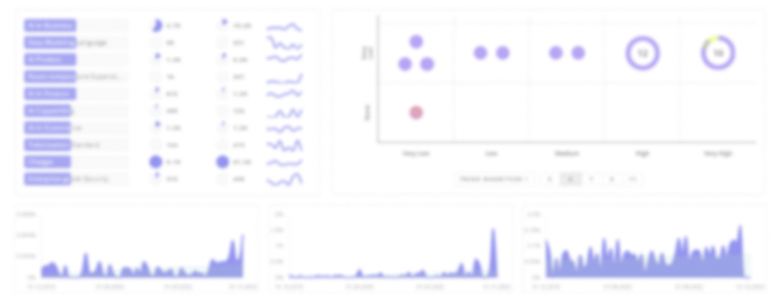
Topic Dominance Index of Noise Reducer
To gauge the impact of Noise Reducer, the Topic Dominance Index integrates time series data from three key sources: published articles, number of newly founded startups in the sector, and global search popularity.
Key Activities and Applications
- Industrial equipment attenuation and enclosures — design and deployment of modular enclosures, silencers, and vibration mounts for manufacturing, power generation, and heavy machinery; typical industrial solutions target operator exposure reduction and regulatory compliance.
- Real-time environmental noise monitoring — deployment of IoT sensor networks and cloud dashboards for cities, airports, and construction sites to provide continuous compliance evidence and event detection; this activity shifts noise management from episodic surveys to continuous operations.
- Speech-centric audio cleansing (communication layer) — low-latency AI engines embedded in headsets, UC platforms, and call-centers that suppress background sound while preserving intelligibility; these systems deliver direct CX metrics (fewer complaints, higher CSAT, lower handling time) and scale via SDK/licensing.
- Active surface conversion — converting surfaces (windows, panels) into active cancellation devices that emit anti-phase signals to block transmitted noise, enabling quieter interiors without massive physical barriers.
- Health and personal hearing augmentation — mobile and wearable software that isolates speech or boosts target voices for people with hearing difficulty or for use in noisy clinical and service environments; local, real-time processing and privacy-preserving execution are common design constraints NeuralEar.
- Niche environmental mitigation (marine, wind energy) — specialized engineering to reduce acoustic impacts on wildlife and to lower broadband tonal noise from renewable energy infrastructure (e.g. blade add-ons, pile-driving mitigation) Marine Construction Technologies.
Emergent Trends and Core Insights
- From blanket cancellation to selective perception — research prototypes and commercial R&D now enable systems that choose which sounds to suppress and which to pass through (semantic hearing, target-voice enrollment), shifting product value toward user-controlled hearing experiences Technology Review – Noise Canceling Headphones, 2024.
- Software-first monetization and data moats — AI/ML engines that run on-device or at the edge accumulate labeled acoustic contexts and usage telemetry; large-scale deployments (enterprise voice platforms) convert usage into continuous model improvement and retention metrics Krisp.
- Hybrid active-passive architectures — commercial solutions increasingly integrate passive material science (metamaterials, MPP panels) with active cancellation and adaptive filters to extend effective low-frequency performance without prohibitive power draw DeNoize.
- Regulation-driven procurement and RCaaS models — municipalities and industrial operators prefer continuous monitoring as a service that produces auditable records for enforcement and permitting; this turns monitoring vendors into long-term service providers rather than one-off equipment sellers.
- Edge efficiency and model compression — field prototypes demonstrate knowledge distillation and microcontroller-level inference are viable for earbuds and hearing aids, enabling target-speaker extraction and low-latency adaptation on battery-limited devices.
- Sustainability as a procurement filter — projects increasingly require low-VOC materials, circular supply chains, and renewable raw-material acoustic barriers; suppliers that document lifecycle benefits gain preference in public tenders and infrastructure projects.
Technologies and Methodologies
- AI-driven real-time denoising engines — low-latency models (distilled student networks, GRU/CNN hybrids) that perform separation, denoising, and speech restoration on-device or at the edge for conferencing and hearables Applied Sciences; OS-Denseformer study.
- Beamforming and super-directional microphones — multi-mic arrays and super-directional designs that increase target SNR before algorithmic processing, improving performance in crowded acoustic scenes.
- Active Noise Cancellation at scale — networked ANC arrays and active panels that create controllable sound fields for cabins, rooms, and outdoor mitigation, paired with sensor feedback loops for adaptive cancellation Silentium Ltd..
- Micro-Perforated Plate (MPP) and metamaterials — precision-machined MPP panels and acoustic metamaterials deliver passive low-frequency attenuation with reduced flow resistance, enabling HVAC and duct silencers that minimize pressure drop Redu-Sone.
- Acoustic holography and 3D sound-field mapping — spatial imaging for source diagnosis and targeted mitigation in automotive, aerospace, and industrial settings AncSonic.
- Sensing + Analytics platforms (RCaaS) — IoT sensor fleets, AI event classification, and regulatory dashboards convert raw sound measurements into compliance workflows and prescriptive mitigation plans NoiseNet.
- Generative speech restoration — models that recover masked or distorted speech content rather than simply suppressing background noise, elevating perceived audio quality for professional communications and transcripts.
Noise Reducer Funding
A total of 350 Noise Reducer companies have received funding.
Overall, Noise Reducer companies have raised $5.9B.
Companies within the Noise Reducer domain have secured capital from 1.1K funding rounds.
The chart shows the funding trendline of Noise Reducer companies over the last 5 years
Noise Reducer Companies
- Deep Hearing — Deep Hearing offers AI-based signal processing SDKs, APIs, and chipset algorithms that integrate beamforming, noise reduction, and echo cancellation into TWS earbuds, hearing protectors, and telephony endpoints. Their product set emphasizes embedding acoustic intelligence at the device level so that clients avoid building custom hardware. The company’s approach targets partners that need a lightweight, integrable SDK to raise speech intelligibility across constrained platforms. Deep Hearing brings a pragmatic path to deployment by combining algorithmic IP with integration services.
- MuTech — MuTech supplies blade add-ons that reduce wind turbine trailing-edge noise by 6 dB while claiming improved annual energy production through aerodynamic tuning. The firm focuses on custom, anisotropic permeability solutions tailored to specific turbine geometries, which aligns noise mitigation with operational KPIs. Their model sells engineering upgrades to turbine OEMs and operators who need measurable environmental improvements without large platform changes.
- RissoAi — RissoAi provides an AI monitoring SaaS that classifies, scores, and reports environmental noise events to support regulatory compliance and community engagement. The platform emphasizes automated event detection and continuous analytics, replacing periodic surveys with always-on evidence streams that simplify permitting and enforcement actions. RissoAi targets municipalities, construction managers, and large sites that must document noise impact with high temporal resolution.
- Revoize — Revoize develops Generative Speech Restoration for real-time communications, aiming to restore clarity in distorted or noisy calls rather than only subtracting background sound. Its positioning targets cloud-phone providers and conferencing platforms that need a quality uplift for enterprise voice, with a licensing model built around SDKs and platform integrations. The company’s generative approach competes on perceptual quality and can reduce the need for downstream human post-processing of transcripts.
- REEDuce – noise protection technologies — REEDuce manufactures ecological noise barriers from reed, thermowood, and clay that prioritize circular materials and habitat co-benefits. Their barrier systems are intended for road and local-source mitigation where sustainability and community acceptance matter; the solution appeals to municipalities and developers seeking lower-carbon alternatives to conventional concrete or polymer walls. REEDuce’s narrative is built on combining acoustic attenuation with regenerative materials and simple installation methods.
Enhance your understanding of market leadership and innovation patterns in your business domain.
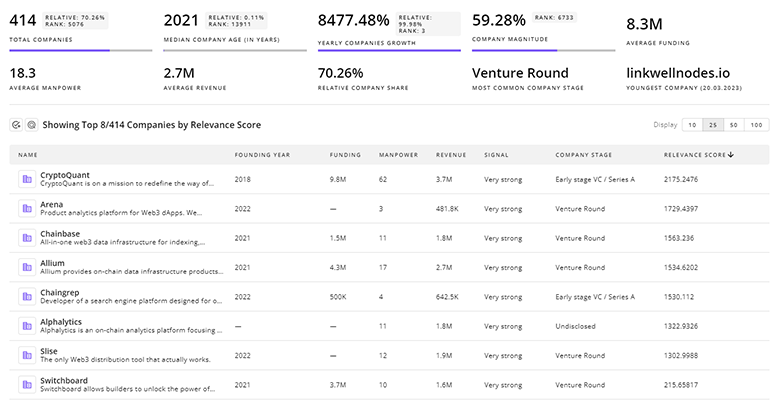
4.4K Noise Reducer Companies
Discover Noise Reducer Companies, their Funding, Manpower, Revenues, Stages, and much more
Noise Reducer Investors
TrendFeedr’s Investors tool offers comprehensive insights into 1.2K Noise Reducer investors by examining funding patterns and investment trends. This enables you to strategize effectively and identify opportunities in the Noise Reducer sector.
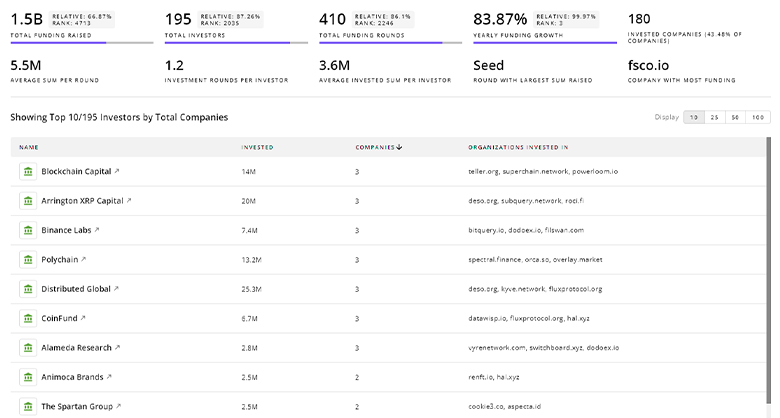
1.2K Noise Reducer Investors
Discover Noise Reducer Investors, Funding Rounds, Invested Amounts, and Funding Growth
Noise Reducer News
TrendFeedr’s News feature provides access to 10.7K Noise Reducer articles. This extensive database covers both historical and recent developments, enabling innovators and leaders to stay informed.

10.7K Noise Reducer News Articles
Discover Latest Noise Reducer Articles, News Magnitude, Publication Propagation, Yearly Growth, and Strongest Publications
Executive Summary
Noise reduction is bifurcating into two durable opportunities: algorithmic, data-driven audio intelligence embedded in communications and consumer devices, and engineered physical systems that meet strict regulatory and ecological requirements. Financial and patent signals show accelerating adoption of AI inference on edge devices and steady, targeted investment in metamaterials and MPP passive systems. For buyers and investors the practical choices are clear: prioritize partners that offer low-latency, low-power acoustic models with proven integration pathways into existing platforms, or select material-science vendors that prove lifecycle and regulatory advantages in infrastructure procurement. The firms that combine measurable acoustic outcomes with measurable business outcomes—lower fines, improved CX metrics, energy or operational gains—will convert technical advantage into durable commercial value.
We value collaboration with industry professionals to offer even better insights. Interested in contributing? Get in touch!