
Non-invasive Liquid Biopsy Report
: Analysis on the Market, Trends, and TechnologiesThe non-invasive liquid biopsy market is accelerating as a clinical and commercial priority, with the internal trend data projecting a market value of USD 8,772,300,000 and a sector CAGR of 20.60%, underlining rapid revenue expansion and technology adoption in the near term. External market reports present a range of trajectories—from conservative six- to eight-year growth rates to multi-billion projections for MCED and MRD use cases—highlighting that while methodology and regional uptake differ, the consensus is significant market growth driven by multi-omics assays, AI analytics, and expanding clinical applications Non-Invasive Liquid Biopsy Market Size & Outlook, 2025-2033.
We last updated this report 320 days ago. Tell us if you find something’s not quite right!
Topic Dominance Index of Non-invasive Liquid Biopsy
To gauge the impact of Non-invasive Liquid Biopsy, the Topic Dominance Index integrates time series data from three key sources: published articles, number of newly founded startups in the sector, and global search popularity.
Key Activities and Applications
- Early multi-cancer screening (MCED): blood-based assays that screen for dozens of tumour types are the highest strategic priority for platform builders and payers given the potential population screening opportunity Liquid Biopsy Market Size to Hit USD 22.69 Billion by 2034.
- Minimal residual disease (MRD) surveillance: ultra-sensitive ctDNA assays for relapse detection and adjuvant therapy guidance represent near-term clinical utility and commercial pathways; specialist MRD firms position assays to detect tumor DNA at parts-per-million sensitivity for post-treatment monitoring Foresight Diagnostics.
- Therapy selection and resistance tracking: serial liquid biopsies inform targeted therapy selection and reveal emergent resistance mutations faster than tissue workflows, improving time to treatment decisions in lung and other cancers Liquid Biopsy Market Size & Growth Forecast to 2030.
- Organ-specific and hard-to-biopsy diagnostics: tests aimed at pancreatic, gastric, ovarian, and other hard-to-screen cancers provide focused clinical pathways with clearer validation endpoints than broad MCED early on Global Breast Cancer Liquid Biopsy Market Size, Share, and Trends Analysis Report – Industry Overview and Forecast to 2032.
- Alternative biofluid screening and point-of-care: urine, sputum, and saliva tests target primary-care workflows and community screening where blood-based NGS is impractical Global Non-Invasive Liquid Biopsy Market – Bis Research.
Emergent Trends and Core Insights
- Multi-omic, multimodal diagnostics are displacing single-analyte tests: integrating cfDNA mutation, methylation, fragmentomics, RNA/miRNA, proteins, and EV cargo yields higher sensitivity and tissue-of-origin resolution required for early detection and MRD.
- RNA and epigenetic signals gain precedence for early-stage detection: investigators and startups shift to methylation and RNA/miRNA signatures because mutation-based ctDNA alone struggles at low tumor fractions in stage I disease Liquid biopsy test uses RNA modifications to detect early-stage colorectal cancer with 95% accuracy.
- Upstream sample handling and yield enhancement emerge as choke points: patent activity and early-stage engineering emphasize high-yield extraction, stabilization, and targeted sampling devices because preanalytical loss limits sensitivity and reproducibility.
- Decentralization and faster time-to-result create a bifurcated market: centralized NGS-heavy MRD/companion diagnostic workflows coexist with lower-cost PCR/ddPCR, microfluidic, or biosensor approaches for community screening and point-of-care testing.
- Data assets and AI models form the strategic moat: competitive advantage accrues to players that combine large, ethnically diverse clinical cohorts with validated ML models that reduce false positives and support payer conversations.
Technologies and Methodologies
- Next-generation sequencing (NGS) with targeted methylation panels and high-depth coverage for MRD and MCED use cases; NGS remains the backbone for multi-analyte assays requiring broad genomic context.
- Digital PCR and droplet digital PCR (ddPCR) for ultra-sensitive quantification of known variants in MRD or therapy monitoring where bespoke, rapid readouts matter.
- Microfluidic capture and lab-on-chip sample prep to increase yield for rare analytes (CTCs, EVs) and enable decentralized workflows LMNTIC Biotech.
- EV and exosome isolation plus proteomic cargo analysis as an orthogonal biomarker strategy that improves specificity and tissue context for hard-to-detect cancers Exosome Analytics.
- Computational biology and AI pipelines that integrate longitudinal ctDNA kinetics, methylation patterns, and clinical metadata to produce actionable clinical calls for screening, MRD, and therapy decisions.
Non-invasive Liquid Biopsy Funding
A total of 321 Non-invasive Liquid Biopsy companies have received funding.
Overall, Non-invasive Liquid Biopsy companies have raised $18.4B.
Companies within the Non-invasive Liquid Biopsy domain have secured capital from 1.6K funding rounds.
The chart shows the funding trendline of Non-invasive Liquid Biopsy companies over the last 5 years
Non-invasive Liquid Biopsy Companies
-
Lipidica, a.s.
Lipidica develops a lipidomics-based liquid biopsy focused on early pancreatic cancer detection and runs IVDR-style clinical validation studies to demonstrate performance in a high-mortality indication. Their LDPC lipidomic test targets a narrow, high-value clinical use case where sensitivity gains translate to clear medical benefit and easier payer conversations than broad MCED approaches. -
Onco Filtration, Inc.
Onco Filtration offers a proprietary filtration platform (Onco Capture™) that claims massively higher circulating tumor cell capture throughput relative to legacy systems, which can materially improve downstream CTC-based sequencing and cell analysis. That capture capability positions the company as an enabling supplier for clinical labs and platform builders that need higher input material for CTC-centric assays. -
EXIT071
EXIT071 commercializes microfluidic EV isolation and high-purity exosome workflows that reduce noise in downstream proteomic and nucleic acid assays. Their dzITP microfluidic approach addresses a common bottleneck for EV diagnostics and offers an integratable front end for multi-omic liquid biopsy pipelines. -
Cleancard
Cleancard targets at-home urine screening for prostate, bladder, and ovarian cancer using synthetic-biology readouts and AI analysis to provide 30-minute results, aiming to lower access barriers and move certain screening workflows into primary care or home collection channels. -
miRoncol
miRoncol develops an miRNA-based, PCR-compatible screening panel for a dozen solid tumors optimized for low cost and broad deployment using existing PCR infrastructure. The strategy reduces capital intensity for deployment while focusing on a validated biomarker class that scales in population screening.
Enhance your understanding of market leadership and innovation patterns in your business domain.
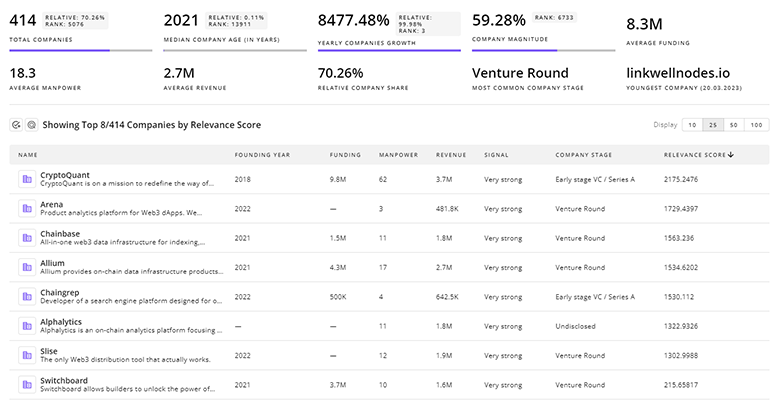
789 Non-invasive Liquid Biopsy Companies
Discover Non-invasive Liquid Biopsy Companies, their Funding, Manpower, Revenues, Stages, and much more
Non-invasive Liquid Biopsy Investors
TrendFeedr’s Investors tool offers comprehensive insights into 1.6K Non-invasive Liquid Biopsy investors by examining funding patterns and investment trends. This enables you to strategize effectively and identify opportunities in the Non-invasive Liquid Biopsy sector.
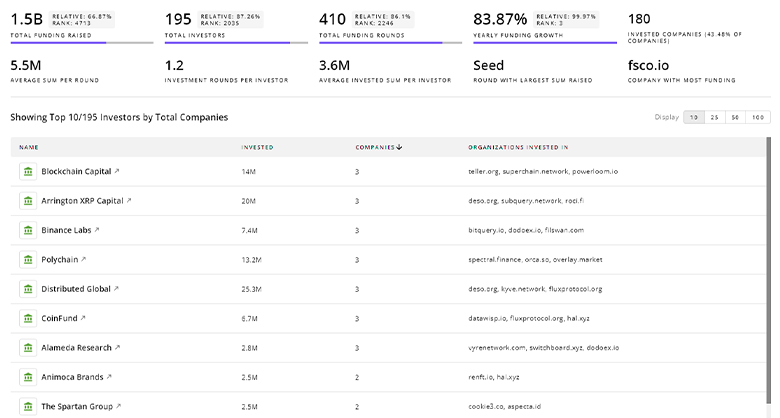
1.6K Non-invasive Liquid Biopsy Investors
Discover Non-invasive Liquid Biopsy Investors, Funding Rounds, Invested Amounts, and Funding Growth
Non-invasive Liquid Biopsy News
TrendFeedr’s News feature provides access to 2.7K Non-invasive Liquid Biopsy articles. This extensive database covers both historical and recent developments, enabling innovators and leaders to stay informed.
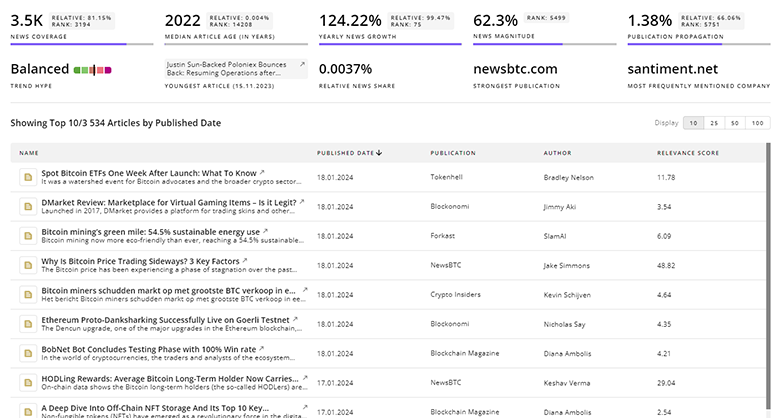
2.7K Non-invasive Liquid Biopsy News Articles
Discover Latest Non-invasive Liquid Biopsy Articles, News Magnitude, Publication Propagation, Yearly Growth, and Strongest Publications
Executive Summary
The available data show a sector in commercial ascent with two simultaneous near-term opportunities: (1) high-value, narrowly focused diagnostics for specific, high-mortality cancers where a validated signal achieves clinical adoption; and (2) scalable, multi-omic screening and MRD platforms that require large clinical cohorts and sophisticated AI models to win reimbursement. Technical bottlenecks concentrate upstream in sample yield and preanalytical standardization, so suppliers that solve capture and stabilization will become acquisition targets. Strategically, companies should choose either to build a defensible data asset (broad, longitudinal cohorts plus ML) or to become indispensable ingredient suppliers (high-yield capture, EV isolation, ultra-sensitive assays). Payers will demand demonstrated, stage-specific sensitivity and health-economic evidence; therefore near-term commercial success will favor focused, clinically validated indications and interoperable technologies that integrate into existing laboratory and clinical workflows.
We value collaboration with industry professionals to offer even better insights. Interested in contributing? Get in touch!