
Nuclear Technology Report
: Analysis on the Market, Trends, and TechnologiesThe nuclear technology sector shows clear commercial momentum: the internal trend data places the sector’s near-term market at about $36.72 billion and a base CAGR of 2.7%, while public market analyses report modest capacity growth (net +14.35 GW to 2030) driven by factory-built small reactors and life-extension work World Nuclear Industry Status Report. So what this means for investors and industrial buyers: capital and policy support now favor modular, lower-capital solutions and non-electrical use cases (hydrogen, industrial heat, data-center PPAs), while incumbents extract near-term value from refurbishment and isotope supply—creating concrete commercial windows for companies that can deliver certified SMR modules, advanced fuels, waste-to-energy pathways, or rapid isotope production Coherent Market Insights.
We last updated this report 135 days ago. Tell us if you find something’s not quite right!
Topic Dominance Index of Nuclear Technology
To gauge the impact of Nuclear Technology, the Topic Dominance Index integrates time series data from three key sources: published articles, number of newly founded startups in the sector, and global search popularity.
Key Activities and Applications
- SMR and microreactor deployment for grid and off-grid power, remote sites and industrial customers. This activity reduces unit capital risk through factory fabrication and staged plant growth.
- Life-extension, refurbishment and uprates of existing fleets to preserve near-term capacity and defer large new builds; regulators increasingly approve multi-decadal license extensions What’s Next for Nuclear Power (Technology Review).
- Nuclear heat for industrial process heat, district heating, desalination and hydrogen production (thermochemical and high-temperature electrolysis pairing) as a route to new revenue streams beyond electricity.
- Medical isotope production and theranostics to supply diagnostics and targeted therapies; market growth supports dedicated production facilities and new cyclotron networks Ionetix.
- Waste-consumption and closed-fuel-cycle pilots (molten-salt, recycled fuels, transmutation) aimed at volume reduction and value recovery from spent fuel.
- Digital transformation, AI and predictive-maintenance platforms targeting licensing, operations and regulatory documentation to lower operating cost and speed approvals.
Emergent Trends and Core Insights
- High-growth niche for sub-500 MWe modular units: market forecasts show rapid expansion of factory-fabricated SMRs and microreactors, supported by private capital and targeted government programs; Asia-Pacific drives a large share of pipeline demand Mordor Intelligence.
So what: firms that nail repeatable module supply chains, standard components and factory QA capture outsized margin advantages versus bespoke large projects. - Non-electric revenue channels (hydrogen, industrial heat, data-center PPAs, desalination) emerge as commercial multipliers that raise project IRR versus power-only models Technology Trends in Nuclear Hydrogen (Frost).
So what: developers should structure off-take and co-location agreements early; fuel-to-heat integration sells higher value than power alone. - Private capital and corporate offtakers enter the field (tech firms and funds investing in SMRs and fuel supply), creating new project sponsors and commercial PPA structures NatLaw Review / Tech investment notes [internal funding signals].
So what: non-utility sponsors shorten commercialization timelines but require clearer regulatory certainty and standard PPA instruments. - Fuel innovation concentrates on TRISO, HALEU and thorium-blend pathways that improve safety margins and enable high-temperature services.
So what: firms controlling advanced-fuel supply or fabrication gain strategic leverage over reactor OEMs and project financiers. - Waste-to-value reactor concepts and transmutation systems gain demonstration funding; early pilot success could materially change lifetime waste costs and public acceptance.
So what: investors should track FOAK demonstration milestones—successful pilots reprice decommissioning liabilities.
Technologies and Methodologies
- Small Modular Reactors (SMRs) and microreactors with factory fabrication and passive safety features; relevant for baseload, remote power, and industrial heat.
- Molten salt and integral molten salt reactor (IMSR) technology for high-temperature heat, closed fuel cycles and potential waste consumption Terrestrial Energy copenhagenatomics.com.
- TRISO and HALEU fuel forms engineered for higher temperature operation, enhanced accident tolerance and extended core life x-energy.
- Advanced fuel-cycle methods (recycling, transmutation, closed cycles) and accelerator-driven systems focused on waste reduction and isotope production.
- AI, digital twins and generative documentation tools for licensing, predictive maintenance and operations optimization fast-draft.ai casl.gov.
- Robotics and remote systems for decommissioning and high-radiation interventions to reduce labor risk and accelerate dismantling schedules Graphitech Nuclear.
- Radiation detection improvements (solid-state scintillators, boron-coated straws, antineutrino concepts) for security, safeguards and environmental monitoring Proportional Technologies Radiation detection market.
Nuclear Technology Funding
A total of 93 Nuclear Technology companies have received funding.
Overall, Nuclear Technology companies have raised $20.1B.
Companies within the Nuclear Technology domain have secured capital from 368 funding rounds.
The chart shows the funding trendline of Nuclear Technology companies over the last 5 years
Nuclear Technology Companies
-
Clean Core Thorium Energy
Clean Core develops thorium-enriched fuel blends intended to retrofit existing reactors and improve operating cost, safety margins and fuel utilization; the company positions thorium-uranium mixes as an incremental product that can fit current reactor fleets while reducing fresh-fuel dependency. Its small team and seed funding profile make it an early commercial partner candidate for utilities pursuing fuel diversification. The firm’s approach targets faster commercialization than front-end reactor builds by focusing on licensing and qualification pathways for new fuel assemblies. -
Exodys Energy
Exodys pursues closed-loop engineering systems that recycle used nuclear fuel into usable energy or feedstock streams, emphasizing end-to-end engineering for recycling pilots and modular processing plants. The company targets reactors and utilities facing large decommissioning liabilities, offering process designs that convert waste streams into lower-volume, value-recovering products; its small, technical team focuses on engineering demonstrations prior to full commercial deployment. -
THORIZON
Thorizon builds a modular molten salt reactor that specifically targets burning legacy waste as feedstock, with a 250 MW conceptual module and replaceable core cartridges for iterative improvements. The company frames its value proposition around waste reduction plus dispatchable heat, which addresses two customer pain points—long-term waste liabilities and industrial heat decarbonization—and it has raised growth-stage capital to advance demonstration designs. -
Realta Systems LLC
Realta develops radiation-hardened autonomous robotics and a one-to-many software platform for remote intervention in high-radiation environments, aimed at lowering decommissioning cost and operator exposure. Its low capital footprint and software-centric control architecture let plant operators scale remote crews for inspections and dismantling tasks without custom heavy tooling per site; the company targets service contracts with utilities and decommissioning integrators. -
Nuclearn
Nuclearn supplies nuclear-specific AI tools pre-trained on plant and regulatory processes to accelerate licensing, predictive maintenance and operational decision support; users report shorter documentation cycles and improved outage planning. The startup focuses on nuclear workflows (not generic OT tooling) and positions its product as a sector-native augmentation to plant engineering teams—an attractive profile for operators seeking measurable OPEX reductions and smoother regulator interactions.
Enhance your understanding of market leadership and innovation patterns in your business domain.
447 Nuclear Technology Companies
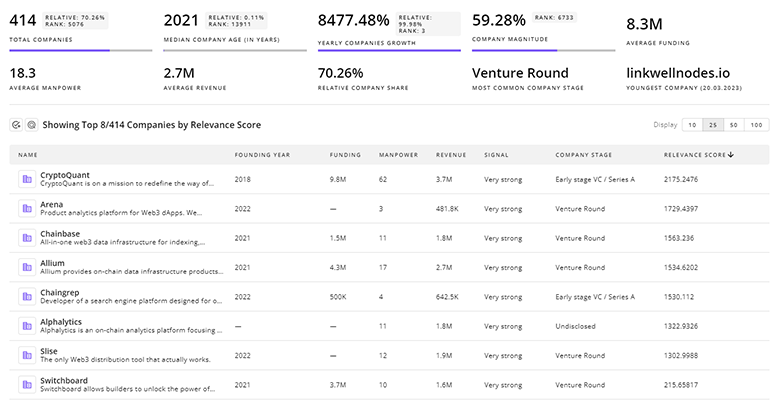
Discover Nuclear Technology Companies, their Funding, Manpower, Revenues, Stages, and much more
Nuclear Technology Investors
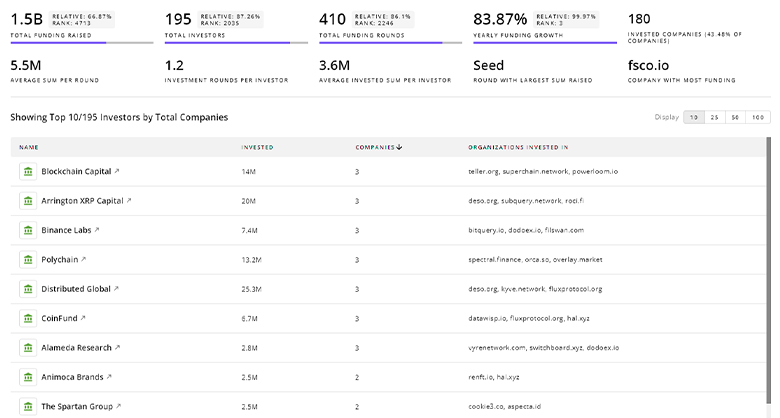
TrendFeedr’s Investors tool offers comprehensive insights into 481 Nuclear Technology investors by examining funding patterns and investment trends. This enables you to strategize effectively and identify opportunities in the Nuclear Technology sector.
481 Nuclear Technology Investors
Discover Nuclear Technology Investors, Funding Rounds, Invested Amounts, and Funding Growth
Nuclear Technology News
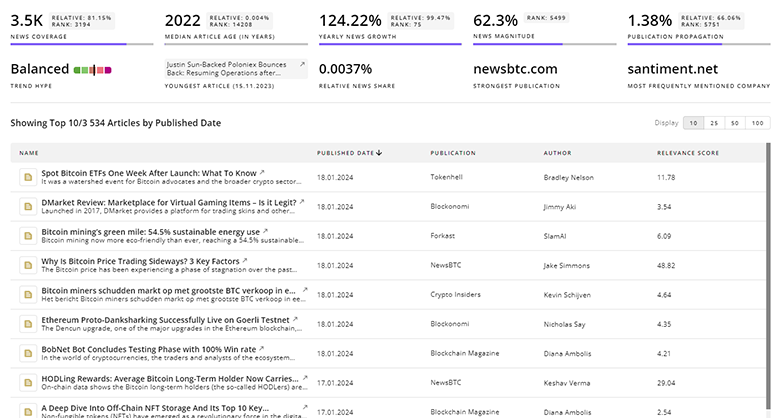
TrendFeedr’s News feature provides access to 2.2K Nuclear Technology articles. This extensive database covers both historical and recent developments, enabling innovators and leaders to stay informed.
2.2K Nuclear Technology News Articles
Discover Latest Nuclear Technology Articles, News Magnitude, Publication Propagation, Yearly Growth, and Strongest Publications
Executive Summary
Nuclear technology has moved from purely long-lead, high-capex projects toward a layered commercial landscape where modular reactors, advanced fuels, waste-value pathways and digital services each offer near-term monetization routes. The internal market baseline (~$36.7 billion) and public forecasts show modest capacity growth but material revenue expansion in services, fuel supply and non-electric applications. Strategic priorities for business stakeholders: secure advanced-fuel or isotope supply positions, partner on factory fabrication and standardized SMR modules, structure co-located offtakes for heat or hydrogen, and deploy digital/robotic offerings that lower operating and decommissioning cost. Investors should monitor FOAK demonstration outcomes (fuel qualification, waste-to-energy pilots, SMR regulatory approvals) as binary catalysts that will reprice project risk and unlock wider private capital flows.
We value collaboration with industry professionals to offer even better insights. Interested in contributing? Get in touch!