
Personalization AI Report
: Analysis on the Market, Trends, and TechnologiesThe personalization AI landscape is accelerating into commercially meaningful deployments as firms convert contextual memory and private-data models into measurable outcomes: total funding into personalization AI reached $6.28B and the topic now covers 2,250 companies, indicating concentrated capital flows and fast firm formation. Market reports show sustained market expansion and real-time use cases that drive revenue: enterprise adopters cite measurable uplifts in engagement and leaders report revenue advantages of roughly 40% versus slower peers Artificial Intelligence-based Personalization Report, 2025. Together, these signals indicate that the winning personalization strategies will be those that pair persistent, explainable memory layers with privacy-preserving model architectures while converting those capabilities into direct commercial workflows.
The last time we updated this report was 322 days ago. If there’s something missing or off, your tips are welcome!
Topic Dominance Index of Personalization AI
The Dominance Index for Personalization AI merges timelines of published articles, newly founded companies, and global search data to provide a comprehensive perspective into the topic.
Key Activities and Applications
- Digital twin and Personal Language Model (PLM) construction — building persistent, private models that represent a person or professional for continuous, context-aware assistance; these models are now being positioned as enterprise assets for knowledge work and regulated workflows
- Real-time intent and next-action prediction — ingesting clickstream, CRM, and sensor signals to forecast immediate user needs and trigger automated assistance or offers in-moment
- Emotion- and context-aware conversational agents — applying affective signals and session context to adapt tone, response selection, and the agent's short-term memory for higher engagement and lower friction AI can now create a replica of your personality.
- On-device and federated personalization — running inference and incremental learning at the edge to meet stringent data-sovereignty requirements and to reduce latency for private assistants.
- Personalized asset generation for commerce — generating product copy, visual variants, and offers tailored by location, weather, and psychographic signals to improve immediate conversion rates AI Meets Media: Content Personalization at Scale.
Emergent Trends and Core Insights
- Memory as competitive moat — firms that operationalize structured, explainable memory layers capture disproportionate value because they convert ephemeral LLM outputs into durable, auditable customer context that supports longitudinal action.
- Agentic personalization — personalization is shifting from passive recommendation to agents that plan, decide, and execute multi-step tasks on behalf of users, creating productivity and scale effects in advisory and back-office functions AI Agent Use Case: Personalized Investment Advice.
- Identity-free personalization — a rising technical pattern uses transient session signals and emotional trait vectors to personalize without persistent identifiers, reducing regulatory friction and offering alternative monetization models.
- Psychographic and morphological simulation — deeper consumer models (taste OS and morphological twins) let brands predict not only preferences but behavioral reactions to campaigns, improving creative testing efficiency and reducing live experiment risk
- Regulatory-driven bifurcation — Europe-style governance and corporate privacy programs are pushing enterprise-grade, on-device, and federated deployments that separate secure PLMs from generalized cloud LLMs
Technologies and Methodologies
- Personal Language Models (PLMs) — specialist, fine-tuned models trained on private corpora to serve as persistent assistants for professions and teams, reducing reliance on public LLM inference.
- Federated learning and differential privacy — architectures that enable learning from distributed user data while keeping raw signals local, supporting regulatory compliance and trust-sensitive deployments
- Multi-modal emotional context fusion — combining voice, text, and visual cues into emotional trait vectors to select response style and content dynamically as user state changes
- Semantic memory and knowledge graphs — ontology-driven memory layers and knowledge graphs that feed retrieval-augmented generation to improve factuality and explainability in personalized outputs.
- Multi-agent orchestration — coordinated agent teams that divide reasoning, planning, and execution tasks to scale multi-step personalization workflows in enterprise contexts.
Personalization AI Funding
A total of 487 Personalization AI companies have received funding.
Overall, Personalization AI companies have raised $7.4B.
Companies within the Personalization AI domain have secured capital from 1.6K funding rounds.
The chart shows the funding trendline of Personalization AI companies over the last 5 years
Personalization AI Companies
- ELZAI — Small team focused on replicating human memory for continuous-learning Personal AI through a product called Memora. ELZAI emphasizes memory-driven assistants that maintain long-term context across interactions, a positioning that targets the memory moat required for high-fidelity personalization. Their offering is engineered for on-going adaptation rather than one-off fine-tuning.
- Partenit — Builds ontology-based memory systems that convert unstructured conversations and documents into structured, connected knowledge to power long-lived AI context. Partenit targets conversational AI, customer support, and regulated verticals where explainable memory increases both value and compliance posture. The company offers deployment flexibility including on-prem and private-cloud options.
- PSYKHE AI — Provides a persistent psychographic operating layer that computes taste and personality signals in real time to power cross-context recommendations for CPG and fashion retailers. PSYKHE AI focuses on psychographic identity as the personalization input, enabling proactive surfacing of items users will want before they search. Their stack targets conversion uplift through taste-driven surfacing and live model updates.
- BullsAI — Specializes in personalizing product presentation by altering images and copy dynamically based on shopper context such as location and weather, moving personalization from recommendation logic to the presentation layer. BullsAI's approach targets immediate conversion gains by making product pages speak directly to the moment. This technique is particularly potent for direct-to-consumer merchants with high traffic and varied contexts.
- Haltia.AI — Offers on-device LLM-based personalization focused on member privacy and explainability, targeting use cases where cloud uploads are unacceptable. Haltia.AI markets private, low-latency assistants that run locally and capture real-time knowledge without centralized data aggregation, addressing the growing enterprise demand for data-sovereign personalization. Their product road map emphasizes voice interaction and offline capabilities.
Delve into the corporate landscape of Personalization AI with TrendFeedr’s Companies tool
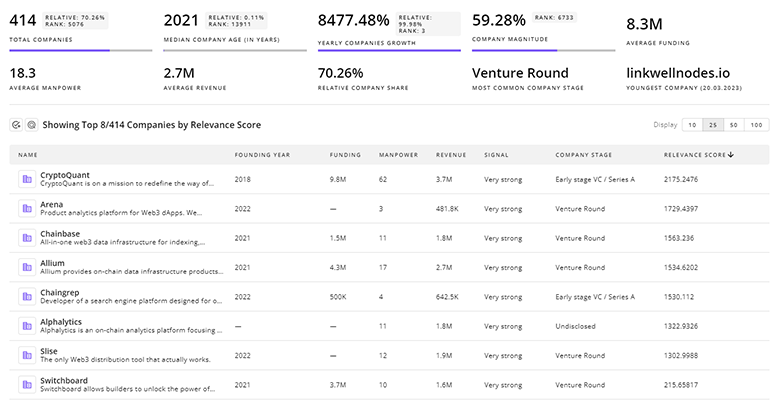
2.6K Personalization AI Companies
Discover Personalization AI Companies, their Funding, Manpower, Revenues, Stages, and much more
Personalization AI Investors
TrendFeedr’s Investors tool provides insights into 1.8K Personalization AI investors for you to keep ahead of the curve. This resource is critical for analyzing investment activities, funding trends, and market potential within the Personalization AI industry.
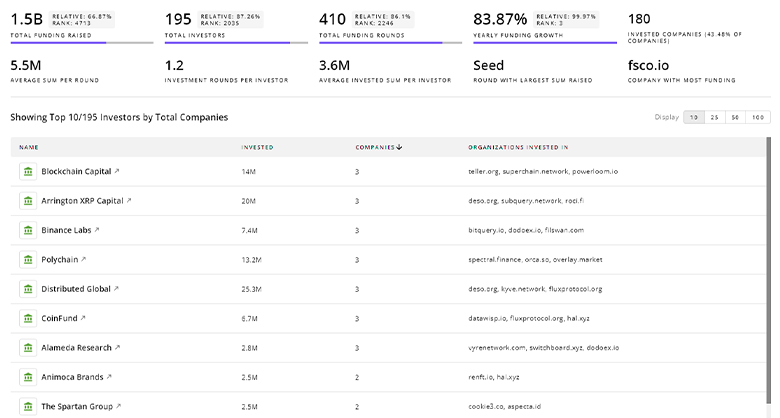
1.8K Personalization AI Investors
Discover Personalization AI Investors, Funding Rounds, Invested Amounts, and Funding Growth
Personalization AI News
TrendFeedr’s News feature offers you access to 232 articles on Personalization AI. Stay informed about the latest trends, technologies, and market shifts to enhance your strategic planning and decision-making.
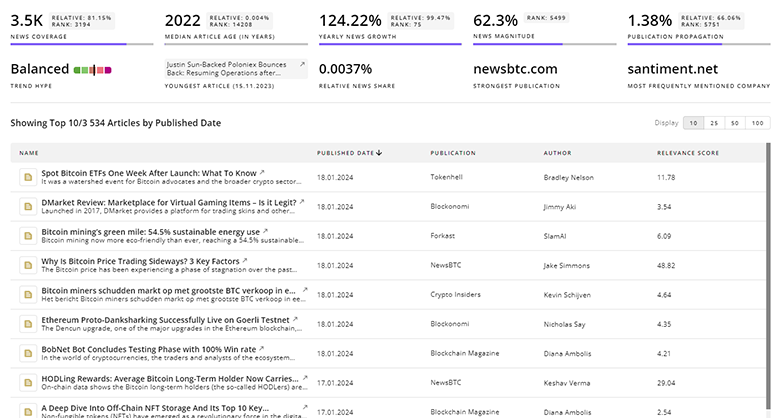
232 Personalization AI News Articles
Discover Latest Personalization AI Articles, News Magnitude, Publication Propagation, Yearly Growth, and Strongest Publications
Executive Summary
Personalization AI has moved from algorithmic experiments to commercially important systems that combine memory, privacy engineering, and agentic workflows. The balance of value favors players that treat persistent context as a proprietary asset and that can operationalize privacy-preserving architectures while tying outputs directly to revenue or compliance outcomes. For businesses, the practical priority is to convert personalization from a marketing tactic into an integrated capability: secure context capture, explainable memory, and modular PLMs that plug into existing workflows will determine who captures the premium in the coming market consolidation.
Are you an insider in the trends or tech industry? We’d love for you to contribute to our content.