Radar Report
: Analysis on the Market, Trends, and TechnologiesThe radar market is undergoing concentrated capitalization and strategic platform formation, anchored by $122.39B in total funding across the sector, which signals sustained investor commitment to scaling sensor-to-software stacks. Market analysis shows continued commercial and defense demand driven by automotive ADAS, air-defense modernization, and spaceborne imaging, with several external forecasts placing the broader radar systems market in the tens of billions of USD across the next decade Radar System Market Report, 2025. The implication for strategic investors and operators is clear: owning the software layer that converts radar returns into reliable decision signals will capture the largest portion of future value while specialized sensor makers that solve physics or miniaturization constraints will remain critical suppliers.
This report was last revised 96 days ago. See a missing piece? Your input can help — contact us.
Topic Dominance Index of Radar
The Dominance Index for Radar delivers a multidimensional view by integrating data from three key viewpoints: published articles, companies founded, and global search trends
Key Activities and Applications
- Air-defense and missile tracking — long-range phased-array radars for early warning and discrimination are being prioritized by defense programs and fleet modernizations 3D Radar Market Size, Industry Analysis Report.
- Automotive ADAS and autonomy — deployment of short- and medium-range mmWave and 4D imaging radar for collision avoidance, blind-spot detection, and in-cabin monitoring continues to drive sensor volume.
- Earth observation and SAR imaging — miniaturized Synthetic Aperture Radar (SAR) for UAVs and small satellites supports environmental monitoring and commercial analytics
- Portable and deployed surveillance — compact, software-defined radars used for temporary perimeter security, drone detection, and tactical weather monitoring enable rapid fielding and recurring revenue models.
- Industrial level measurement and GPR — guided wave and ground-penetrating radars (GPR) for process control, subsurface mapping, and infrastructure diagnostics remain high-value, non-commodity applications.
Emergent Trends and Core Insights
- 4D imaging proliferation — heightened spatial and velocity resolution is moving from research into production for automotive and UAS missions, with dedicated 4D market forecasts showing rapid expansion Automotive 4D Imaging Radar Market Report.
- Edge AI and radar-on-chip — single-chip mmWave solutions that embed neural processing reduce system cost and latency, changing OEM sourcing economics for in-vehicle and in-cabin sensing Automotive Radar-on-Chip Technology Market Size, 2034 Report.
- Software-defined, reconfigurable radar architectures — modular architectures let operators repurpose hardware via waveform and processing updates, creating serviceable platform offerings rather than one-off hardware sales.
- Interference management and cooperative spectrum — as vehicle and urban sensor density rises, solutions that manage mutual interference and enable radar communications are commercially relevant for large OEM fleets RadChat.
- Consolidation around platform integrators — defense primes and a set of well-funded startups are acquiring niche sensor capabilities to assemble integrated perception stacks; suppliers with hard-to-replicate physics expertise (SAR, subsea, HF ocean sensing) retain pricing power.
The commercial opportunity concentrates where high-fidelity sensing meets fast, field-deployable analytics: 4D perception plus edge AI is the practical lever for capturing platform value.
Technologies and Methodologies
- Frequency Modulated Continuous Wave (FMCW) and mmWave architectures — dominant for short and medium-range automotive and industrial sensing due to low cost and fine range/Doppler performance.
- MIMO, digital beamforming and pulse compression — enable higher angular resolution and multi-target discrimination required for crowded operational theaters.
- AESA and metamaterials (MESA®) — electronically steered arrays and metamaterial implementations provide low SWaP, fast beam agility for compact platforms Echodyne.
- Ultra-Wideband (UWB) and terahertz radars — address sub-millimeter resolution short-range use cases such as vital-sign sensing and fine industrial inspection Aria Sensing.
- Advanced signal processing and ML/AI pipelines — AI-enhanced clutter rejection, object classification, and sensor fusion convert raw returns into actionable tracks and lower false alarm rates.
Radar Funding
A total of 2.4K Radar companies have received funding.
Overall, Radar companies have raised $122.4B.
Companies within the Radar domain have secured capital from 7.6K funding rounds.
The chart shows the funding trendline of Radar companies over the last 5 years
Radar Companies
- aiRadar Inc. — aiRadar Inc. develops compact, high-performance radar sensors targeting drone detection, maritime situational awareness, and miniature SAR for small platforms. Their modular approach aims to place high-resolution imaging on affordable UAVs and maritime systems, combining interferometric approaches with AI classification to reduce operator workload
- Zadar Labs — Zadar Labs builds Software-Defined 4D Imaging Radar (SDIR) platforms that let integrators reprogram sensing modes via software updates. The company emphasizes flexible deployment across automotive and industrial automation applications and positions its stack as a developer-friendly perception ingredient for system integrators
- IMSAR — IMSAR focuses on miniaturized Synthetic Aperture Radar (SAR) systems for manned and unmanned platforms, delivering high resolution imagery at lower size, weight, and power. Their product set targets customers seeking SAR capability without legacy cost and logistics burdens, enabling more frequent and tactical imaging missions
- Raider Technologies — Raider Technologies offers low-cost, low-power continuous-wave and frequency-diverse sensing that provides unambiguous range, angle, and Doppler in constrained SWaP envelopes. The company serves AAM, counter-UAS, and tactical surveillance use cases where affordable, distributed sensing is required
- MetaSensing — MetaSensing produces compact, customizable airborne and ground SAR products and recently expanded into ground-based deformation monitoring and weather radar niches. Their hands-on control of subsystem design lets them tailor radars for specific scientific and commercial observability tasks
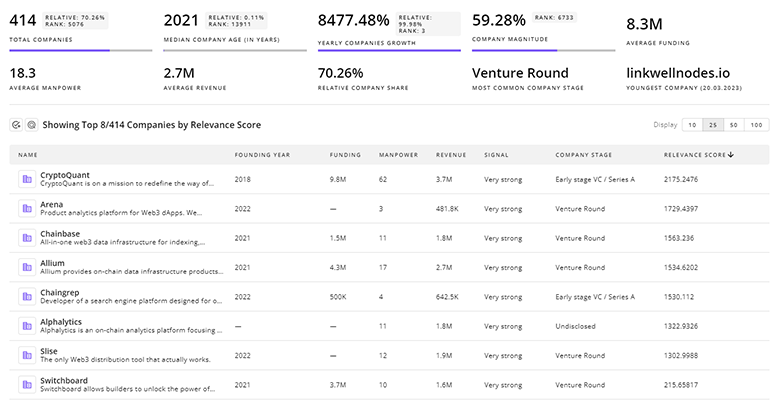
TrendFeedr's Companies feature is your gateway to 20.1K Radar companies.
20.1K Radar Companies
Discover Radar Companies, their Funding, Manpower, Revenues, Stages, and much more
Radar Investors
The Investors tool by TrendFeedr offers a detailed perspective on 8.1K Radar investors and their funding activities. Utilize this tool to dissect investment patterns and gain actionable insights into the financial landscape of Radar.
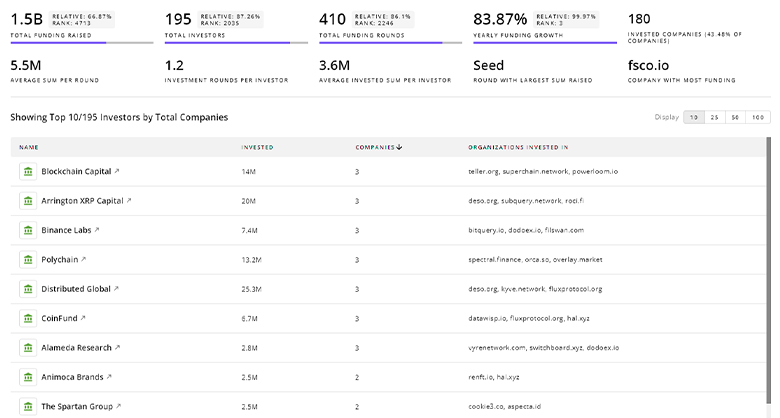
8.1K Radar Investors
Discover Radar Investors, Funding Rounds, Invested Amounts, and Funding Growth
Radar News
TrendFeedr’s News feature allows you to access 61.8K Radar articles as well as a detailed look at both historical trends and current market dynamics. This tool is essential for professionals seeking to stay ahead in a rapidly changing environment.
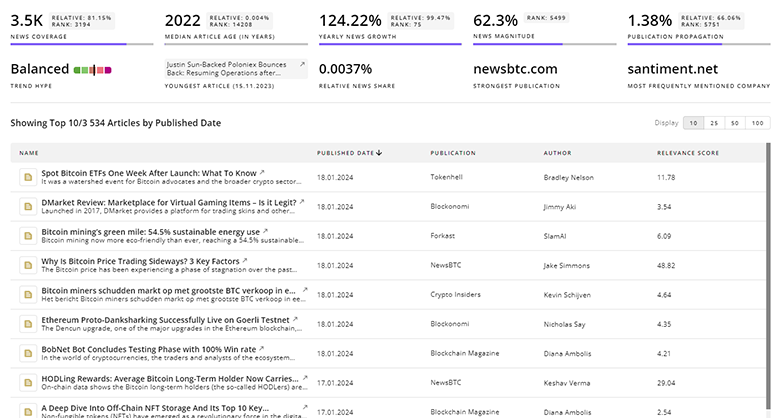
61.8K Radar News Articles
Discover Latest Radar Articles, News Magnitude, Publication Propagation, Yearly Growth, and Strongest Publications
Executive Summary
The data indicates a bifurcated competitive trajectory: large integrators will capture platform economics by bundling radar data with AI and fusion services, while focused suppliers that master a physical or miniaturization constraint will retain high margin, supplier-level positions. Commercial adoption hinges on two simultaneous technical outcomes: cost-effective, high-resolution 4D sensing and embedded AI pipelines that make radar outputs reliable for real-time decisioning. For strategy teams and investors, the priority actions are clear: (1) secure long-term partnerships with niche sensor innovators that solve physics or SWaP bottlenecks; (2) invest in the edge-AI and software stacks that convert radar returns into deterministic signals for autonomy and security use cases; and (3) evaluate M&A targets that supply specialized IP in SAR, metamaterials AESA, or radar-on-chip to accelerate time to product at scale.
Partner with us to offer cutting-edge insights into trends and tech. We welcome your input.