Risk Management Report
: Analysis on the Market, Trends, and TechnologiesThe risk management market is in the middle of a structural pivot from fragmented, compliance-led processes toward integrated, predictive systems that quantify and act on interdependencies; market data records a base size of $12.09 billion in 2024 and an expected CAGR of 11.9%—evidence that investment and adoption are accelerating. Alternate market estimates place the 2024 market between $12.09 billion and $15.40 billion, underscoring methodological variance but a shared direction of significant growth driven by regulatory pressure, AI adoption, and demand for real-time visibility Grand View Research – Risk Management Market.
This report was last revised 85 days ago. See a missing piece? Your input can help — contact us.
Topic Dominance Index of Risk Management
The Dominance Index for Risk Management delivers a multidimensional view by integrating data from three key viewpoints: published articles, companies founded, and global search trends
Key Activities and Applications
- Enterprise risk aggregation and contextual mapping — Firms replace siloed registers with platforms that link risks to processes, controls, and objectives to reveal cascade effects and residual exposure.
- Continuous monitoring and early warning — Real-time telemetry, streamed KPIs and ML signals enable continuously updated risk scores rather than episodic heat maps, reducing detection latency in cyber, operational and supply-chain events.
- Regulatory automation and evidence collection — Automated compliance workflows and audit trails reduce reporting friction and shorten control testing cycles, addressing rising regulatory complexity in multiple jurisdictions.
- Scenario simulation and stress testing — Monte Carlo and digital-twin simulations embed capital, liquidity and climate stress scenarios into decision processes to quantify tail exposures before they crystallize.
- Third-party and supply-chain risk orchestration — Lifecycle TPRM (onboarding, continuous assessment, remediation) has moved from point solutions to integrated modules inside ERM stacks because supply networks drive material business interruption risk Third-Party Risk Management.
- Risk-adjusted performance and 'Risk as Alpha' — Risk frameworks increasingly feed portfolio and operational strategy, converting risk control into measurable decision advantage in capital markets and treasury functions KRM22.
Emergent Trends and Core Insights
- Contextual, graph-based risk intelligence is displacing flat registers; the priority is mapping interdependencies so one trigger surfaces linked exposures across people, processes and partners.
- AI-first predictive analytics now goes beyond anomaly detection to forecast likelihood and impact trajectories, with governance and model-risk controls rising as a parallel requirement Artificial Intelligence and Machine Learning in Risk Management Models.
- Risk convergence at the executive agenda: executives cite converging cyber, climate and supply risks as top priorities—78% of surveyed decision makers rate risk convergence a priority, with supply-chain disruption showing up for 62% Aon – Global Risk Management Survey.
- Cloud-native SaaS becomes the default delivery model as organizations trade capital expense for faster updates and integrated threat intelligence; this accelerates adoption among SMEs as well as enterprises.
- Model governance and auditability become business constraints; regulators and boards demand explainability as AI models are used for critical decisions, pushing investment into model validation and lifecycle controls.
- Non-financial risks are being commodified: ESG, regulatory and workforce risks now feed quantitative portfolios and insurance strategies, shifting budget toward analytical tooling and insurance innovation Risk-Enterprise.
Technologies and Methodologies
- Graph and network engines for interdependency mapping — Graph-based models link entities (suppliers, systems, controls) to show propagation paths and accumulation nodes, enabling prioritized remediation.
- AI/ML early-warning systems — Supervised and unsupervised models identify precursors to fraud, operational failure, or cyber breach; firms combine these with continuous monitoring to produce dynamic risk scores.
- Dynamic stochastic optimization and ALM studios — Real-time asset-liability balancing and adaptive hedging rely on low-code ALM platforms to reprice exposures and recommend hedging actions automatically RisKontroller Global LLC.
- Digital twin and scenario simulation — Digital replicas of plants, portfolios and supply chains enable high-fidelity "what if" testing under correlated shock scenarios to estimate systemic loss paths.
- Federated and privacy-preserving learning — Use cases that require cross-firm intelligence (e.g. pooled cyber indicators) adopt federated learning to preserve data sovereignty while improving model accuracy.
- No-code configuration and fast integration layers — To accelerate adoption across non-technical line owners, platforms expose workflow builders and API fabrics that connect ERP, SIEM, and OT telemetry without heavy professional services Protecht.
- Risk dollarisation and financialisation of intangible risk — Methods that convert safety, reputational and compliance failures into financial metrics help boards allocate capital and insurance; this supports decisions such as captive formation or retention limits Manage Damage Group.
Risk Management Funding
A total of 19.4K Risk Management companies have received funding.
Overall, Risk Management companies have raised $1.8T.
Companies within the Risk Management domain have secured capital from 64.5K funding rounds.
The chart shows the funding trendline of Risk Management companies over the last 5 years
Risk Management Companies
PredictRAM — PredictRAM offers AI/ML investment research and portfolio risk tools focused on portfolio stress and fixed-income strategies; its platform fuses predictive signals and automated compliance for advisors and asset managers, and the company publicly positions itself as an AI-powered risk analytics provider.
The firm targets tactical portfolio risk reduction and automated reporting workflows, delivering capabilities that can translate market risk signals into actionable hedging steps for mid-market asset managers.RENrisk — RENrisk builds a resilience engineering stack for heavy industry that treats risk as a dynamic indicator using its IRIS platform; the solution creates digital twins to surface operating conditions that precede major accidents and prescribes corrective actions in near real time.
RENrisk's focus on Major Accident Hazard sites makes it highly relevant where process uptime and safety are mission critical, offering predictive maintenance and operational resilience analytics that align with industrial risk management needs.Near-Miss Management — Near-Miss Management commercializes an early-risk detection engine for process industries called Dynamic Risk Analyzer (DRA); the ML-driven system scans high-frequency process data to detect precursors to failures and has documented savings through avoided shutdowns and repair costs.
The product suits plants that require peripheral visibility into subtle drift patterns, translating rare signal detection into maintenance and operational actions that materially reduce downtime.RiskDynamyx® — RiskDynamyx® provides a dynamic security risk dashboard for commercial property, using local and national data (crime stats, points of interest) to update property risk scores continuously; the platform supports 24/7 early warning and decision workflows for security teams.
Its value proposition targets owners/operators seeking to move from annual security assessments to a live monitoring posture that reduces reaction time and insurance surprises.RiskKarma.io — RiskKarma.io focuses on employer liability and workplace risk by combining behaviour analytics, compliance gamification and portable worker profiles to reduce claim incidence and litigation exposure; the product aims to make worker-level risk visible for insurers and employers to lower loss adjustment expenses.
The platform appeals to insurers and HR teams that want to move from reactive claims handling to proactive loss prevention tied to ESG and DEI metrics.
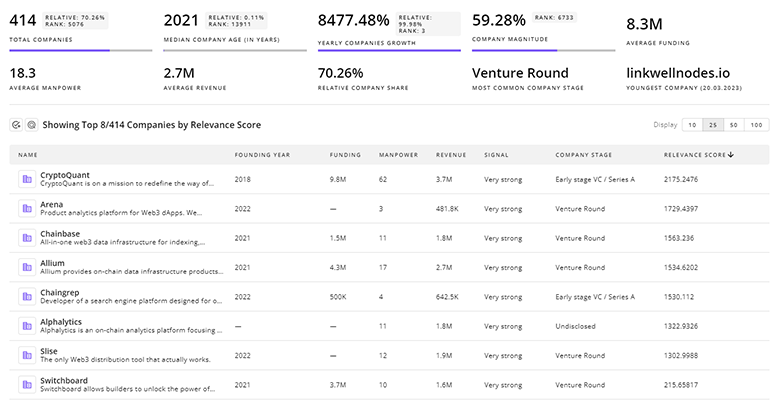
TrendFeedr's Companies feature is your gateway to 199.0K Risk Management companies.
199.0K Risk Management Companies
Discover Risk Management Companies, their Funding, Manpower, Revenues, Stages, and much more
Risk Management Investors
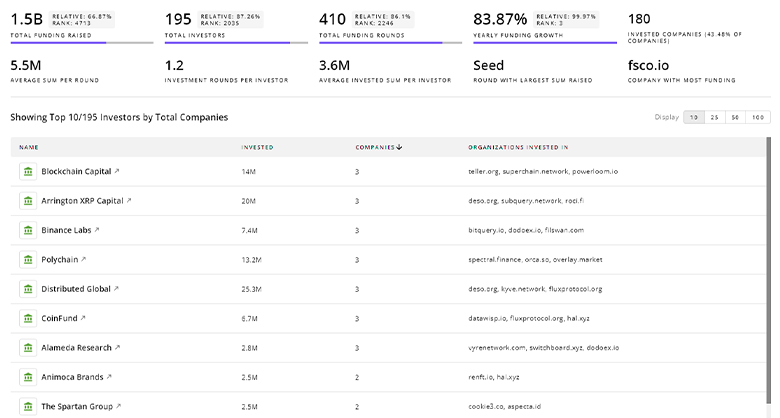
The Investors tool by TrendFeedr offers a detailed perspective on 42.8K Risk Management investors and their funding activities. Utilize this tool to dissect investment patterns and gain actionable insights into the financial landscape of Risk Management.
42.8K Risk Management Investors
Discover Risk Management Investors, Funding Rounds, Invested Amounts, and Funding Growth
Risk Management News
TrendFeedr’s News feature allows you to access 88.0K Risk Management articles as well as a detailed look at both historical trends and current market dynamics. This tool is essential for professionals seeking to stay ahead in a rapidly changing environment.
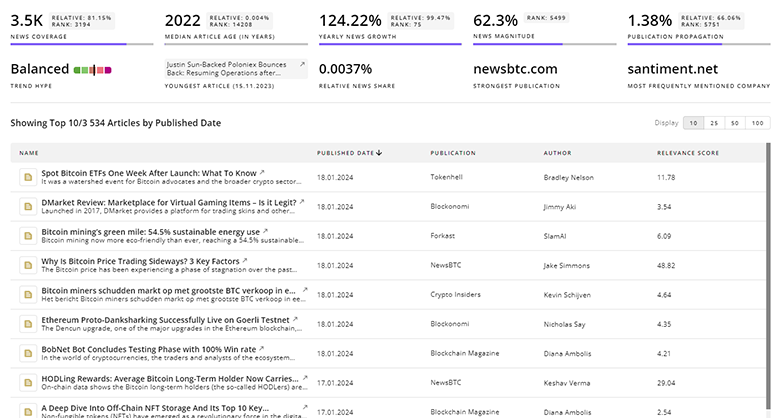
88.0K Risk Management News Articles
Discover Latest Risk Management Articles, News Magnitude, Publication Propagation, Yearly Growth, and Strongest Publications
Executive Summary
The central strategic imperative for businesses is clear: migrate from fragmented, episodic risk controls to continuous, contextual risk intelligence that ties exposure to business outcomes. Market indicators and company activity show heavy investment in AI, graph modeling and simulation, while regulatory complexity and converging threat vectors (cyber, climate, supply) push ERM into the center of corporate strategy. For executives the priority is pragmatic: instrument critical corridors of value (finance, supply chain, operations), govern AI models and data quality tightly, and shift budgets from isolated audits to systems that show quantified residual risk and prescriptive actions. The commercial winners will be platforms that convert risk visibility into repeatable decision flows and firms that embed measurable risk metrics into performance and capital allocation frameworks.
Partner with us to offer cutting-edge insights into trends and tech. We welcome your input.