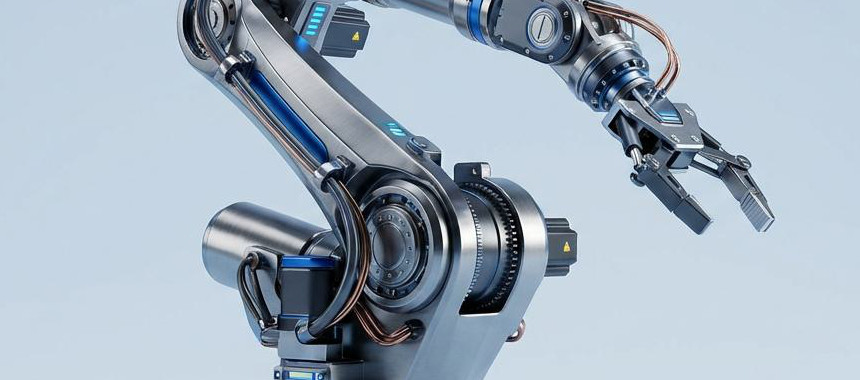
Robotic Arm Report
: Analysis on the Market, Trends, and TechnologiesThe robotic arm market is entering a concentrated growth window with measured scale and clear numeric milestones: the internal trend report records a 2025 market size of $43,220,000,000 and a reported CAGR of 16.9% that underpins a 2029 projection of $80,820,000,000. These figures reflect simultaneous trends: rising AI-driven perception, faster deployment through modular designs, and an expansion of application verticals from warehousing and precision manufacturing to inspection and assistive healthcare. The immediate implication is that companies that pair advanced perception / control software with differentiated end-effectors will capture disproportionate value as hardware alone commoditizes.
This report was last revised 3 days ago. See a missing piece? Your input can help — contact us.
Topic Dominance Index of Robotic Arm
The Dominance Index for Robotic Arm delivers a multidimensional view by integrating data from three key viewpoints: published articles, companies founded, and global search trends
Key Activities and Applications
- Warehouse picking and material handling at scale. E-commerce growth is the primary demand engine for articulated arms in logistics, where automation reduces cycle time and increases throughput thebusinessresearchcompany – Robotic Arm Global Market Report, 2025.
- Precision assembly, soldering and welding in electronics and automotive lines. Multi-axis manipulators and force-aware control systems target high-mix, high-precision assembly tasks.
- Surface finishing and small-batch manufacturing. AI-powered, no-programming cells automate sanding, polishing and finishing for high-mix parts, reducing setup time for lot-size-one production cohesiverobotics.com.
- Inspection and maintenance in hazardous or constrained environments. Snake-like and mobile arms enable remote inspection (energy, nuclear, subsea), offering risk reduction and access where humans struggle
- Medical and assistive manipulator systems. Lower-cost, portable surgical platforms and home assistive arms broaden clinical access and personal independence in care settings Articulus Surgical.
Emergent Trends and Core Insights
- Software becomes the primary moat. Investment velocity concentrates on control stacks, VLM integration, and teachless controllers that make arms adaptable to varied tasks, shifting margin capture from hardware to software Jacobi Robotics.
- Move from position-only control to contact-aware manipulation. Integrated force/torque sensing at joints and end-effectors enables contact-rich tasks, expanding feasible applications from rigid pick-and-place to delicate assembly and cooperative human interaction.
- Actuation diversification — biomimetic and low-inertia architectures. Novel actuators (artificial muscles) and cable-driven or base-mounted motor layouts reduce distal inertia and increase safety and dexterity, making new classes of tasks viable
- Deployment time collapses through modular, simulation-first development. High-fidelity simulation and digital-twin validation shrink development cycles and lower integration risk, enabling faster commercial pilots and rollouts
- Niche verticals hold premium margins. Hazardous-environment inspection, surgical robotics, and high-value surface finishing capture outsized contract value compared with volume segments like commodity palletizing GrayMatter Robotics.
Technologies and Methodologies
- Visual-Language and Vision-Language-Haptics models for task understanding. These models enable natural-language task specification and reduce programming burden for integrators
- Imitation learning and demonstration-based skill transfer. Systems that generalize from a handful of human demonstrations accelerate deployment in variable environments Kinisi Robotics.
- Force/torque sensing integrated into joint actuation. Embedded sensing across joints yields compliant control and safer human interaction for collaborative tasks.
- Soft end-effector technologies (electroadhesion, granular jamming). These approaches expand graspable object classes and lower the need for perfect perception when handling fragile items Omnigrasp.
- Digital twin and reinforcement-learning-in-simulation pipelines. Training policies and validating motion plans in simulation reduce physical test cycles and shorten time to market
Robotic Arm Funding
A total of 222 Robotic Arm companies have received funding.
Overall, Robotic Arm companies have raised $6.8B.
Companies within the Robotic Arm domain have secured capital from 946 funding rounds.
The chart shows the funding trendline of Robotic Arm companies over the last 5 years
Robotic Arm Companies
- Sarcomere Dynamics — Sarcomere builds a compact, highly dexterous robotic hand intended for plug-and-play integration with existing arms and mobile platforms; their design emphasizes near-human manipulation using tactile and position sensing to allow delicate tasks without large custom controllers. The company positions the hand as agnostic hardware that upgrades existing automation stacks and reduces integration friction for manufacturers targeting fine assembly. Their early funding and small team profile place them as a specialist supplier for firms seeking to add human-level dexterity to standard arms
- T-robotics — T-robotics provides a software box that combines Visual-Language-Haptics models with robotic skill libraries so an integrator can specify tasks in plain language or short demonstrations; this cuts program time for machine-tending and CNC tending to hours rather than weeks. Their approach targets SME machine shops and automation integrators that lack robotics programming teams, creating a rapid ROI path for common industrial tasks
- Kyber Labs — Kyber Labs develops low-cost artificial muscle fiber actuators that emulate human muscle contraction, offering smoother, more anthropomorphic motion and inherent compliance compared with traditional servos; this enables safer contact tasks and reduces control complexity in dexterous manipulations. Their actuator platform targets integrators building advanced grippers and general-purpose manipulators that need lightweight, high-bandwidth actuation for learning-based control
- Fabrica AI — Fabrica AI pairs high-fidelity simulation with reinforcement learning to shorten robot development timelines from years to days, exemplified by a tile-grouting robot deployed on construction sites; their simulation-to-reality loop reduces integration risk for novel use cases and accelerates domain validation. This asset reduces cost and calendar time for pilots, attractive to enterprise customers who need proof-of-value before scaling automation
- Armatrix — Armatrix focuses on inspection and maintenance robotics, delivering snake-like manipulators and mobile dual-arm solutions for energy and heavy-industry inspections where contamination, reach, and dexterity matter; they sell robotics-as-a-service for hazardous environments. Their product fit targets long procurement cycles in regulated industries by offering turnkey autonomy and inspection reporting, capturing higher-margin service contracts versus pure hardware sales
TrendFeedr's Companies feature is your gateway to 1.5K Robotic Arm companies.
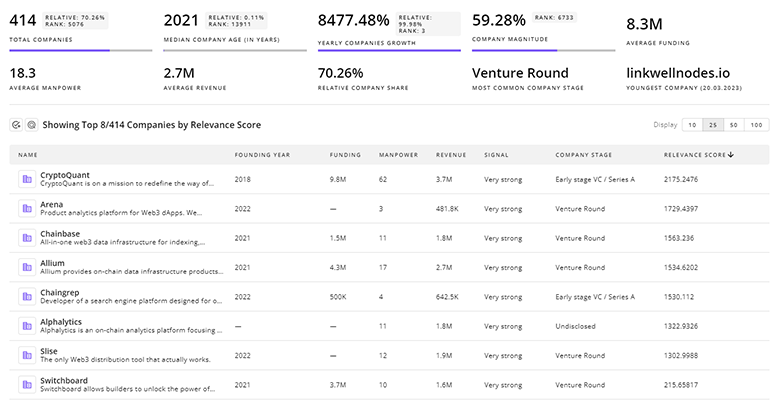
1.5K Robotic Arm Companies
Discover Robotic Arm Companies, their Funding, Manpower, Revenues, Stages, and much more
Robotic Arm Investors
The Investors tool by TrendFeedr offers a detailed perspective on 1.3K Robotic Arm investors and their funding activities. Utilize this tool to dissect investment patterns and gain actionable insights into the financial landscape of Robotic Arm.
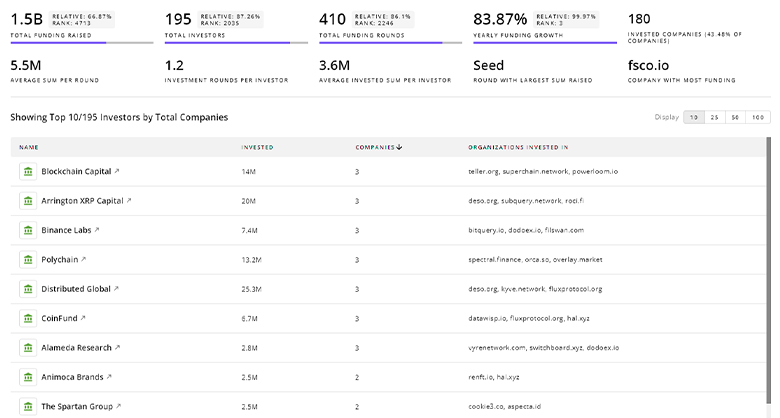
1.3K Robotic Arm Investors
Discover Robotic Arm Investors, Funding Rounds, Invested Amounts, and Funding Growth
Robotic Arm News
TrendFeedr’s News feature allows you to access 7.9K Robotic Arm articles as well as a detailed look at both historical trends and current market dynamics. This tool is essential for professionals seeking to stay ahead in a rapidly changing environment.
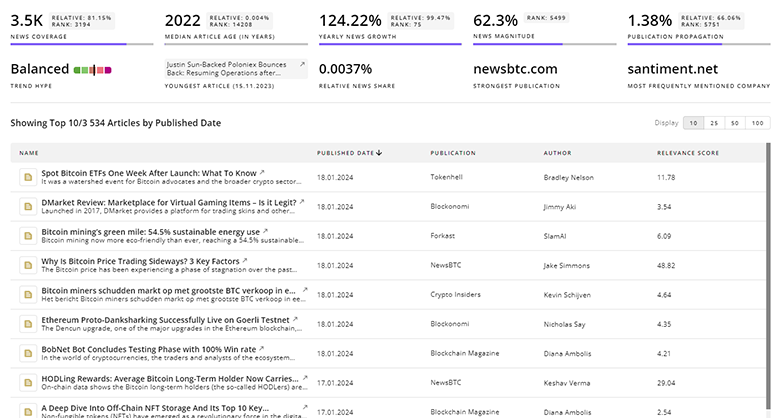
7.9K Robotic Arm News Articles
Discover Latest Robotic Arm Articles, News Magnitude, Publication Propagation, Yearly Growth, and Strongest Publications
Executive Summary
The available market and company data show a clear pivot: value is migrating from mechanical specification to the software and end-effector layer that translates perception into reliable physical action. With $43.22B recorded in 2025 and a projected $80.82B by 2029, firms that combine advanced perception (VLMs and vision systems), contact-aware control, and rapid validation (simulation/digital twins) will outcompete hardware-only suppliers. For practitioners and investors, the practical strategy is to prioritize integrated stacks that shorten deployment time, offer runtime safety supervision, and support modular end-effectors so customers can field arms across multiple use cases without repeated heavy integration.
Partner with us to offer cutting-edge insights into trends and tech. We welcome your input.