Space Research Report
: Analysis on the Market, Trends, and TechnologiesThe space research landscape is entering a commercial growth phase defined by concentrated investment and expanding application scope, with the internal data valuing the 2024 market at USD 564.6 billion and showing accelerating technology adoption that favors data-centric and platform plays. External market evidence supports fast subsector growth: launch services project high mid-teens CAGR and debris-removal shows very steep expansion, shifting investor attention toward launch, propulsion, and orbital-safety services Space Market Research Reports & Consulting – MarketsandMarkets and the European space economy report indicates rising launch cadence and public spending that sustain downstream service demand ESA Report on the Space Economy 2025. The combined signal demands strategies that pair mission-grade hardware with scalable software and autonomous operations to capture recurring revenue in Earth observation, in-orbit services, microgravity R&D, and deep-space enabling technologies thebusinessresearchcompany – Microgravity Research Market 2025 thebusinessresearchcompany – Deep Space Exploration Market Insights 2025.
351 days ago, we last updated this report. Notice something that’s not right? Let’s fix it together.
Topic Dominance Index of Space Research
To gauge the influence of Space Research within the technological landscape, the Dominance Index analyzes trends from published articles, newly established companies, and global search activity
Key Activities and Applications
- Development and deployment of small satellites and CubeSats for frequent, low-cost Earth observation, scientific experiments, and technology demonstration; this activity underpins many downstream data services and lowers access barriers for new entrants.
- Persistent Earth observation and remote sensing (SAR, hyperspectral, GNSS-R) for agriculture, climate monitoring, disaster response, and maritime/blue-economy use cases; demand increases as commercial users pay for higher revisit and analytics layers Space-Based Oceanography Market Insights 2025.
- Space situational awareness and orbital-safety services including tracking, conjunction assessment, and active debris-removal; strong policy, insurance, and operator risk management drive rapid growth in debris-removal and SDA markets (multi-digit CAGRs cited in market studies).
- Microgravity research and commercial ISS/biolab payloads for drug discovery, tissue engineering, and materials testing; private platforms and commercial labs increase experiment throughput and recurring revenue potential.
- In-space robotics and on-orbit servicing (refuel, repair, life-extension) that extend satellite lifetimes and enable new mission architectures; these activities tie directly into satellite economics and constellation ROI.
Emergent Trends and Core Insights
- Commercial funding and platform concentration. Private capital increasingly funds end-to-end platform builders (launch + bus + data stack), producing winners that aggregate customers and capture recurring revenue; niche suppliers must embed into platform value chains or face margin compression.
So what: Investors should favor companies with platform integration plans or clear API/contractual pathways into larger platform ecosystems. - Orbital sustainability moves from PR to procurement. Stricter regulations, insurer pricing, and operator risk management drive rapid growth in debris-removal and SDA markets (multi-digit CAGRs cited in market studies).
So what: Startups that provide verifiable end-of-life services and standardized rendezvous/mitigation interfaces will be able to charge premium rates and win mandated contracts. - Data monetization as the primary recurring revenue engine. Higher revisit rates and onboard edge processing convert imagery and telemetry into subscription products across agriculture, insurance, and logistics.
So what: Business models that combine verticalized analytics with SLA guarantees (timeliness, anomaly detection) will command higher ARPU. - Propulsion and autonomy enable new mission classes. Advances in electric, green, and high-thrust concepts expand orbital maneuverability and deep-space access, enabling satellite servicing, cislunar logistics, and small-sat deep-space missions.
So what: Control of propulsion IP or low-cost, flight-proven propulsion modules becomes a scalable defensive asset for system integrators. - Small-sat miniaturization meets systems-level limits. Engineering fundamentals constrain how far miniaturization can replace capability; successful small-sat missions reframe the science question to exploit cadence and constellations rather than replicate flagship instruments Technology Review – Inside NASA’s bid to make spacecraft as small as possible.
So what: Product teams must match mission design to unique small-sat strengths (rapid revisit, distributed sensing) rather than attempt one-for-one substitution of large-sat performance.
Technologies and Methodologies
- Synthetic Aperture Radar (SAR), hyperspectral imaging, and GNSS-Reflectometry. Patents and recent deployments prioritize multi-sensor fusion for persistent monitoring and climate applications.
Implication: Companies combining SAR and hyperspectral data with machine learning extract higher-value, hard-to-replicate products for niche industries. - Electric and green propulsion (Hall thrusters, water-based propellants, high-power electric systems). Market forecasts and internal trend data highlight doubling of propulsion spend over the coming decade.
Implication: Lower operational costs and agile station-keeping open new revenue paths for multi-mission spacecraft and tug services. - On-orbit robotics and modular servicing (robotic arms, autonomous grapples, in-space assembly). Dedicated R&D and increasing contract awards validate in-orbit servicing as a commercial market with multi-year revenue streams.
Implication: Operators will buy life-extension services when cost < replacement; standard interfaces (mechanical, electrical, data) will accelerate adoption. - AI/ML for space situational awareness and edge analytics. AI reduces bandwidth dependence by performing event detection on orbit and prioritizing downlink, improving timeliness and reducing ground cost.
Implication: Firms able to certify onboard inference under radiation and power constraints will gain sticky technical differentiation. - Additive manufacturing and rapid prototyping for propulsion components and satellite structures. 3D printing shortens iteration cycles and reduces cost of spare hardware.
Implication: Vertical integrators use AM to lower lead times; component suppliers should target certification for flight heritage.
Space Research Funding
A total of 123 Space Research companies have received funding.
Overall, Space Research companies have raised $2.7B.
Companies within the Space Research domain have secured capital from 375 funding rounds.
The chart shows the funding trendline of Space Research companies over the last 5 years
Space Research Companies
- Space Resource Technologies — Provider of regolith simulants and laboratory tooling to accelerate ISRU research and testing; targets early-stage lunar and Mars mission integrators with realistic testbeds and material characterization services. The company positions its simulants as a repeatable, validated input for architecture validation, reducing schedule risk for lander and habitat developers. That value chain role makes it attractive for partnerships with robotics and habitat OEMs.
- KSF Space Foundation — Nonprofit accelerator running low-cost educational microgravity missions and launch access programs; it connects universities and regional research teams with flight opportunities and small payload integration support. By lowering the experiment cost of entry, KSF expands the pipeline of applied microgravity experiments and creates a feeder market for commercial payload integrators.
- ResearchSat — Small operator offering hosted payload slots and microgravity research infrastructure for life-science and biotech experiments; the company bundles experiment design, flight integration, and analytics to accelerate commercial R&D outcomes. Its integrated service model turns single experiments into repeatable programs, enabling recurring revenue from pharmaceutical and materials customers.
- SpaceScavengers / Spacescavengers — Specialist in autonomous debris detection and capture prototypes, experimenting with modular grappling and net systems for LEO cleanup and satellite servicing demos. The firm’s tactical focus on low-mass capture tools suits early procurement by constellation operators searching for compliant end-of-life options.
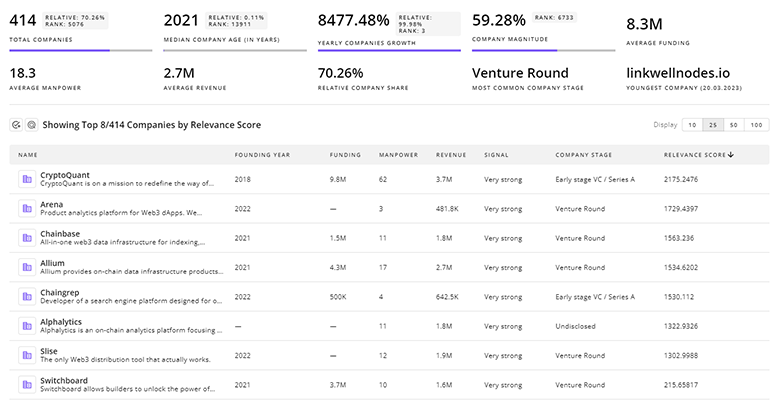
Get detailed analytics and profiles on 837 companies driving change in Space Research, enabling you to make informed strategic decisions.
837 Space Research Companies
Discover Space Research Companies, their Funding, Manpower, Revenues, Stages, and much more
Space Research Investors
TrendFeedr’s Investors tool provides an extensive overview of 448 Space Research investors and their activities. By analyzing funding rounds and market trends, this tool equips you with the knowledge to make strategic investment decisions in the Space Research sector.
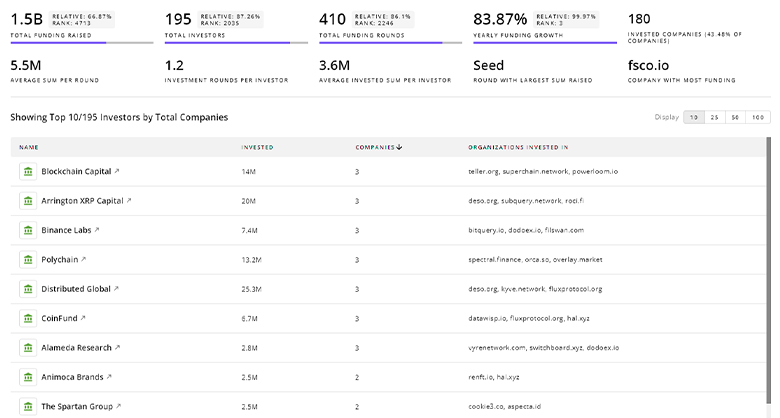
448 Space Research Investors
Discover Space Research Investors, Funding Rounds, Invested Amounts, and Funding Growth
Space Research News
Explore the evolution and current state of Space Research with TrendFeedr’s News feature. Access 4.9K Space Research articles that provide comprehensive insights into market trends and technological advancements.
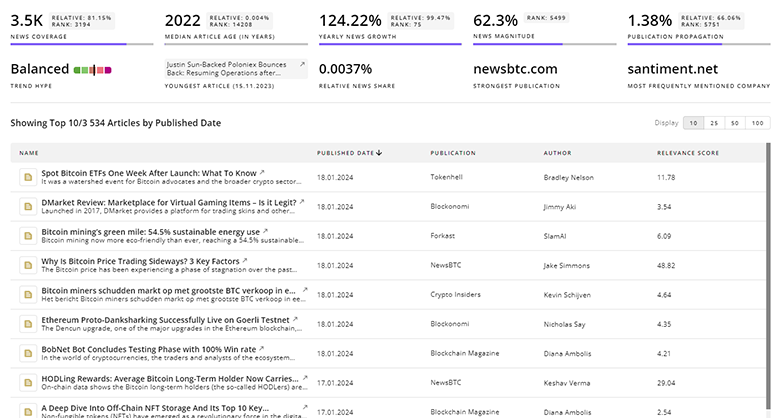
4.9K Space Research News Articles
Discover Latest Space Research Articles, News Magnitude, Publication Propagation, Yearly Growth, and Strongest Publications
Executive Summary
The evidence in the data available points to a space research market where scale and integration determine value capture: large platform builders will aggregate demand while service and software specialists sell essential capabilities into their stacks. Short-term winners will prove commercial product/market fit by combining technical credibility (flight heritage, certified propulsion or robotic subsystems) with repeatable commercial contracts (SLA-backed data products, debris-removal agreements, or hosted payload subscriptions). For investors and operators, the practical strategy is twofold: back platform integrators that control launch, bus, and customer access where possible; and for niche technology teams, pursue tightly specified interfaces and contractual pathways (refueling standards, dock protocols, data APIs) that embed you into platform procurement rather than competing at the platform level. Priorities to watch across 2025 include procurement rules for orbital sustainability, certification progress for electric/green propulsion, and commercial uptake of on-orbit servicing as a substitute for satellite replacement.
We're looking to collaborate with knowledgeable insiders to enhance our analysis of trends and tech. Join us!