Underwater Drones Report
: Analysis on the Market, Trends, and TechnologiesThe underwater drone market is maturing into a high-growth industrial sector: market data show $4,530,000,000 projected for 2025 with a 12% CAGR used in core forecasting models, indicating substantial near-term expansion anchored in inspection, defense, and environmental services. Recent independent market reports corroborate double-digit growth projections and highlight diverging forecasts driven by methodology differences, but all reportable datasets point to continued strong demand for longer-endurance autonomy and high-fidelity sensing ResearchAndMarkets – Underwater Drone Market.
242 days ago, we last updated this report. Notice something that’s not right? Let’s fix it together.
Topic Dominance Index of Underwater Drones
The Topic Dominance Index offers a holistic analysis of Underwater Drones, merging data from 3 diverse sources: relevant published articles, newly founded companies, and global search metrics.
Key Activities and Applications
- Subsea infrastructure inspection — pipelines, subsea power and telecom cables, foundation and cable-lay surveys for offshore wind and oil & gas, increasingly replacing diver work with remote visual and sonar inspection suites.
- Defense and maritime security — mine countermeasures, persistent ISR, harbor security, and anti-submarine support are major procurement drivers; navies prioritize long-endurance AUVs and hybrid systems for stand-off operations.
- Environmental monitoring & blue-carbon verification — routine reef health surveys, seagrass and benthic habitat mapping, and emissions/leak detection for blue-carbon accounting are growing commercial use-cases supported by high-resolution sensors.
- Aquaculture operations — automated net-cleaning, fish-health monitoring, and farm infrastructure inspection to lower labor costs and reduce stock losses.
- Search, salvage and scientific exploration — seabed mapping, wreck identification, and rapid-response search missions increasingly use AUV swarms or coordinated ROV fleets for area coverage efficiency.
- Underwater cinematography and media — high-definition autonomous platforms enable commercial filming, 360° VR capture, and immersive content for tourism and documentary production.
Emergent Trends and Core Insights
- Hybrid air/sea architectures and dual-domain platforms are moving from prototypes to fielded pilots, enabling compact launch/recovery and rapid mission handover between domains SubUAS LLC.
- AI-first autonomy for navigation, target recognition, and onboard data triage is shifting value from raw vehicle hardware to data-management and mission-planning software stacks.
- Swarm and cooperative multi-vehicle operations reduce cost-per-area surveyed and enable fault-tolerant large-area campaigns; governments and research teams are funding pilot programs for coordinated small-vehicle fleets.
- Energy & endurance advances (hydrogen fuel cells, hybrid propulsion) are enabling multi-day missions and reducing dependency on tethered systems for mid-depth operations.
- Sensor fusion and data-as-a-service (DaaS): high-resolution LiDAR, SAS, multi-beam sonar and computer vision pipelines are increasingly commercialized as subscription services rather than one-off hardware sales marketresearch - Unmanned Marine Autonomous Vehicles Market.
- Regulatory progress is uneven: regional harmonization is emerging but licensing and cross-border operational restrictions still constrain global deployment for many autonomous mission profiles.
Technologies and Methodologies
- AI-driven navigation and SLAM for GPS-denied localization and adaptive mission replanning on board AUV/ROV platforms.
- Acoustic communications and optical modems (high-bandwidth short-range optical links) to reduce reliance on tethers for data offload during inspection missions.
- Synthetic Aperture Sonar (SAS) + multi-beam fusion delivering centimeter-to-decimeter seabed mapping for engineering-grade surveys.
- Hybrid propulsion systems & hydrogen fuel cells for multi-day endurance, and asymmetric propulsion concepts for superior low-speed station-keeping and inspection precision.
- Modular payload bays and open software architectures enabling rapid reconfiguration between inspection, ecological sensing, and defense payloads to maximize vehicle utilization.
- Digital twin and cloud analytics workflows that convert repeated inspection passes into predictive maintenance indicators and regulatory evidence packages for operators Ocean infinity.
Underwater Drones Funding
A total of 63 Underwater Drones companies have received funding.
Overall, Underwater Drones companies have raised $705.7M.
Companies within the Underwater Drones domain have secured capital from 229 funding rounds.
The chart shows the funding trendline of Underwater Drones companies over the last 5 years
Underwater Drones Companies
- 3D at Depth — Commercializes the only deep-water LiDAR acquisition system for contactless, high-accuracy subsea measurement; their products produce millimetric 3D point clouds used in energy and utilities inspections and are sold as integrated service packages that reduce vessel time and risk. Their patented LiDAR approach targets survey customers that require repeatable, high-fidelity digital twins for asset management.
- SUBmerge Baltic — A Latvian R&D startup developing compact AUVs and ROVs with a focus on cost reduction through ML-based autonomy and low-cost sensors; their early funding indicates an aggressive low-price strategy aimed at aquaculture and coastal survey customers trying to lower operating expenditure.
- ARMADA Marine Robotics — Commercializes asymmetric propulsion systems developed in collaboration with maritime research institutions to improve low-speed maneuverability and station-keeping; the technology is aimed at inspection fleets that need a single vehicle to perform both fast survey and precision close-up tasks, reducing fleet complexity.
- Jaia Robotics — Builds micro, high-speed aquatic drones intended to operate in pods for persistent coastal monitoring and rapid data collection; their JaaS (JaiaBots as a Service) model targets municipalities and conservation agencies that require frequent, low-cost coverage rather than one-off high-value surveys.
- DeepWater Exploration Inc. — Focuses on subsea computer vision and perception stacks to enable better object recognition, real-time stereo reconstruction, and autonomy for extreme-depth missions; their software aims to convert lower-bandwidth sensor streams into actionable inspection products for AUV/ROV fleets.
Stay connected with industry movements through TrendFeedr’s Companies tool, which covers 416 Underwater Drones companies.
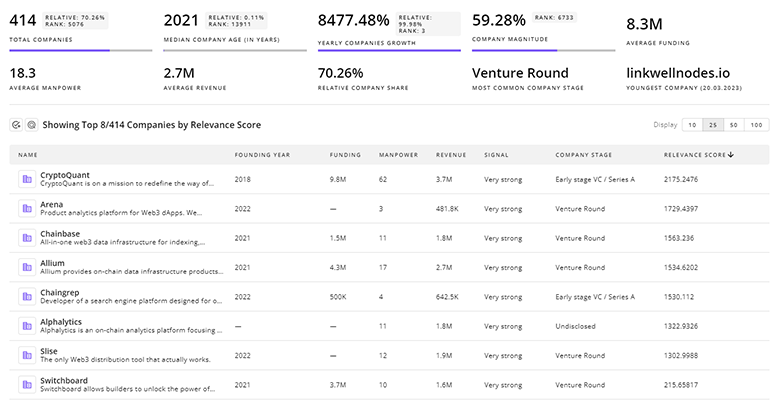
416 Underwater Drones Companies
Discover Underwater Drones Companies, their Funding, Manpower, Revenues, Stages, and much more
Underwater Drones Investors
Discover investment patterns and trends with TrendFeedr’s Investors tool based on insights into 257 Underwater Drones investors. This tool is essential for understanding the financial ecosystem of Underwater Drones and developing successful investment strategies.
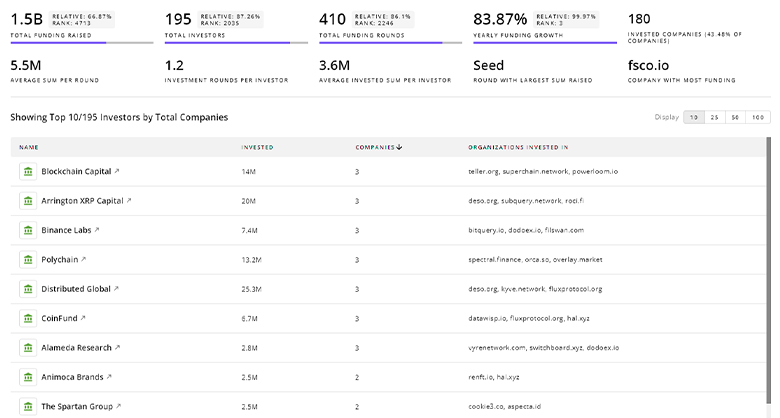
257 Underwater Drones Investors
Discover Underwater Drones Investors, Funding Rounds, Invested Amounts, and Funding Growth
Underwater Drones News
TrendFeedr’s News feature grants you access to 974 Underwater Drones articles. This tool supports professionals in tracking both past trends and current momentum in the industry.
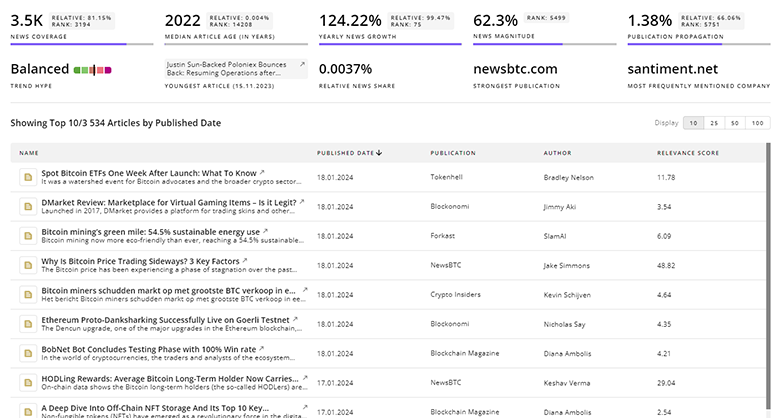
974 Underwater Drones News Articles
Discover Latest Underwater Drones Articles, News Magnitude, Publication Propagation, Yearly Growth, and Strongest Publications
Executive Summary
The underwater drone market is entering a phase where data orchestration and mission autonomy capture more economic value than vehicle hardware alone. Companies that combine long-endurance platforms with high-fidelity sensing and cloud analytics will access the largest contract opportunities in energy, defense, and environmental monitoring. At the same time, lower-cost micro-vehicle fleets and domain-specialist sensors will undercut traditional inspection models in mid-market segments (aquaculture, ports, and municipal services). Strategic decisions for firms and investors should therefore separate near-term hardware bets from longer-term investments in software, sensor fusion, and persistent monitoring contracts.
We're looking to collaborate with knowledgeable insiders to enhance our analysis of trends and tech. Join us!