Unmanned Aerial System Report
: Analysis on the Market, Trends, and TechnologiesThe unmanned aerial system sector is at a decisive scaling point: cumulative private funding across active firms tops $33.53B and the topic comprises 2,465 active companies, indicating both deep capital commitment and broad industrial participation. Market sizing from complementary internal forecasts estimates the UAS market at $40,680,000,000 in 2025 with a projected double-digit CAGR (~16.1%) through the coming decade, creating simultaneous demand for airspace orchestration, endurance solutions, and data-to-intelligence services.
93 days ago, we last updated this report. Notice something that’s not right? Let’s fix it together.
Topic Dominance Index of Unmanned Aerial System
The Topic Dominance Index offers a holistic analysis of Unmanned Aerial System, merging data from 3 diverse sources: relevant published articles, newly founded companies, and global search metrics.
Key Activities and Applications
- Precision Agriculture — crop health mapping, variable-rate spraying, and sterile insect release missions are moving from pilot projects to contracted services with direct yield and cost metrics tied to UAS deployments.
- Infrastructure Inspection & Maintenance — power lines, pipelines, rail, and telecom inspections now use DiaB (drone-in-a-box) fleets and RTK/PPK LiDAR payloads to replace costly manual surveys and accelerate maintenance cycles.
- Logistics & Tactical Resupply — last-mile delivery experiments and military resupply pilots emphasize VTOL and hybrid fixed-wing platforms to extend range and payload capability under constrained airspace rules.
- Public Safety, Search & Rescue, Disaster Response — persistent ISR and rapid medical parcel delivery are generating recurring, revenue-bearing contracts for service providers operating under experimental BVLOS corridors and institutional procurement.
- Defense ISR, EW, and Precision Strike Support — modular payload integration (EO/IR, SAR, SIGINT) and loitering munitions remain high priority for national buyers investing in force-protection and battlefield autonomy Unmanned Combat Aerial Vehicle Market Research Report.
- Airspace Management & Compliance Services — operators and municipalities increasingly purchase UTM/U-Space services for mission planning, preflight deconfliction, and regulatory compliance; these services act as gatekeepers for commercial BVLOS scale-up.
Emergent Trends and Core Insights
- UTM / Airspace Platform Consolidation — commercial scale depends on interoperable traffic management; a small set of software platforms is capturing regulatory validation and customer lock-in, creating a platform vs. ingredient competitive split.
- Edge AI for Mission Autonomy — on-board ML is shifting missions from human-supervised flights to conditional autonomous execution (object recognition, delivery confirmation, mission replanning), raising the value of high-integrity software stacks.
- Endurance & Hybrid Propulsion Race — extended time-on-station is the primary differentiator for surveillance, logistics, and naval UAS; investments target hybrid fuel-electric systems, solar energy harvesting, and hydrogen/fuel-cell powertrains to overcome battery limits.
- Swarm Operations and Manned–Unmanned Teaming — multi-UAS coordination and MUM-T architectures are moving from lab demonstrations to doctrinal experiments, altering force structure and operational concepts Combined Arms Warfare and Unmanned Aircraft Systems.
- Counter-UAS & Resilience Focus — proliferating small UAS threats drive rapid procurement of multi-sensor C-UAS suites and doctrine changes for layered defenses in both civilian and military theaters Countering Small Uncrewed Aerial Systems.
- Data Monetization Superseding Hardware Sales — companies that convert imagery and telemetry into standardized, actionable products (predictive maintenance feeds, regulatory audit trails, forensics) extract greater margins than pure airframe vendors.
Technologies and Methodologies
- Unmanned Traffic Management (UTM / U-Space) — cloud-native deconfliction, identity services, and strategic path planning are prerequisites for multi-operator BVLOS operations and regional commercialization pilots.
- Sensor Fusion: EO/IR + LiDAR + SAR + GMTI — multi-modal payloads enable cueing at scale and persistent wide-area surveillance; SAR integration onto small platforms is an accelerating capability for all-weather monitoring Global SAR UAV Overview and Forecast 2023-2029.
- Edge/Onboard AI & Autonomy — optimized neural inference for collision avoidance, GNSS-denied navigation (vision-based SLAM), and target classification reduce the need for continuous command links and improve survivability in contested EM environments.
- Drone-in-a-Box (DiaB) & Automated Ground Stations — autonomous charging, secure data offload, and automated launch/recovery are enabling persistent perimeter surveillance and industrial inspection business models.
- Modular, Open-Architecture Avionics — SOSA-aligned avionics and plug-and-play payload bays reduce upgrade cycles, shorten procurement risk, and enable reuse across military and commercial missions.
- SwarmC2 & Multi-UAS Mission Management — distributed mission managers with adaptive task reallocation create resilient fleet behavior when individual nodes fail; these systems are rapidly moving into field trials with defense partners.
Key takeaway: The dominant sources of near-term value are not airframes but secure, certified airspace orchestration, endurance hardware that extends mission time, and AI pipelines that convert sensor streams into revenue-grade intelligence.
Unmanned Aerial System Funding
A total of 481 Unmanned Aerial System companies have received funding.
Overall, Unmanned Aerial System companies have raised $33.5B.
Companies within the Unmanned Aerial System domain have secured capital from 1.7K funding rounds.
The chart shows the funding trendline of Unmanned Aerial System companies over the last 5 years
Unmanned Aerial System Companies
- OneSky — OneSky builds enterprise UTM and predictive airspace assessment tools for BVLOS and mixed-traffic environments; its platform leverages decades of aerospace modeling and targets enterprise operators and ANSPs. The company lists 34 employees and raised $11.00M in venture funding, positioning it as an early UTM platform contender.
- UAVOS (Switzerland) — UAVOS focuses on autopilot systems, servo drives, and high-reliability subsystems that integrate into industrial and defense fleets; its product set addresses the ingredient moat (components that platform integrators cannot easily substitute). The firm reports approximately 90 employees and emphasizes avionics integration for commercial and military clients.
- Kraus Hamdani Aerospace, Inc. — Kraus Hamdani Aerospace pursues solar-augmented, AI-driven persistent UAS that aim for extended airborne endurance and low emissions; the firm describes a full-scene AI approach to persistent ISR and lists 44 employees with early-stage funding activities. Its value proposition targets missions where time-on-station controls mission economics.
- M3 Agriculture Technologies — M3 Agriculture Technologies offers UAS-as-a-Service for agriculture, including sterile insect release and crop autonomy programs; the company operates mission services rather than pure hardware sales, converting flight hours into recurring agronomic value for growers and reporting 11 employees and angel funding.
- UAS Components — UAS Components supplies proven sub-systems (gimbals, antennas, tracking, batteries) to integrators and operators in multiple countries, forming a non-replaceable supplier layer for bespoke platforms; the vendor is a small team of roughly 10 staff focused on reliability and field-proven hardware.
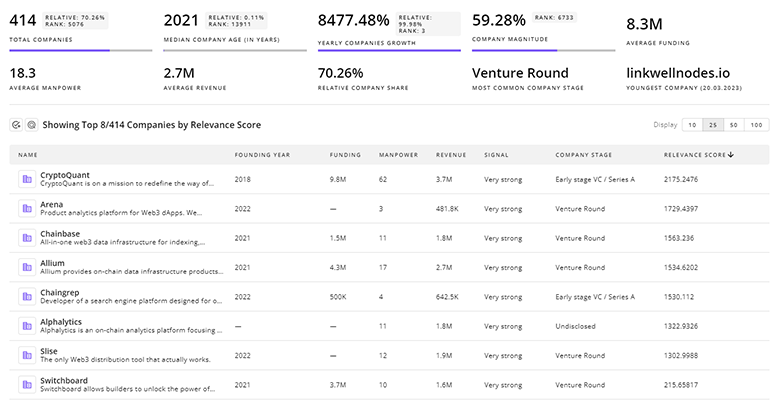
Stay connected with industry movements through TrendFeedr’s Companies tool, which covers 2.5K Unmanned Aerial System companies.
2.5K Unmanned Aerial System Companies
Discover Unmanned Aerial System Companies, their Funding, Manpower, Revenues, Stages, and much more
Unmanned Aerial System Investors
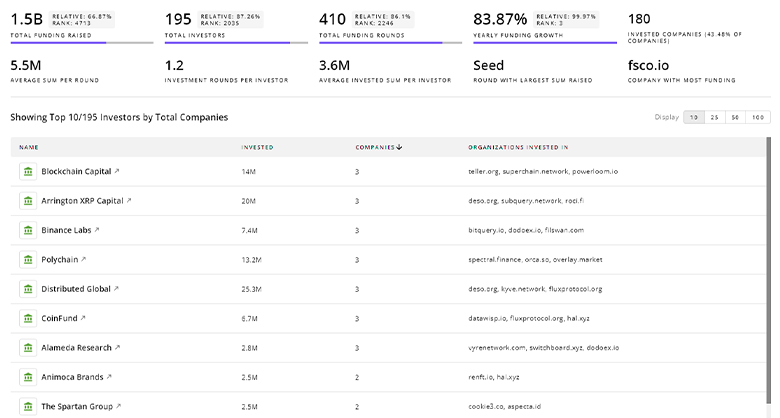
Discover investment patterns and trends with TrendFeedr’s Investors tool based on insights into 1.7K Unmanned Aerial System investors. This tool is essential for understanding the financial ecosystem of Unmanned Aerial System and developing successful investment strategies.
1.7K Unmanned Aerial System Investors
Discover Unmanned Aerial System Investors, Funding Rounds, Invested Amounts, and Funding Growth
Unmanned Aerial System News
TrendFeedr’s News feature grants you access to 6.3K Unmanned Aerial System articles. This tool supports professionals in tracking both past trends and current momentum in the industry.
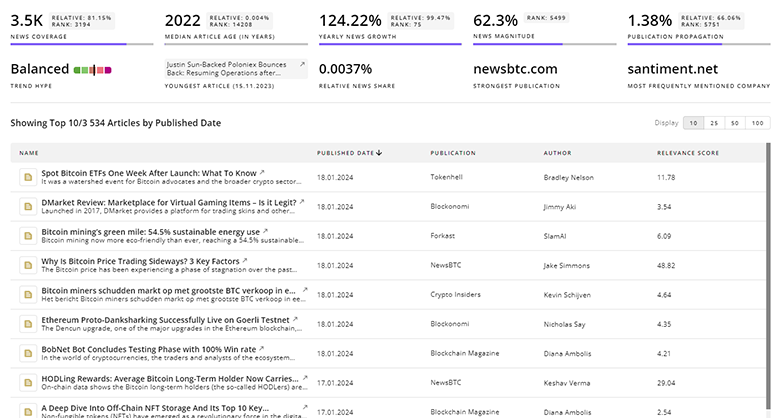
6.3K Unmanned Aerial System News Articles
Discover Latest Unmanned Aerial System Articles, News Magnitude, Publication Propagation, Yearly Growth, and Strongest Publications
Executive Summary
The unmanned aerial system market is shifting from hardware novelty to infrastructure and software governance. Success for investors and operators will come from capturing the non-airframe layers: validated UTM services, energy/endurance technologies, high-integrity autonomy stacks, and data products that convert imagery into recurring revenue. Firms that secure regulatory certifications and dual-sourced supply chains will face lower geopolitical and procurement risk; service providers must either integrate analytic product lines or partner with platform providers to avoid margin compression. Strategic bets that combine certified airspace control, long-endurance propulsion, and onboard AI will produce the most durable commercial returns in the next five years.
We're looking to collaborate with knowledgeable insiders to enhance our analysis of trends and tech. Join us!