
Voip Technology Report
: Analysis on the Market, Trends, and TechnologiesThe global VoIP market is already large and accelerating: the market size stood at $167,300,000,000 in 2024 with a projected compound annual growth rate of 15.8% that underpins aggressive expansion in business and mobile segments. Major demand drivers are enterprise migration to hosted Cloud PBX/UCaaS, rising mobile VoIP use, and embedding of AI for call analytics and automated routing; these dynamics are reshaping vendor economics from raw transport toward feature and intelligence monetization market.us – Global VoIP Services Market.
76 days ago, we last updated this report. Notice something that’s not right? Let’s fix it together.
Topic Dominance Index of Voip Technology
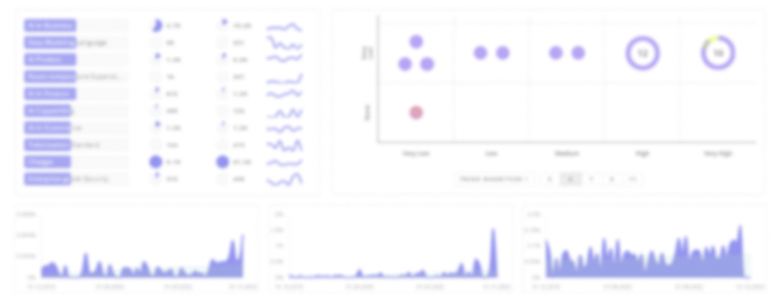
The Topic Dominance Index offers a holistic analysis of Voip Technology, merging data from 3 diverse sources: relevant published articles, newly founded companies, and global search metrics.
Key Activities and Applications
- Cloud PBX and UCaaS migrations — Enterprises replace on-premises PBX with hosted platforms to lower infrastructure costs and enable hybrid work. This trend concentrates spend on managed cloud services and SIP trunking.
- Contact center modernization — Cloud contact centers adopt VoIP plus AI for real-time transcription, sentiment scoring, and automated routing to reduce agent load and shorten handling times nextiva - VoIP Statistics & Trends.
- Mobile VoIP (mVoIP) and softphones — Smartphone softphone apps and integrated mobile dialers support BYOD and remote-first operations; mobile implementations drive international calling and virtual-number services grandviewresearch - Mobile VoIP Market.
- Wholesale voice and SIP trunking — Carriers and wholesalers continue to supply international termination and SIP trunk capacity as enterprises offload PSTN lines.
- Voice AI / Conversation Intelligence — Automated agents, call summarization, and coaching engines convert voice streams into measurable business outcomes (conversion lift, containment rates), shifting value capture upward to the application and analytics layer Vapi.
- POTS/ISDN replacement and 5G/VoWiFi enablement — Operators and vendors supply fixed-wireless and VoWiFi/VoLTE interworking products to retire legacy copper infrastructure and extend indoor coverage researchandmarkets - Mobile VoIP.
Emergent Trends and Core Insights
- AI as baseline for differentiation — Providers now compete on measurable AI outcomes (e.g. reduced agent handling time, automated containment) rather than on feature lists alone; AI is moving from novelty to a procurement requirement.
- Mobile-first and 5G / VoWiFi uplift — Lower latency and broader bandwidth from 5G and VoWiFi materially improve call quality and enable voice services to migrate further onto mobile networks, increasing mobile VoIP adoption rates in APAC and urban markets researchandmarkets - VoWiFi Market.
- Session and signaling control remain a high-value engineering domain — Patent activity and product roadmaps emphasize session establishment, SIP signaling hardening, and SBC capabilities to guarantee call reliability and regulatory compliance even as media transport improves.
- Security-first product design — As voice traffic increases, investments in SBCs, real-time threat detection, and end-to-end encryption rise to counter eavesdropping, toll fraud, and denial-of-service risks.
- Platformization and ingredient plays — Markets reward vendors that either provide broad platform APIs (CPaaS) or become indispensable ingredients (voice quality analytics, IMS stacks). This bifurcation drives M&A: buyers want either breadth or unique technical assets.
- Regulatory fragmentation and data residency risk — Global expansion requires localized routing, emergency-call handling, and data protection approaches; compliance adds delivery complexity and persistent implementation cost.
Technologies and Methodologies
- Session Initiation Protocol (SIP) trunking — The primary signaling model for enterprise VoIP interconnection and PSTN replacement; SIP remains fundamental to PBX replacement and wholesale routing.
- WebRTC for browser-based RTC — Enables in-browser voice/video without plugins and accelerates CPaaS adoption for softphones and embedded calling UI.
- Cloud-native IMS and containerized network functions — Operators pursue cloud IMS for VoLTE/VoNR and VoWiFi with faster TCO and automated lifecycle management; hyperscale IMS reduces operator OPEX in mobile voice delivery ng-voice.
- Session Border Controllers (SBCs) and SBC-as-a-Service — Critical for interworking, security, and lawful-access compliance across heterogeneous networks.
- AI-powered speech processing and voice analytics — Real-time STT, sentiment analysis, and voice biometrics drive contact-center automation and measurable KPIs for revenue and support efficiency researchandmarkets - Voice & Speech Recognition Technology Market.
- Edge computing for low-latency voice — Placing media and processing near users reduces jitter and enables higher quality mobile VoIP and immersive audio services.
- Quality monitoring & analytics (media + control plane) — Continuous voice-quality telemetry and correlation to control-plane events enable SLAs and automated remediation.
Voip Technology Funding
A total of 481 Voip Technology companies have received funding.
Overall, Voip Technology companies have raised $17.0B.
Companies within the Voip Technology domain have secured capital from 1.1K funding rounds.
The chart shows the funding trendline of Voip Technology companies over the last 5 years
Voip Technology Companies
Voipfuture
Voipfuture supplies high-resolution voice quality monitoring and analytics that correlate media and control planes to diagnose call quality at scale; the product targets service providers and enterprises seeking actionable SLAs and root-cause visibility. The company emphasizes operator-grade monitoring and visualization to reduce troubleshooting cycles and assure user experience. Its specialized analytics are a natural fit for platforms focused on predictable UC performance.Unicoi Systems
Unicoi Systems provides embedded networking stacks and reference designs used in massive device deployments; its Fusion stack appears in hundreds of millions of embedded designs that require real-time voice and multimedia support. The company positions itself as an ingredient supplier for device makers who need deterministic VoIP behavior without building networking software in-house. This lowers time-to-market for CPE and embedded voice endpoints.PrimeVOX Communications
PrimeVOX Communications offers a cloud PBX with patented AI quality enhancements and claims HIPAA compliance for healthcare telephony use cases; the firm targets regulated verticals where privacy and certified security are procurement prerequisites. Its differentiated focus on encrypted, auditable voice services makes it appealing to medical and legal customers that must meet strict data controls. PrimeVOX positions product reliability and regulatory readiness as its primary selling points.Vodia Networks Inc.
Vodia Networks delivers an OS-independent PBX software suite for on-premise and cloud telephony with broad SIP device compatibility; the product appeals to service providers and resellers who require flexible deployment models and multi-tenant operation. Vodia emphasizes a compact, feature-complete PBX that integrates easily with SIP trunks and contact center workflows, supporting distributed teams and hybrid topologies. The vendor's product is frequently used by operators seeking a low-footprint, standards-compliant PBX software stack.VoApps, Inc.
VoApps developed a patented DirectDrop voicemail delivery method that deposits messages directly into recipients' voicemail servers without calling the handset, creating a non-intrusive outreach channel for collections and large-scale notifications. That specialization makes VoApps attractive to enterprises seeking higher deliverability and compliance in outbound voice programs. The patent-backed approach and subsequent acquisition interest reflect investor appetite for niche, patentable voice technologies.
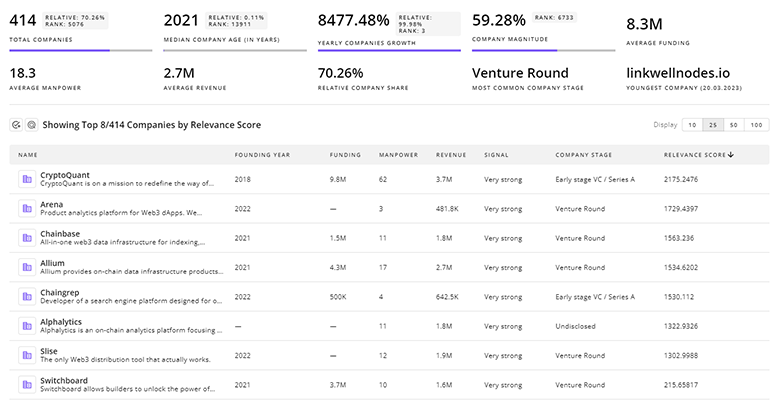
Stay connected with industry movements through TrendFeedr’s Companies tool, which covers 11.1K Voip Technology companies.
11.1K Voip Technology Companies
Discover Voip Technology Companies, their Funding, Manpower, Revenues, Stages, and much more
Voip Technology Investors
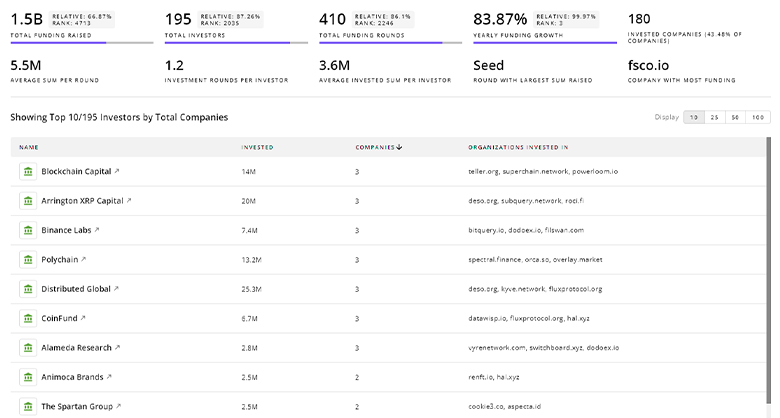
Discover investment patterns and trends with TrendFeedr’s Investors tool based on insights into 921 Voip Technology investors. This tool is essential for understanding the financial ecosystem of Voip Technology and developing successful investment strategies.
921 Voip Technology Investors
Discover Voip Technology Investors, Funding Rounds, Invested Amounts, and Funding Growth
Voip Technology News
TrendFeedr’s News feature grants you access to 4.2K Voip Technology articles. This tool supports professionals in tracking both past trends and current momentum in the industry.

4.2K Voip Technology News Articles
Discover Latest Voip Technology Articles, News Magnitude, Publication Propagation, Yearly Growth, and Strongest Publications
Executive Summary
VoIP has shifted from a connectivity innovation to an outcomes business where AI, compliance, and developer APIs capture the premium. The largest near-term opportunities sit in enterprise contact center automation, mobile VoIP assisted by 5G/VoWiFi, and platform APIs that embed voice into business workflows. Vendors should decide whether to pursue platform scale via integrated stacks and M&A or to defend a high-value ingredient position (quality telemetry, IMS, voice AI) that buyers cannot easily replicate. Security and regional regulatory compliance will remain gating factors for global expansion; addressing them early converts technical capability into commercial trust. Companies that map product roadmaps explicitly to measurable business outcomes (reduced handle time, improved FCR, certified compliance) will preserve margins as transport commoditizes.
We're looking to collaborate with knowledgeable insiders to enhance our analysis of trends and tech. Join us!