Agentic AI Report
: Analysis on the Market, Trends, and TechnologiesThe Agentic AI market is moving from experiment to execution: total funding across the topic reached $106.96B, showing that capital and commercial activity already back wide enterprise deployment. Businesses pursue agentic systems because they combine planning, tool use, and autonomous action to remove repetitive work, orchestrate workflows across silos, and run multi-step processes with limited human oversight — outcomes documented in industry surveys and vendor advisories that show rapid pilots and early production use in finance, insurance, customer service, and IT operations Imagining the future of banking with agentic AI The Rise of Agentic AI: Transforming Business Processes and Decision Making.
This report was last updated 377 days ago. Spot an error or missing detail? Help us fix it by getting in touch!
Topic Dominance Index of Agentic AI
To identify the Dominance Index of Agentic AI in the Trend and Technology ecosystem, we look at 3 different time series: the timeline of published articles, founded companies, and global search.
Key Activities and Applications
- Autonomous task execution and workflow automation — agents plan multi-step workflows, call APIs or systems, handle exceptions and escalate when confidence is low; enterprises deploy these agents to cut manual exception-handling and speed outcomes Finding value from AI agents from day one.
- Customer-facing virtual employees and contact automation — agentic agents manage end-to-end interactions (onboarding, claims, billing adjustments) that previously required multistage human handoffs, improving throughput and personalization Agentic AI: Automated Claims Processing Multi-Agent System.
- Security automation and autonomous defense — swarming, goal-directed security agents that detect, investigate, and remediate threats without manual orchestration are emerging as a high-value use case for reducing mean-time-to-detect and respond.
- Industry workflows and decision support (finance, healthcare, supply chain) — agents synthesize unstructured documents, run simulations, and execute decisions (underwriting, triage, procurement) while maintaining audit trails for governance The Impact of Agentic AI on the Financial Services Industry.
- Agentic developer platforms and marketplaces — platforms provide reasoning LLMs, orchestration fabrics, connectors and no-code tooling to package agents as deployable digital workers for enterprise systems.
Emergent Trends and Core Insights
- Platform consolidation and “agent orchestration” as the standard. Market research shows vendors building full-stack agent platforms (data, orchestration, tooling, governance); buyers expect integrated platforms rather than point solutions C3 AI Highlights New Agentic AI Platform Capabilities.
- Interoperability and data readiness determine early winners. Analysts emphasize that agent value depends on access to clean, connected enterprise data and standards (agent-to-agent protocols, model-context connectors) to scale multi-agent use cases.
- Multi-agent systems replace isolated automations. Workflows evolve from single-agent automations to cooperative agent crews and orchestrators that divide labor, improving resilience and specialization Automation 2.0: The Rise of Intelligent AI Agents (Vol. 1).
- Trust, explainability, and governance become product features, not afterthoughts. Regulators and enterprise buyers demand auditability, fail-safes, and transparent decision records as part of agentic deployments Agentic AI in Cybersecurity: A Primer Guide for Cybersecurity Architects.
- No-code/low-code agent creation will democratize adoption but shift risk profiles; organizations must pair democratization with guardrails and observability to avoid runaway or misaligned agents.
Technologies and Methodologies
- Reasoning-capable LLMs and domain-specific foundation models — agents increasingly rely on LLMs extended with planning primitives and domain adapters to perform multi-step reasoning and tool calls.
- Retrieval-augmented generation (RAG) and knowledge-grounding — RAG remains the principal technique to ground agents in current, auditable enterprise data to reduce hallucination risk and increase domain alignment Agentic AI Market Research Report By Technology Global Agentic AI Market Size, Share, and Trends Analysis Report.
- Multi-agent orchestration frameworks and supervisor agents — orchestration layers (supervisors, choreographers) assign subtasks and reconcile outputs from specialist agents to reach higher-level goals.
- Neurosymbolic and hybrid architectures for explainability — combining symbolic reasoning with neural models provides deterministic traces for critical decisions in regulated domains.
- Agent testing, observability, and lifecycle tooling — mature deployments require versioned agent artefacts, simulation environments, replay logs, and quantitative performance thresholds before agents can operate untethered Moving Agentic Workflows into Work.
Agentic AI Funding
A total of 3.8K Agentic AI companies have received funding.
Overall, Agentic AI companies have raised $111.8B.
Companies within the Agentic AI domain have secured capital from 12.2K funding rounds.
The chart shows the funding trendline of Agentic AI companies over the last 5 years
Agentic AI Companies
- TheAgentic — TheAgentic offers a stack designed to let startups and mid-market teams build reasoning LLM-driven digital workers, plus web automation and a digital-worker framework that targets enterprise integration and cost efficiency; the company positions itself as an infrastructure provider for private agent fleets and provides hands-on launch support for customers.
- 7AI — 7AI focuses on agentic security: the platform uses swarms of autonomous agents to detect, investigate, and act on cyber threats, aiming to reduce human workload in SOCs; the company has substantial VC backing and targets rapid enterprise security automation.
- NAITIVE — NAITIVE acts as an agentic AI consultancy and systems integrator that designs and delivers customized autonomous agents and multi-agent crews for cloud-first enterprises; it emphasizes business outcome mapping and production integration on major public clouds.
- AgenticFlow — AgenticFlow provides a no-code OS for building and running agent workforces focused on marketing and sales workflows; the product aims at rapid deployment for business teams that need to automate content pipelines and lead workflows without deep engineer resources.
- SimplAI — SimplAI supplies an enterprise-focused studio for building, deploying, and monitoring high-accuracy agentic applications with connectors, observability, and flexible deployment options (cloud, private cloud, on-prem) targeted at regulated verticals like finance and healthcare.
Identify and analyze 17.6K innovators and key players in Agentic AI more easily with this feature.
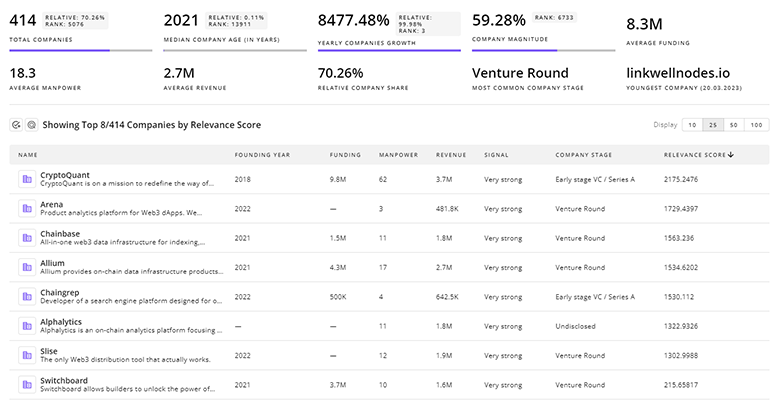
17.6K Agentic AI Companies
Discover Agentic AI Companies, their Funding, Manpower, Revenues, Stages, and much more
Agentic AI Investors
TrendFeedr’s investors tool offers a detailed view of investment activities that align with specific trends and technologies. This tool features comprehensive data on 12.2K Agentic AI investors, funding rounds, and investment trends, providing an overview of market dynamics.
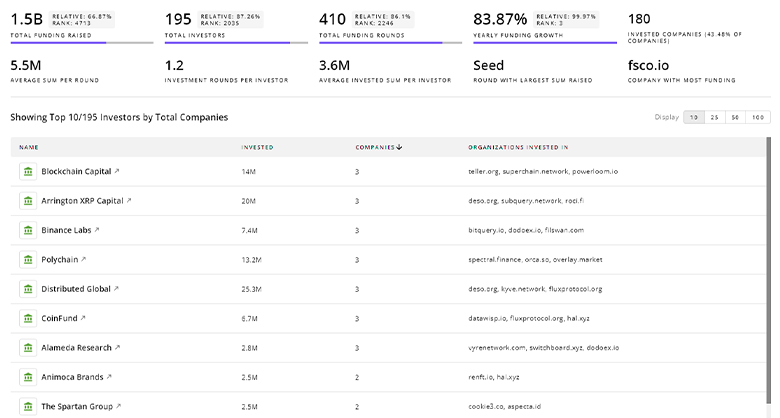
12.2K Agentic AI Investors
Discover Agentic AI Investors, Funding Rounds, Invested Amounts, and Funding Growth
Agentic AI News
Stay informed and ahead of the curve with TrendFeedr’s News feature, which provides access to 23.0K Agentic AI articles. The tool is tailored for professionals seeking to understand the historical trajectory and current momentum of changing market trends.
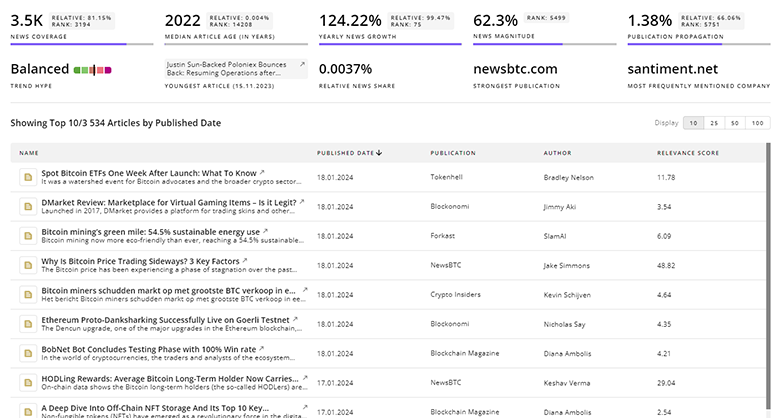
23.0K Agentic AI News Articles
Discover Latest Agentic AI Articles, News Magnitude, Publication Propagation, Yearly Growth, and Strongest Publications
Executive Summary
Agentic AI is already moving past proof-of-concept into domain-specific production. The most immediate business value appears where agents replace brittle, exception-heavy automation (claims, customer operations, security playbooks) and where enterprises invest first in data interoperability and governance. Winning vendors will deliver: (1) integrated agent stacks that include reasoning models plus observability and safety tooling; (2) connectors and protocols that make agents plug into enterprise data and workflows; and (3) clear governance primitives that let organizations run agents with auditable decisions. Firms that follow a stepwise, use-case-led adoption path — stabilizing data and controls before broad agent rollout — will capture outsized operational gains while minimizing regulatory and trust friction.
Interested in enhancing our coverage of trends and tech? We value insights from experts like you - reach out!