AI Semiconductors Report
: Analysis on the Market, Trends, and TechnologiesThe AI semiconductor landscape is concentrated and accelerating: the topic shows 884 published articles, 455 active companies and $10.54B total funding to date, indicating a mature news cycle and meaningful capital commitment to applied device innovation. Market forecasts place the broader AI-semiconductor market at $56.42B (2024) and projecting to $232.85B by 2034 at an expected ~15% CAGR, driven by data-center training demand and rapidly expanding inference at the edge precedenceresearch – Artificial Intelligence (AI) in Semiconductor, 2024. This report synthesizes company signals, patent/technology signals, and market research to show where value will pool: specialized architectural integration, advanced packaging and memory-centric designs will determine winners across data-center, automotive and edge segments market_us – Global Semiconductor Market Report, 2024.
This report was last updated 303 days ago. Spot an error or missing detail? Help us fix it by getting in touch!
Topic Dominance Index of AI Semiconductors
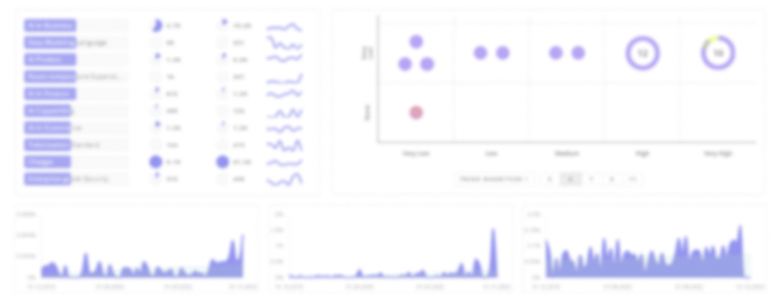
To identify the Dominance Index of AI Semiconductors in the Trend and Technology ecosystem, we look at 3 different time series: the timeline of published articles, founded companies, and global search.
Key Activities and Applications
- Design and deployment of domain-specific accelerators for training and inference (GPUs, TPUs, ASICs, NPUs) to meet data-center and cloud provider demands, with growing allocation of capex to AI-tailored silicon.
- Development of ultra-low-power edge AI processors and sensor-integrated inference IP for always-on devices (wearables, smart cameras, in-vehicle sensors), enabling local privacy and sub-milliwatt operation marketresearch – The Global Market for AI Chips, 2023.
- Integration of memory-centric compute (in-memory, PIM, analog memory-computing) to cut energy cost of data movement for large model inference and specialized workloads.
- Advanced packaging and chiplet ecosystems (2.5D/3D stacking, hybrid bonding, large interposers) to combine heterogeneous dies (logic + HBM + I/O) and extend performance without exclusive reliance on node scaling.
- Wide-bandgap and backend materials work (SiC, GaN, thermal substrates, novel ILDs) to address thermal and power delivery constraints inside AI racks and high-power modules.
- AI-assisted EDA and yield flows (AI/ML for placement, routing, virtual metrology and defect detection) that compress design cycles and raise effective productivity across the value chain.
- Automotive-grade AI silicon and safety-certified SoCs (ASIL/B–D) focused on sensor fusion, ADAS and domain controllers where deterministic latency and FuSa compliance command premium margins.
Emergent Trends and Core Insights
- The market narrative is shifting from node-centric scaling to system-level integration: package and interconnect cost share has increased materially, placing strategic value in back-end capabilities and chiplet ecosystems researchandmarkets – Thematic Intelligence: AI Chips, 2024.
- Data movement now dominates AI energy budgets; memory bandwidth (HBM evolution) and co-located memory stacks are central technical priorities for high-throughput accelerators.
- Neuromorphic and analog in-memory approaches are maturing as edge-first, ultra-low-power alternatives—these architectures show outsized CAGR potential relative to their current base and will reframe edge use cases if latency and programmability gaps close.
- Geopolitical and policy programs are re-shaping manufacturing geography: localized capacity for advanced packaging and test is rising in Europe, North America and India, changing logistics and strategic supplier choice.
- EDA and design automation will become a competitive lever: AI-native flows promise step-function productivity improvements and create a moat for vendors who integrate toolchains with hardware IP.
Technologies and Methodologies
- Packet-based neural acceleration and event-driven pipelines for low-latency inference in constrained environments, delivering throughput while minimizing idle power.
- Analog in-memory computing and memcapacitor/memristor arrays to collapse read/write cycles and reduce energy per MAC for inference workloads.
- 3D scalable die stacking and chiplet fabrics (die-to-wafer hybrid bonding, large 2.5D interposers) to mix process nodes and memory technologies inside single packages for superior bandwidth/latency profiles.
- Charge-domain and mixed-signal compute (sensor-level inference without ADC overhead) to achieve sub-milliwatt always-on sensing and eliminate digitization bottlenecks for camera/audio/edge sensor stacks.
- Materials and thermal substrates (SiC, GaN, advanced ILDs, diamond thermal interfaces) deployed to expand power headroom in racks and reduce cooling/power costs per TOPS.
- AI-driven EDA and virtual metrology that co-optimizes layout, interconnect and yield predictions to shorten time-to-market and lower NRE for semi-custom ASIC flows.
AI Semiconductors Funding
A total of 149 AI Semiconductors companies have received funding.
Overall, AI Semiconductors companies have raised $12.0B.
Companies within the AI Semiconductors domain have secured capital from 519 funding rounds.
The chart shows the funding trendline of AI Semiconductors companies over the last 5 years
AI Semiconductors Companies
- AIStorm Inc. — AIStorm pairs charge-domain processing with sensor-level IP to execute inference directly on electrical charge, eliminating ADC overhead and delivering sub-milliwatt always-on capabilities. The firm targets in-sensor vision and audio applications where latency and power dominate system design choices. Its IP-first model (charge-domain blocks and reference designs) makes it attractive to OEMs designing privacy-sensitive endpoint devices. Financial and company profile detail support its position as a niche analog/mixed-signal innovator.
- Semidrive Semiconductor — Semidrive produces automotive-grade SoCs and domain controllers with explicit emphasis on ISO 26262 safety readiness and mass production for vehicle OEMs. The company claims broad platform coverage (cockpit, ADAS, gateway) and reports adoption across a sizable share of domestic automakers, making it a readable play on high-reliability, FuSa-certified AI silicon for vehicles. Its revenue/funding profile and client footprint indicate fast scaling inside a safety-constrained vertical.
- CoolCAD Electronics, Inc. — CoolCAD focuses on wide-bandgap SiC transistors and ICs engineered for extreme-temperature, high-voltage environments (up to 400°C) and targets power-dense modules for EV chargers, industrial converters and rugged sensors. That materials focus addresses a backend pain point—thermal limits and power delivery in high-density AI power systems—and positions the company for partnerships in high-power infrastructures. Small team and IP posture make CoolCAD a specialized supplier for high-temperature power subsystems.
- llmda Inc — llmda offers an AI-native design automation/semantic engine for semiconductor and hardware systems that claims to speed verification and reduce end-to-end design defects by orders of magnitude. Its product addresses the productivity bottleneck in complex AI SoC flows and aligns with the industry trend of embedding ML into EDA for placement, routing and yield forecasting. As a compact, early-stage vendor it can become a leverage point for teams adopting AI-first design methodologies.
Identify and analyze 500 innovators and key players in AI Semiconductors more easily with this feature.
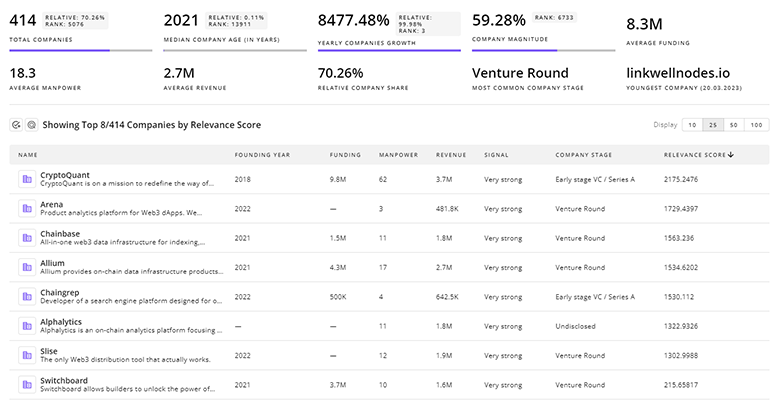
500 AI Semiconductors Companies
Discover AI Semiconductors Companies, their Funding, Manpower, Revenues, Stages, and much more
AI Semiconductors Investors
TrendFeedr’s investors tool offers a detailed view of investment activities that align with specific trends and technologies. This tool features comprehensive data on 832 AI Semiconductors investors, funding rounds, and investment trends, providing an overview of market dynamics.
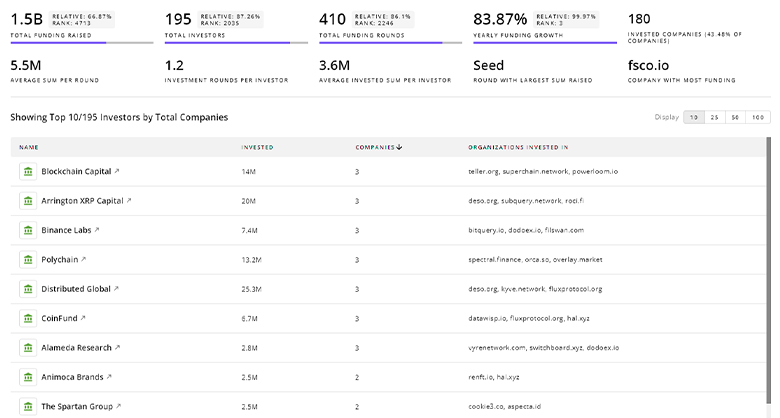
832 AI Semiconductors Investors
Discover AI Semiconductors Investors, Funding Rounds, Invested Amounts, and Funding Growth
AI Semiconductors News
Stay informed and ahead of the curve with TrendFeedr’s News feature, which provides access to 1.0K AI Semiconductors articles. The tool is tailored for professionals seeking to understand the historical trajectory and current momentum of changing market trends.
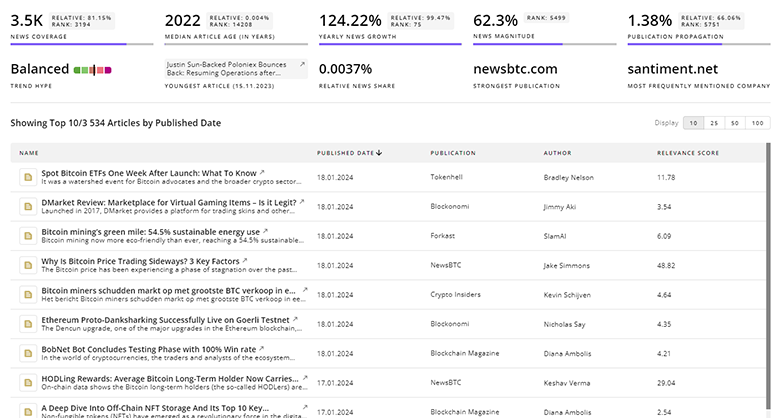
1.0K AI Semiconductors News Articles
Discover Latest AI Semiconductors Articles, News Magnitude, Publication Propagation, Yearly Growth, and Strongest Publications
Executive Summary
The competitive frontier for AI semiconductors sits at the intersection of architectural specialization, heterogeneous integration and manufacturing resilience. Financial and news signals show strong investor interest, but real margin capture will attach to those who control system integration layers—advanced packaging, memory stacking and domain-tuned IP—rather than commodity die production. For the business community this implies three strategic priorities: secure access to advanced packaging and test capacity; invest in memory-centric and low-power compute building blocks; and adopt AI-driven design tooling to compress NRE and accelerate product cycles. Those who align product roadmaps, supply-chain commitments and IP strategies around these priorities will best capture the expanding AI-silicon value pool.
Interested in enhancing our coverage of trends and tech? We value insights from experts like you - reach out!