Alternate Credit Scoring Report
: Analysis on the Market, Trends, and TechnologiesThe alternative credit scoring sector is accelerating into mainstream underwriting, driven by rapid adoption of permissioned transaction feeds and AI models that materially improve risk separation; the market is estimated at USD 1.82 billion in 2024 and is forecast to reach USD 8.67 billion by 2033 (CAGR 18.9%) Alternative Credit Scoring Market Research Report 2033. Bank-transaction streams account for 17.2% of global alternative-data usage and BNPL activity supported US $94 billion of U.S. lending in 2024, shifting where predictive signal value sits inside underwriting Alternative Financial Credit Scoring Market Share & Trends [2033]. These dynamics create immediate commercial opportunities for API-first scoring engines, telco/telco-data specialists and psychometric providers that can prove measurable lift while meeting tightening explainability requirements. Institutional capital and regulatory pressure are simultaneously concentrating development and raising the technical bar for deployment Credit Scoring Market Report 2023-28 – Juniper Research.
This report was last updated yesterday. Spot an error or missing detail? Help us fix it by getting in touch!
Topic Dominance Index of Alternate Credit Scoring
To identify the Dominance Index of Alternate Credit Scoring in the Trend and Technology ecosystem, we look at 3 different time series: the timeline of published articles, founded companies, and global search.
Key Activities and Applications
- Permissioned cash-flow underwriting via open-banking APIs. Lenders and scoring providers ingest consumer bank statements in real time to generate affordability and volatility signals that supplement bureau files, improving approvals for thin-file borrowers.
- BNPL and installment behavior integration. Lenders incorporate point-of-sale installment histories as credit signals; BNPL funded volumes reached US $94 billion in 2024, creating a fast-growing ledger of near-repayment performance that can proxy short-term creditworthiness.
- Telco and device data scoring for the un-banked. Telco metadata (voice, SMS, data usage, top-up patterns) is used in markets with sparse bureau coverage to produce accept/reject signals and fraud flags, especially for mobile-first lending AI Credit Scoring Market Forecasts to 2032 – Global Analysis By Data Type.
- Psychometric and behavioral assessments to capture repayment intention. Short, validated psychometric assays and passive behavioral proxies are used to augment propensity signals for gig and informal workers Alternative Credit Scoring Market Forecasts To 2032 – Global Analysis By Data Type.
- SME credit using platform data and transaction analytics. E-commerce, POS and supplier payment flows feed models that estimate cash conversion cycles and working capital risk for small business lending, enabling faster credit decisions and dynamic limits.
Emergent Trends and Core Insights
- Hybrid scores that combine bureau, open-banking and alternative feeds are standard adoption paths. Integrating these sources roughly improves predictive power in pilot programs by about 10% versus bureau-only models.
- Explainability and audit trails have moved from “nice to have” to procurement gatekeepers. Regulators in multiple jurisdictions now require documented reasoning for adverse actions, forcing vendors to bake feature-level explanations into models and to demonstrate fairness testing methods.
- Real-time and continuous scoring is replacing static snapshots. Lenders want low-latency updates to reflect recent cash-flow shocks or BNPL delinquencies, changing both architecture and data-ingestion economics.
- Geographic specialization delivers defensibility. Country-level data ecosystems (telco patterns, rental records, payment rails) produce stronger local models than generic global approaches, so regional players that own data partnerships outperform plug-and-play entrants GCC AI-Driven Credit Scoring Platforms Market.
- Capital and consolidation risk for small innovators. While total sector funding is large in aggregate, acquisition interest by incumbents is high; smaller providers must demonstrate replicable lift or embed into platform partners quickly Credit Scoring Market Report 2025.
Technologies and Methodologies
- Gradient-boosted decision ensembles (XGBoost, LightGBM). Widely used for tabular alternative data and known to deliver high AUC and interpretable feature importance for compliance workflows.
- Random Forest and ensemble stacking for stability. Ensembles remain popular where model stability and variance reduction are prioritized for regulatory review.
- Neural embeddings and sequence models for transactional streams. RNNs and transformer-style encoders extract temporal patterns from bank feeds and POS logs where sequence matters. Explainability layers are added to satisfy compliance needs.
- Federated learning and privacy-preserving analytics. Privacy constraints encourage architectures that train across institutional silos without exposing raw data, enabling larger training sets while reducing legal exposure.
- Explainable AI toolkits (SHAP, LIME) integrated into decision pipelines. These produce per-customer reason codes required for fair-lending audits and adverse-action notices.
- API-first LaaS platforms for embedding credit. Lending as a Service products expose underwriting and scoring as modular APIs so retailers and platforms can originate credit without building models in-house.
Alternate Credit Scoring Funding
A total of 1.7K Alternate Credit Scoring companies have received funding.
Overall, Alternate Credit Scoring companies have raised $499.2B.
Companies within the Alternate Credit Scoring domain have secured capital from 7.1K funding rounds.
The chart shows the funding trendline of Alternate Credit Scoring companies over the last 5 years
Alternate Credit Scoring Companies
- Finclude
Finclude offers a pan-European transactional scoring engine built on PSD2 connectivity that targets underserved consumers across EU markets. The firm emphasizes affordability and forward-looking measures derived from account streams, helping merchants and lenders accelerate onboarding while staying GDPR-compliant. Its product suite includes API endpoints for affordability, propensity and fraud flags tailored to regional banks and fintechs. - Begini
Begini produces behavioral-analytics scores that rely on first-party, privacy-preserving signals to estimate repayment intent without exposing identity data. The company focuses on zero-PII feature engineering and short, anonymous behavioral surveys that lift approvals for thin-file consumers in EU and UK pilots. Begini positions its score as a non-bureau complement that reduces false negatives among low-history applicants. - Aawaz AI
Aawaz AI concentrates on women-led micro and small enterprises in Pakistan, integrating psychometrics, web/social signals and passive collection pipelines designed for low-touch data capture. The company’s niche focus enables deeper feature creation for a demographic often invisible to traditional models, improving inclusion while preserving targeted risk controls. - 20NINE
20NINE builds credit readiness for micro-retailers in markets such as Sweden, Kenya and Vietnam by combining point-of-sale patterns with lightweight identity verification. Its platform ties everyday purchase behavior to scoring outputs that lenders and suppliers can consume through an embedded payments flow, enabling credit offers at checkout with minimal friction. The company’s data strategy focuses on small merchant panels and transaction exhaust that legacy bureaus miss. - RiskSeal
RiskSeal produces a digital-footprint credit signal by verifying email and phone attributes across 140+ online sources, returning 300+ data points per applicant and a ready-to-use digital credit score. That signal reduces manual verification and doubles approval rates in pilots, while also offering fraud indicators suitable for thin-file workflows. RiskSeal’s model is API-first and targets marketplaces and digital lenders needing global coverage.
Identify and analyze 12.3K innovators and key players in Alternate Credit Scoring more easily with this feature.
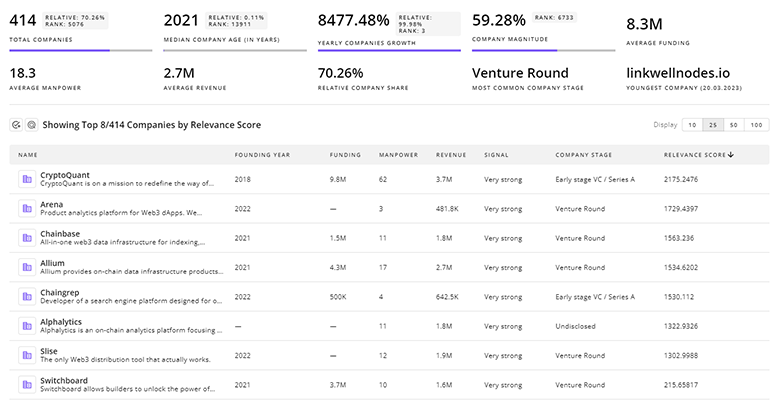
12.3K Alternate Credit Scoring Companies
Discover Alternate Credit Scoring Companies, their Funding, Manpower, Revenues, Stages, and much more
Alternate Credit Scoring Investors
TrendFeedr’s investors tool offers a detailed view of investment activities that align with specific trends and technologies. This tool features comprehensive data on 8.2K Alternate Credit Scoring investors, funding rounds, and investment trends, providing an overview of market dynamics.
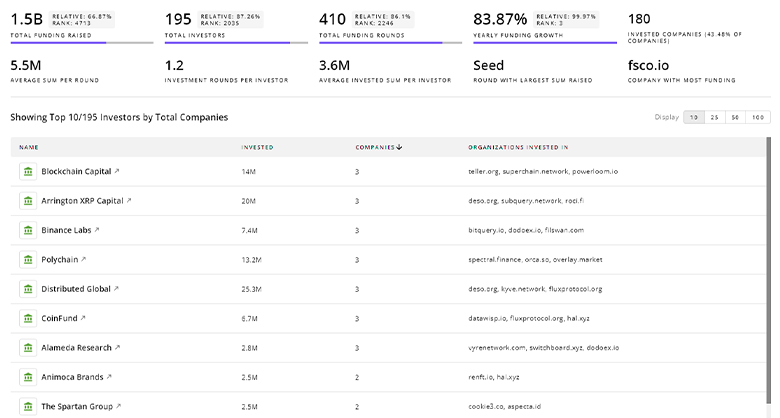
8.2K Alternate Credit Scoring Investors
Discover Alternate Credit Scoring Investors, Funding Rounds, Invested Amounts, and Funding Growth
Alternate Credit Scoring News
Stay informed and ahead of the curve with TrendFeedr’s News feature, which provides access to 2.1K Alternate Credit Scoring articles. The tool is tailored for professionals seeking to understand the historical trajectory and current momentum of changing market trends.
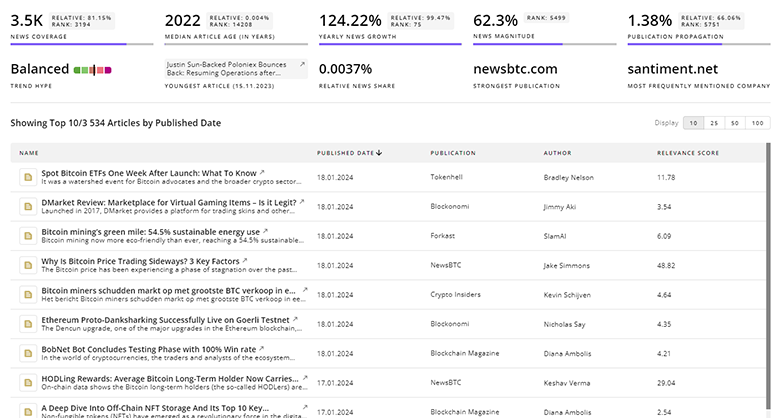
2.1K Alternate Credit Scoring News Articles
Discover Latest Alternate Credit Scoring Articles, News Magnitude, Publication Propagation, Yearly Growth, and Strongest Publications
Executive Summary
Alternate credit scoring has shifted from experimental pilots to production-grade underwriting where wins require both superior signal lift and documented explainability. The near-term winners will be firms that pair provable predictive gains from non-traditional data with engineering that satisfies audit and privacy constraints. Commercial strategies should prioritize: (1) rapid integration with platform partners to scale ingestion, (2) clear adverse-action reasoning and fairness testing to pass regulatory gates, and (3) geographic specialization where local data partnerships create defensible performance advantages. Lenders that adopt hybrid scoring stacks, and fintechs that embed those stacks as APIs, will capture higher conversion for thin-file and cross-border segments while managing the operational risk of model governance.
Interested in enhancing our coverage of trends and tech? We value insights from experts like you - reach out!