
Camera Technology Report
: Analysis on the Market, Trends, and TechnologiesThe camera-technology market is being restructured around computational intelligence and application-specific sensing: Total funding raised: $287.00B signals the scale of ongoing investment while 217,842 articles and 115,364 active companies show the topic’s broad industrial footprint. Market demand concentrates on AI-enabled image signal processing, depth-aware sensing for automation, and networked video platforms that convert visual streams into actionable telemetry, with specialized subsegments (e.g. intelligent cameras at $6.04B market size in 2024) growing at double-digit rates.
We updated this report 65 days ago. Noticed something’s off? Let’s make it right together — reach out!
Topic Dominance Index of Camera Technology
The Topic Dominance Index trendline combines the share of voice distributions of Camera Technology from 3 data sources: published articles, founded companies, and global search
Key Activities and Applications
- Low-light and HDR video enhancement (real-time AI ISP) — Vendors implement prediction-based ISPs and neural image pipelines to deliver color-accurate, low-noise video for security, automotive, and mobile devices; commercial partners include silicon and SoC integrators that embed inference on edge processors Visionary.ai.
- ADAS and vehicle surround-view / driver monitoring — Multi-camera arrays, stereo and passive depth sensors, and sensor-fusion stacks support perception and safety telemetry in road vehicles, with mature deployments exceeding 1.2M ADAS units from fleet and Tier-1 integrators A.I.MATICS Inc.
- Industrial machine vision and automation — High-speed global-shutter sensors, IP68 edge-AI cameras, and synchronized multi-camera rigs deliver inspection, pick-and-place guidance, and AOI across manufacturing lines; the machine-vision segment is forecast to exceed $13.52B by 2025 at a 15.2% CAGR.
- Networked surveillance with on-device analytics — IP cameras and VSaaS platforms shift value to event extraction (object classification, ANPR, anomaly detection), driving an IP camera share approaching 49.6% of system sales and necessitating PoE, edge compute, and hardened cybersecurity Camera Systems Market Size & Opportunities, 2025-2032.
- 3D, SWIR, and multispectral sensing for harsh / low-visibility conditions — Short-wave infrared (SWIR), hyperspectral, and passive single-sensor depth solutions extend imaging capability into fog, night, and material-analysis use cases; CMOS-compatible SWIR and passive 3D are moving from lab to production TriEye
- Creator and broadcast augmentation (AI + specialty optics) — Edge AI and novel optics enable new capture modes (real-time portrait segmentation, volumetric/live VR streaming) for content creators and live events, coupling camera hardware with LLM/AI-driven workflows Quidich Innovation Labs.
Emergent Trends and Core Insights
- AI migration from server to sensor pipeline — On-device neural ISPs and embedded accelerators are replacing legacy ISP blocks, improving inference fidelity and reducing bandwidth to cloud services
- Shift from 2D to depth-native perception — Passive 3D and stereo solutions (single-sensor depth masks, DVS, Pseudo-LiDAR algorithms) reduce cost and power relative to LiDAR while providing the depth maps required for robotics and traffic analytics Machine Can See.
- Data-light sensing as an operational lever — Event-based vision sensors and bio-inspired DVS reduce data volumes by orders of magnitude, enabling high-speed capture with lower compute and storage needs for industrial automation.
- Networked camera stacks become perception platforms — IP cameras plus edge compute and cloud analytics create subscription revenue models and tighter vendor lock-in for fleets, municipalities, and enterprise security buyers
- Optical miniaturization via computational imaging — Replacing or simplifying complex optics with learned computational pipelines reduces module thickness and component count, enabling high image quality in ultrathin form factors.
- Regulatory and privacy friction shapes procurement — Public procurement and enterprise buyers weigh data protection and cybersecurity risk as core criteria; this drives demand for on-device analytics and privacy-first architectures (local processing, selective event upload).
Technologies and Methodologies
- Backside-Illuminated (BSI) and Stacked-Die CMOS — Sensor architectures that improve low-light quantum efficiency and allow separation of pixel and logic layers for increased readout speed and miniaturization.
- Neural Image Signal Processing (Neural ISP) — Learned ISP blocks that replace classical pipelines to improve dynamic range, denoising, and feature extraction for downstream AI tasks
- Event-based / Dynamic Vision Sensors (DVS) — Bio-inspired sensors that emit asynchronous events on intensity change, enabling microsecond latency captures with minimal data throughput
- FMCW 4D imaging on silicon (solid-state LiDAR alternatives) — Integrated FMCW silicon photonics enable compact, range-accurate depth sensing that scales toward automotive and robotics volumes SiLC Technologies, Inc.
- SWIR and Hyperspectral CMOS solutions — Mass-market SWIR sensors and compact hyperspectral modules open sensing windows for fog/SM conditions, material identification, and machine inspection
- FPGA/SoC-based embedded vision stacks — Deterministic pipeline implementations (global shutter control, ISP chains, hardware acceleration of neural networks) used where latency or certification matters, notably in automotive and industrial systems e-con Systems.
- Computational optics (metalenses, folded optics, micro-gimbals) — Nanophotonic lenses and folded optical paths reduce thickness while preserving focal length and zoom capability for mobile and AR/VR devices.
Camera Technology Funding
A total of 8.5K Camera Technology companies have received funding.
Overall, Camera Technology companies have raised $308.8B.
Companies within the Camera Technology domain have secured capital from 27.4K funding rounds.
The chart shows the funding trendline of Camera Technology companies over the last 5 years
Camera Technology Companies
- AIRY3D
AIRY3D commercializes a passive, single-sensor 3D solution that converts standard CMOS modules into correlated 2D+depth devices with a simple transmissive diffraction mask and computational pipeline, lowering BOM and power compared with active LiDAR. The approach targets automotive and robotics OEMs that must add depth without redesigning camera modules. Its drop-in compatibility positions customers to add depth mapping to existing production lines while preserving 2D image quality. AIRY3D has raised $19.03M and focuses on scalability for mass deployments - GLASS Imaging
GLASS Imaging replaces parts of traditional optics with deep neural processing to compress optical complexity into a learned ISP, enabling SLR-like output from ultra-thin modules aimed at smartphones and wearables. That software-first strategy reduces mechanical parts and the physical camera bump, appealing to OEMs seeking slimmer industrial design without losing image quality. The company couples neural ISP models with sensor calibration toolchains to speed OEM integration - EYE2DRIVE
EYE2DRIVE develops intelligent imaging sensors inspired by human-eye dynamics to deliver adaptive exposure and high information content under variable lighting—an advantage for forward automotive perception where missing visual cues degrade downstream models. The company integrates AI to change sensor response by scene, which reduces false negatives in object detection for ADAS stacks. Their approach addresses edge reliability and resilience to extreme illumination transitions in road environments - Sheba Microsystems Inc
Sheba Microsystems Inc supplies silicon MEMS actuators for autofocus and optical stabilization that enable compact, high-repeatability optical control in automotive and embedded vision cameras. MEMS actuation reduces power and mechanical complexity compared with conventional motors and supports high-frequency autofocus operations needed for fast scene changes in safety systems. Its small team targets certification and ruggedization requirements specific to automotive forward-facing cameras and industrial modules - Lumenuity, Inc.
Lumenuity, Inc. develops deep-tech optics and projection capabilities optimized for phones, drones, and AR, with a focus on ultra-compact folded optical assemblies and advanced lens stacks to enable extended zoom and optical performance in tight form factors. That niche addresses the persistent consumer demand for high-quality telephoto capture without bulky periscope modules. Lumenuity's early collaborations with major component partners aim to place its optical engines into next-generation mobile and wearable reference designs
Gain a better understanding of 122.1K companies that drive Camera Technology, how mature and well-funded these companies are.
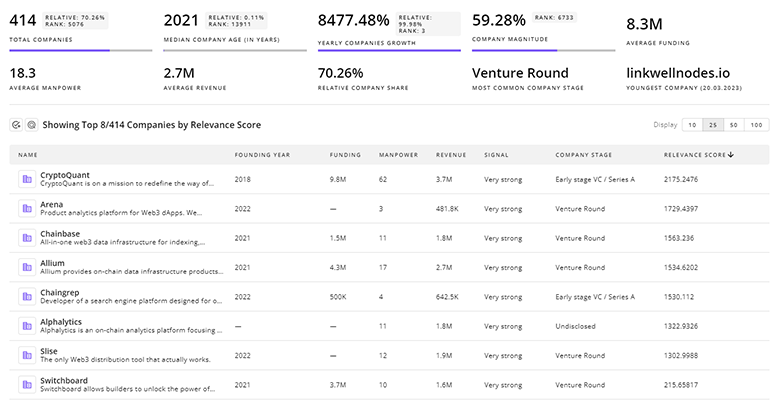
122.1K Camera Technology Companies
Discover Camera Technology Companies, their Funding, Manpower, Revenues, Stages, and much more
Camera Technology Investors
Gain insights into 21.4K Camera Technology investors and investment deals. TrendFeedr’s investors tool presents an overview of investment trends and activities, helping create better investment strategies and partnerships.
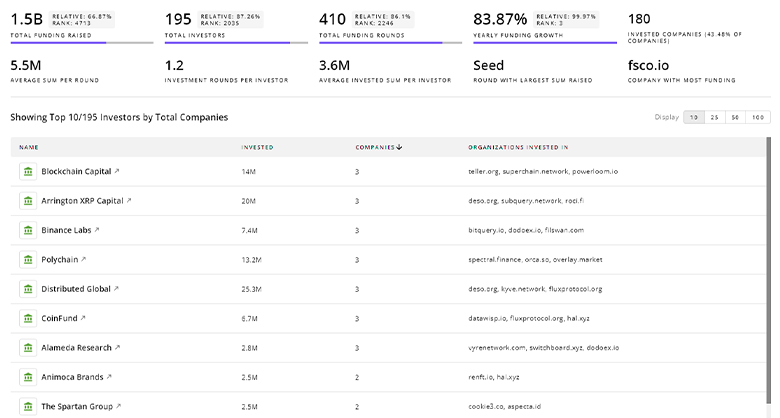
21.4K Camera Technology Investors
Discover Camera Technology Investors, Funding Rounds, Invested Amounts, and Funding Growth
Camera Technology News
Gain a competitive advantage with access to 219.5K Camera Technology articles with TrendFeedr's News feature. The tool offers an extensive database of articles covering recent trends and past events in Camera Technology. This enables innovators and market leaders to make well-informed fact-based decisions.

219.5K Camera Technology News Articles
Discover Latest Camera Technology Articles, News Magnitude, Publication Propagation, Yearly Growth, and Strongest Publications
Executive Summary
Camera technology now competes on perception value rather than raw pixel counts. Firms that combine sensor innovation with proprietary on-device intelligence, low-data sensing modalities, and certifiable system integration will monopolize high-value segments in automotive, industrial automation, and secure surveillance. Strategic moves that matter include: securing partnerships with SoC and vehicle integrators, investing in depth and SWIR modalities to address environmental edge cases, and offering privacy-first edge analytics that reduce cloud exposure. Investors and corporate strategists should prioritize assets that provide reproducible inference quality across conditions, modular depth solutions that retrofit existing supply chains, and optical+compute co-designs that lower total system cost while meeting regulatory and reliability thresholds.
We seek partnerships with industry experts to deliver actionable insights into trends and tech. Interested? Let us know!