Data Hosting Report
: Analysis on the Market, Trends, and TechnologiesThe data hosting market is shifting from capacity build-out to value captured at the data and compute layer: global data hosting registered a market size of $99,000,000,000 in 2022 with a projected CAGR of 11%, indicating sustained demand for hosted services as businesses migrate workloads and require compliant, high-performance environments. This structural growth is concentrated in three economic pressures—power density and cooling for AI/HPC, data sovereignty and localized hosting, and software layers that abstract physical location—that together re-price the hosting value chain and create win conditions for providers that can combine high-density compute, strict compliance, and data-mobility features Western Europe Existing & Upcoming Data Center Portfolio.
We updated this report 23 days ago. Noticed something’s off? Let’s make it right together — reach out!
Topic Dominance Index of Data Hosting
The Topic Dominance Index trendline combines the share of voice distributions of Data Hosting from 3 data sources: published articles, founded companies, and global search
Key Activities and Applications
- High-density AI/HPC colocation — Provisioning racks and pods with elevated power budgets, liquid or immersion cooling, and validated GPU/accelerator support to host training and inference clusters; this activity drives new floor-space designs and higher per-rack ARPU Digital Realty Launches High-Density Colocation.
- DBaaS and managed database hosting — Delivering fully managed, multi-engine database platforms that remove administrative burden and support HTAP and real-time analytics use cases; database hosting shows high growth potential with a 2022 market size of $21,964,000,000 and a CAGR of 21.32%, reflecting strong enterprise migration to DBaaS models.
- Edge and modular data center deployment — Deploying factory-built or micro data centers near users to satisfy low-latency needs for IoT, gaming, and media; modular solutions compress deployment times and improve PUE metrics at the site level.
- Data sovereignty and localized cloud offerings — Building country- or region-specific clouds and colocation that meet regulatory, privacy, and residency requirements for regulated industries and public sector clients.
- Long-term archival and alternative media hosting — Providing cost-efficient archival services and experimental media (e.g. synthetic DNA, LTO tape) for cold data where retrieval economics and data longevity matter Atlas Data Storage.
- Data productization and cataloging — Packaging hosted datasets into governed, discoverable products (catalog, lineage, access controls) so downstream teams and ML systems can consume data with trust and speed DataHub.
Emergent Trends and Core Insights
- Power density overtakes square footage as the controlling metric — Contracts and procurement now evaluate kW per rack, PUE, and cooling architecture more heavily than raw white-space, steering CapEx to sites with favorable grid and cooling economics.
- Data mobility technologies erode geographic moats — Platforms that present a single namespace across edge, colocation, and public cloud reduce the stickiness of any single facility and force operators to compete on service-level differentiation such as validated GPU support, pricing per-GPU-hour, and guaranteed ingress/egress performance Hammerspace.
- Compliance-driven fragmentation increases TCO for global consolidation — Data localization rules and sectoral compliance (healthcare, finance, government) require localized footprints and certified services, which diminishes some hyperscaler cost advantages and creates commercial space for regional specialist providers.
- Database convergence pressures hosting stacks — Adoption of HTAP and distributed SQL databases forces hosting layers to provide low-latency interconnects and storage systems that can support mixed transactional/analytic workloads; this trend raises the value of providers that enable seamless interconnect and low-latency storage tiers.
- Archival innovation reduces cost per TB while increasing retrieval complexity — Emergence of alternative archival media and lifecycle automation reduces cold-storage cost but adds product complexity for SLAs and restore workflows.
- Security and immutable storage are contractual must-haves — Ransomware risk and regulatory auditability make immutable buckets, WORM, and documented chain of custody standard requirements in procurement and service-level agreements.
Technologies and Methodologies
- Software-Defined Storage and Data Fabric — SDS and metadata-driven fabrics unify heterogeneous pools (on-prem, hybrid, cloud) and enable policy-based tiering and automated migration; these layers convert hosting into a service of connected capabilities rather than raw capacity.
- Lakehouse and open table formats — Adoption of Apache Hudi, Iceberg, and Delta enables hosted analytics that avoid format lock-in and reduce ELT costs; lakehouse platforms reduce repeated copies and speed query freshness Onehouse.
- Distributed SQL and HTAP engines — Databases that support ACID at global scale and combine OLTP/OLAP remove synchronization penalties for hosted analytics and open new near-real-time product use cases.
- Advanced cooling and power architectures — Liquid immersion, direct-to-chip cooling, row containment, and modular UPS/PDU designs enable sustained high-density deployments and materially influence site selection economics.
- Zero-Trust and runtime encryption for hosted data — End-to-end governance, runtime encryption, and zero-knowledge models are now required for hosting contracts in regulated sectors.
- AI-driven operations and predictive maintenance — Machine learning optimizes capacity planning, failure prediction, and workload placement to reduce downtime and improve power efficiency.
Data Hosting Funding
A total of 109 Data Hosting companies have received funding.
Overall, Data Hosting companies have raised $10.9B.
Companies within the Data Hosting domain have secured capital from 371 funding rounds.
The chart shows the funding trendline of Data Hosting companies over the last 5 years
Data Hosting Companies
- Leil Storage
Leil Storage builds on hyperscaler techniques to deliver high-capacity, energy-efficient on-premises archival solutions that let organizations expand capacity without migration windows and without cloud lock-in. The company targets customers that need predictable TB economics as data volumes scale into petabytes and offers a pricing model that improves with scale. Leil positions its product as an enterprise hedge against public-cloud archival costs while preserving local control and fast restore paths. - Nexodata Inc
Nexodata Inc commercializes a software-defined defensive layer that fragments and encodes data across nodes to improve ransomware resiliency and reduce storage footprint by roughly 25%, according to the company's efficiency claims. Its patented network-coding approach targets mission-critical repositories where recovery speed and repair performance matter. The solution integrates into hybrid cloud or private data center topologies to provide an operationally lightweight last-line defence and improved repair economics. - Doorda
Doorda offers a data product platform that packages hosted datasets with connectors, quality metadata, and API access tailored for commercial analytics, underwriting, and location planning use cases. The company emphasizes ready-to-consume data products so customers avoid repeated ingestion and cleansing work, shortening time-to-insight for hosted datasets. By combining cataloging, API delivery, and governance into the hosting layer, Doorda targets mid-market and specialized verticals that need curated, production-ready data. - DataVita
DataVita operates a Tier-III data center in Scotland and differentiates through a low design PUE of 1.18 and a stated focus on 100% renewable energy, making it a competitive choice for customers with strict sustainability and procurement constraints. The provider bundles colocation with agile cloud and connectivity services for regional enterprises, pitching measurable carbon reduction and predictable operational costs as part of the hosting contract. - Datapod
Datapod delivers modular data center systems for rapid deployment that emphasize repeatable PUE performance and short build timelines, enabling organizations to locate compute at edge or campus sites with lower construction lead times. The modular approach reduces the site risk and supports scalable rollouts for organizations balancing latency needs and capital constraints. Datapod targets government, telecom, and enterprise customers that need fast, energy-efficient capacity expansion.
Gain a better understanding of 2.3K companies that drive Data Hosting, how mature and well-funded these companies are.
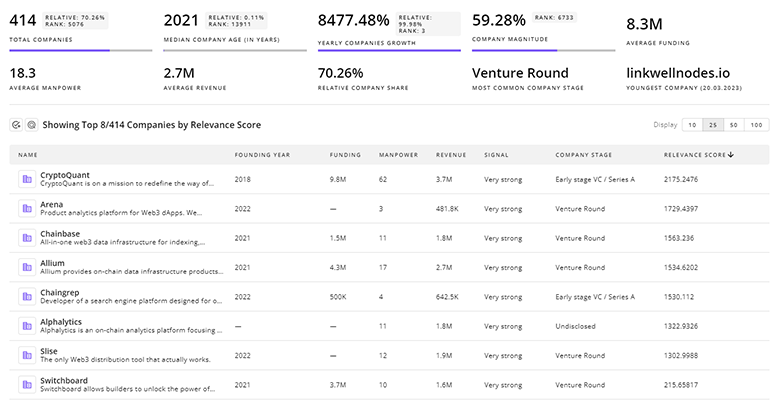
2.3K Data Hosting Companies
Discover Data Hosting Companies, their Funding, Manpower, Revenues, Stages, and much more
Data Hosting Investors
Gain insights into 469 Data Hosting investors and investment deals. TrendFeedr’s investors tool presents an overview of investment trends and activities, helping create better investment strategies and partnerships.
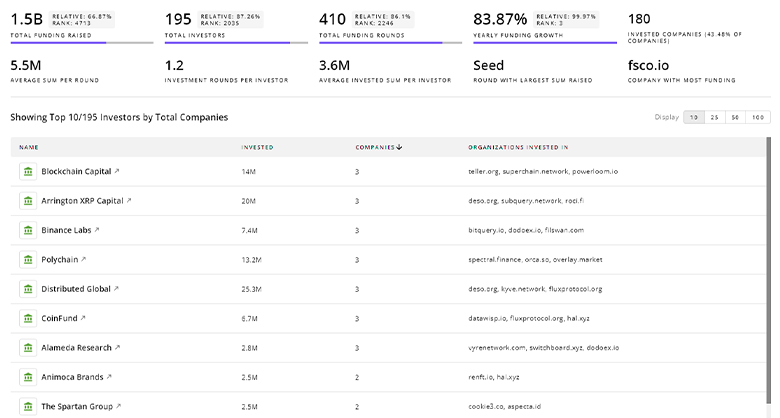
469 Data Hosting Investors
Discover Data Hosting Investors, Funding Rounds, Invested Amounts, and Funding Growth
Data Hosting News
Gain a competitive advantage with access to 699 Data Hosting articles with TrendFeedr's News feature. The tool offers an extensive database of articles covering recent trends and past events in Data Hosting. This enables innovators and market leaders to make well-informed fact-based decisions.
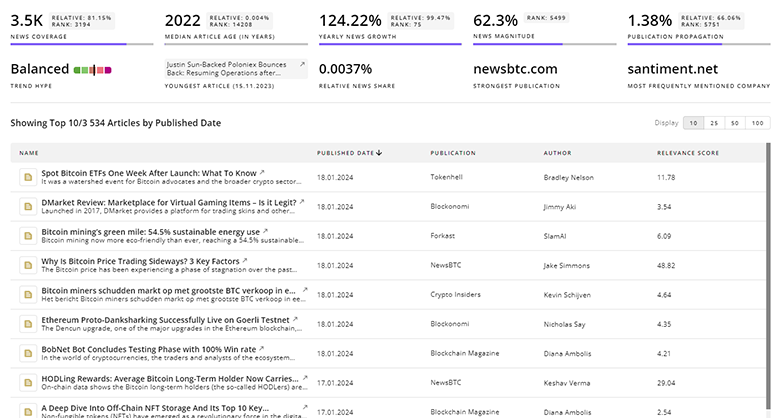
699 Data Hosting News Articles
Discover Latest Data Hosting Articles, News Magnitude, Publication Propagation, Yearly Growth, and Strongest Publications
Executive Summary
Hosting is no longer a commodity sell on square footage. The commercial frontier rewards providers that combine validated high-density compute with governance and mobility features that directly map to buyer procurement criteria: low PUE and renewable sourcing for sustainability-conscious contracts; certified GPU and cooling stacks for AI workloads; DBaaS and HTAP support to compress time from data to decision; and sovereign, certified deployments for regulated sectors. Service designers should reframe hosting propositions as a stack of interdependent guarantees—power, latency, compliance, and recoverability—rather than as isolated capacity units. Providers that align pricing and SLAs to those guarantees will extract premium value and grow enterprise share while others risk becoming interchangeable facility landlords.
We seek partnerships with industry experts to deliver actionable insights into trends and tech. Interested? Let us know!