
Generative Modeling Report
: Analysis on the Market, Trends, and TechnologiesThe generative modeling landscape is accelerating from research proofs to enterprise deployment, supported by 824 active companies and a Market CAGR of 50.87%, which together imply rapid commercial scaling and intensified competition for data, compute, and domain expertise. Market intelligence also records strong enterprise uptake and sizeable security and infrastructure allocations that will shape who captures value in the next three years thebusinessresearchcompany – 2025.
We updated this report 118 days ago. Missing information? Contact us to add your insights.
Topic Dominance Index of Generative Modeling
The Topic Dominance Index combines the distribution of news articles that mention Generative Modeling, the timeline of newly founded companies working within this sector, and the share of voice within the global search data
Key Activities and Applications
- Synthetic data generation for model training and testing, reducing dependence on scarce or privacy-sensitive datasets and enabling faster model iteration (especially in regulated sectors). Evidence of this activity appears across patent filings that target dataset synthesis for downstream training.
- Generative design and engineering optimization where inverse-forward loops produce candidate designs and automatic validation shortens development cycles and material costs; several startups commercialize end-to-end workflows for parallelized design testing.
- Multimodal content production (text, image, audio, video, 3D) for marketing, media, and product visualization; enterprises deploy these capabilities to scale creative output and personalize experiences.
- Agentic workflow orchestration where planner components assemble micro-agents to execute multi-step business processes, converting high-level goals into automated integrations and data flows.
- Digital twins and simulation for robotics, manufacturing, and testing, enabling safe, repeatable training of embodied agents and rapid scenario testing while reducing physical prototyping costs Genie 3 Studios.
Emergent Trends and Core Insights
- Multimodal foundation models are moving from novelty to necessity; competitive advantage shifts to models that natively handle text, images, audio, and 3D input/output rather than single-modality specialists HyperGAI.
- Inference and deployment efficiency now define commercial defensibility; firms that reduce latency and cost at scale (3x–6x reductions reported by specialized compute platforms) win broader enterprise adoption.
- Customization and grounding (RAG) are standard enterprise practices to reduce hallucination and preserve IP; organizations pair retrieval pipelines with fine-tuning and evaluation tooling to create defensible, domain-specific offerings Customizing generative AI for unique value.
- Data governance and consent infrastructures gain strategic importance as content provenance and rights management become litigation and reputation risks; solutions that verify training provenance or implement consent registries attract creator and enterprise demand.
- Control over generation (constrained outputs, functional scoring, latent-space regularization) emerges as the decisive capability for high-value domains such as engineering, healthcare, and defense where fidelity and verifiability matter more than novelty.
Technologies and Methodologies
- Diffusion models for high-fidelity image and video synthesis, with ongoing work to reduce computational cost per sample and improve conditioning.
- Generative Adversarial Networks (GANs) where stabilized training variants and semi-supervised conditioning remain valuable for style-accurate or identity-preserving generation.
- Large Language Models (LLMs) + Retrieval (RAG) as the enterprise pattern for grounded, auditable text and decision outputs.
- LoRA and low-rank adaptation for rapid, cost-efficient fine-tuning that keeps base model parameters frozen while producing domain-specialized behavior ForGen AI capabilities.
- Agentic orchestration frameworks that coordinate tool use, data pipelines, and micro-agents to execute complex tasks described in natural language FlowGenX AI.
- Latent-space engineering and inversion techniques to enable controllable edits, provenance checks, and interpretability in safety-critical deployments.
Generative Modeling Funding
A total of 271 Generative Modeling companies have received funding.
Overall, Generative Modeling companies have raised $31.5B.
Companies within the Generative Modeling domain have secured capital from 910 funding rounds.
The chart shows the funding trendline of Generative Modeling companies over the last 5 years
Generative Modeling Companies
nuvo — nuvo builds foundation models for 3D Generative AI and neural rendering focused on production-ready meshes for e-commerce and metaverse use cases. They emphasize assembling high-quality 3D datasets to overcome public-data scarcity and enable enterprise-grade model accuracy. nuvo targets retailers and digital-asset platforms that need scalable, photorealistic 3D pipelines.
Fairgen — Fairgen uses generative models to synthesize survey responses and augment niche market segments, improving statistical power and reducing data-collection costs for market researchers. Their platform offers validation tooling to increase confidence in synthetic augmentation and supports rapid segmentation analyses. This approach targets agencies and firms that require representative samples without lengthy fieldwork.
Generative Engineering — Generative Engineering provides a platform that generates and simulates thousands of engineering designs in parallel, integrating with engineers' existing toolchains via a code-first framework. The company reduces prototype cycles and surfaces novel, constraint-satisfying designs at scale. Their product is aimed at OEMs and suppliers seeking faster product iteration and lower development costs.
ScaleGenAI — ScaleGenAI offers a unified compute platform that aggregates heterogeneous cloud and datacenter resources to lower fine-tuning and inference costs for generative workloads. Their stack supports many accelerator SKUs and claims 3x–6x cost reductions for customers through workload placement and accelerator matching. This infrastructure-first approach helps startups and enterprises deploy multimodal models more affordably.
Gain a competitive edge with access to 915 Generative Modeling companies.
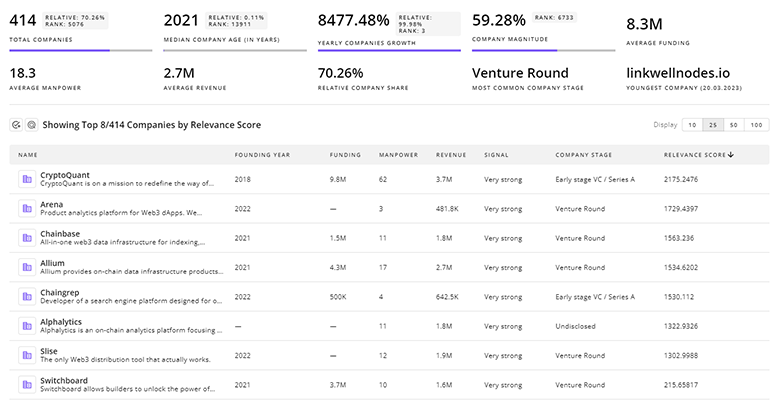
915 Generative Modeling Companies
Discover Generative Modeling Companies, their Funding, Manpower, Revenues, Stages, and much more
Generative Modeling Investors
Leverage TrendFeedr’s sophisticated investment intelligence into 1.6K Generative Modeling investors. It covers funding rounds, investor activity, and key financial metrics in Generative Modeling. investors tool is ideal for business strategists and investment experts as it offers crucial insights needed to seize investment opportunities.
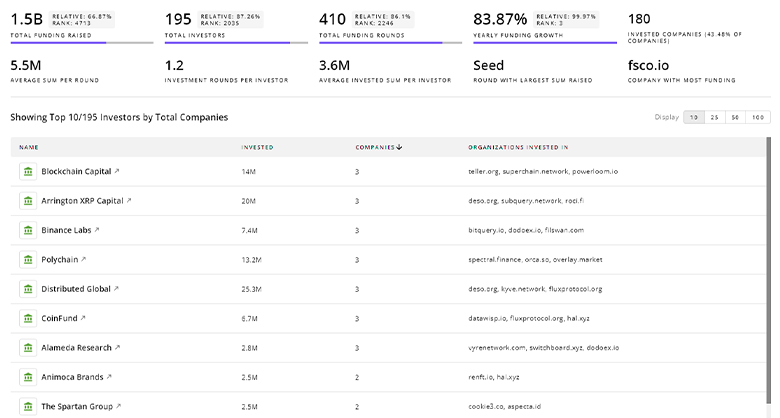
1.6K Generative Modeling Investors
Discover Generative Modeling Investors, Funding Rounds, Invested Amounts, and Funding Growth
Generative Modeling News
TrendFeedr’s News feature provides a historical overview and current momentum of Generative Modeling by analyzing 189 news articles. This tool allows market analysts and strategists to align with latest market developments.
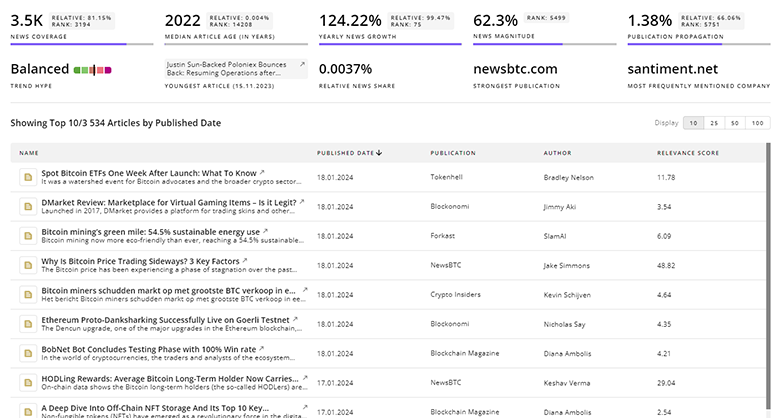
189 Generative Modeling News Articles
Discover Latest Generative Modeling Articles, News Magnitude, Publication Propagation, Yearly Growth, and Strongest Publications
Executive Summary
Generative modeling now competes on three linked axes: fidelity and controllability, deployment economics, and data governance. Firms that pair domain-specialized models with efficient inference stacks and verifiable data practices gain a practical advantage. Investors and executives should prioritize capabilities that reduce time-to-value: synthetic-data pipelines that pass validation, fine-tuning methods that preserve IP while lowering compute spend, and orchestration layers that integrate models into real business processes. Those strategic moves convert generative modeling from an experimental capability into a sustained operational lever.
Interested in contributing your expertise on trends and tech? We’d love to hear from you.