Hydrogen Storage Report
: Analysis on the Market, Trends, and TechnologiesThe hydrogen storage sector is poised for rapid expansion with the market projected at USD 14,760,000,000 in 2025, driven by accelerating deployment across mobility, industrial decarbonization and long-duration grid balancing. Compressed-gas solutions continue to serve immediate demand while material-based approaches (metal hydrides, MOFs, LOHC) and geological options (salt caverns, aquifers) are moving from laboratory validation toward demonstration and early commercial rollouts, supported by strong policy funding and multi-hundred-million-dollar infrastructure investments Hydrogen Storage Market.
We updated this report 248 days ago. Missing information? Contact us to add your insights.
Topic Dominance Index of Hydrogen Storage
The Topic Dominance Index combines the distribution of news articles that mention Hydrogen Storage, the timeline of newly founded companies working within this sector, and the share of voice within the global search data

Key Activities and Applications
- On-board vehicle storage (350–700 bar composite tanks) — High-pressure composite vessels remain the practical route for light- and heavy-duty fuel-cell vehicles; the tank market and partnerships around Type IV cylinders are scaling with automotive integration projects. Type IV composite tanks are prioritized for weight-sensitive mobility use cases Hydrogen Storage Tanks & Transportation Market.
- Stationary bulk storage for grid balancing (salt caverns, aquifers) — Large geological reservoirs enable seasonal storage at low per-kWh cost and are central to hub strategies that link electrolyzers to power markets; projects targeting hundreds of GWh by 2030 are under development Hydrogen Energy Storage Market.
- Industrial feedstock and process resilience — Storage systems (compressed, liquid, material) supply refining, ammonia, and steelmaking decarbonization pathways where continuous hydrogen availability matters.
- Renewable integration and long-duration energy shifting — Electrolyzer-linked storage converts surplus renewable electricity into hydrogen that can be stored and dispatched seasonally or for multi-day firming, creating value beyond short-duration batteries Hydrogen Energy Storage Market Report.
- Carrier and logistics solutions (LOHC, chemical carriers, hydride liquids) — Ambient-temperature carriers that leverage existing liquid-fuel logistics reduce immediate CAPEX for distribution and open export pathways where pipelines are absent HSL Technologies (HydroSil).
Emergent Trends and Core Insights
- System integration outruns single-material breakthroughs — Patent and project activity shows innovators shifting emphasis from pure material metrics to thermal management, cycling reliability, and modular stacks that integrate storage medium with heat exchange and controls; this narrows the field toward solutions that reduce operational complexity and maintenance burdens.
- Solid-state approaches gaining strategic footholds for weight-sensitive use cases — Metal hydrides and MOF-derived adsorbents now claim volumetric densities and cycle stability that make aviation, drones and specialised mobility plausible first markets for ambient-temperature solid storage.
- Underground salt-cavern deployments concentrate early scale — Salt caverns and selected aquifers reduce per-unit storage cost and are central to hub business cases; this creates a two-track market where geology-capable players focus on bulk seasonal supply while materials companies target distributed and mobile niches.
- LOHC and liquid carriers accelerate trade and maritime use — Liquid carriers that allow ambient handling lower near-term logistics barriers and tap existing maritime and tank-truck supply chains, making them attractive for export corridors and hard-to-electrify industrial clusters.
- Policy and hub funding materially change risk calculus — Public programs and large-scale hub capital reduce off-taker and infrastructure risk, which in turn directs private capital into storage-adjacent projects (electrolyzers, compressors, vessel manufacturing) rather than pure early-stage material bets.
Technologies and Methodologies
- High-pressure composite cylinders (Type III/IV, 350–700 bar) — Widely deployed for on-board and refueling stations; advances in filament winding, liners and additive manufacturing compress system mass and improve certification timelines.
- Metal hydrides and sorbent MOFs — Offer high volumetric density at lower pressure; recent R&D emphasizes catalytic doping, nanostructuring and integrated phase-change thermal buffers to lower desorption temperatures and accelerate kinetics.
- Liquid Organic Hydrogen Carriers (LOHC) and engineered liquids — Enable ambient storage and use existing logistics; chemistry focuses on reversible hydrogenation/dehydrogenation cycles and catalyst durability to maximize round-trip efficiency.
- Cryogenic liquefaction and advanced insulation systems — For long-distance bulk shipping and long-duration high-density storage; innovations target boil-off reduction through multi-layer insulation and integrated cryo-compressors.
- Underground geological systems (salt caverns, aquifers, depleted reservoirs) — Engineering focuses on cushion-gas selection, well patterns to limit purity loss, and microbial/chemical mitigation to prevent hydrogen losses in situ.
- Integrated thermal management (phase-change materials, micro-channel heat exchangers) — Emerging as the performance lever for solid-state systems to meet fast refueling and high-cycle mobility requirements.
Hydrogen Storage Funding
A total of 259 Hydrogen Storage companies have received funding.
Overall, Hydrogen Storage companies have raised $38.4B.
Companies within the Hydrogen Storage domain have secured capital from 870 funding rounds.
The chart shows the funding trendline of Hydrogen Storage companies over the last 5 years
Hydrogen Storage Companies
- SolidState H2 — SolidState H2 develops a metal hydride nanotechnology claiming 150 kg/m³ solid-state storage density, positioning the company for weight- and safety-sensitive mobility and aviation pilots; the firm reports early prototype testing and industry partnerships while remaining at pre-seed funding scale (raised: $300K), indicating a near-term technical proof-of-concept focus rather than commercial scale-up.
- H2MOF — H2MOF applies reticular chemistry and MOF engineering to enable hydrogen adsorption at near-ambient conditions, targeting distributed refueling and specialized transport where tank volume limits matter; the team (including Nobel-level founders) emphasizes atomic-scale material control and small-scale deployments as the route to early commercial traction.
- Carbon280 Hydrilyte® — Carbon280 commercializes the Hydrilyte ambient liquid storage system that stores hydrogen safely for grid firming and longer-duration renewable backup, offering a non-toxic alternative to compressed or cryogenic options and targeting renewable-firming contracts where long-duration economics beat batteries.
- Ayrton Energy — Ayrton Energy develops an organic liquid carrier solution for ambient handling and conventional logistics, aiming to replace diesel generators and battery backup in off-grid and telecom sites; its value lies in seamless transportability and rapid field deployment for remote industrial customers.
- GRZ Technologies — GRZ Technologies supplies modular metal hydride and thermochemical storage systems tailored for power-to-power and decentralized electricity storage, focusing on reliability and turnkey plant delivery for commercial and industrial customers rather than speculative material science bets.
Gain a competitive edge with access to 1.2K Hydrogen Storage companies.
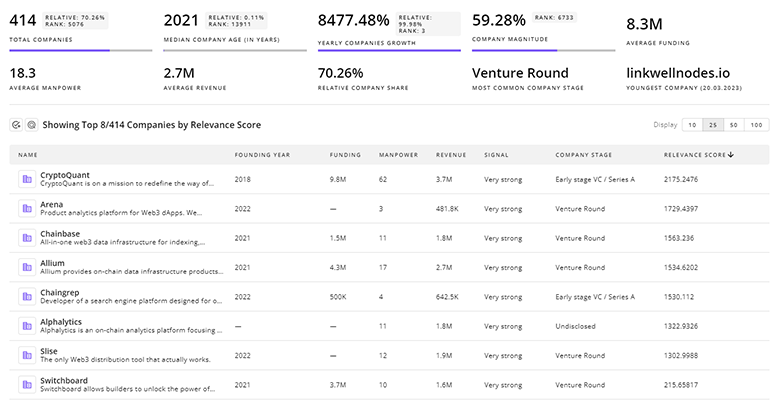
1.2K Hydrogen Storage Companies
Discover Hydrogen Storage Companies, their Funding, Manpower, Revenues, Stages, and much more
Hydrogen Storage Investors
Leverage TrendFeedr’s sophisticated investment intelligence into 822 Hydrogen Storage investors. It covers funding rounds, investor activity, and key financial metrics in Hydrogen Storage. investors tool is ideal for business strategists and investment experts as it offers crucial insights needed to seize investment opportunities.
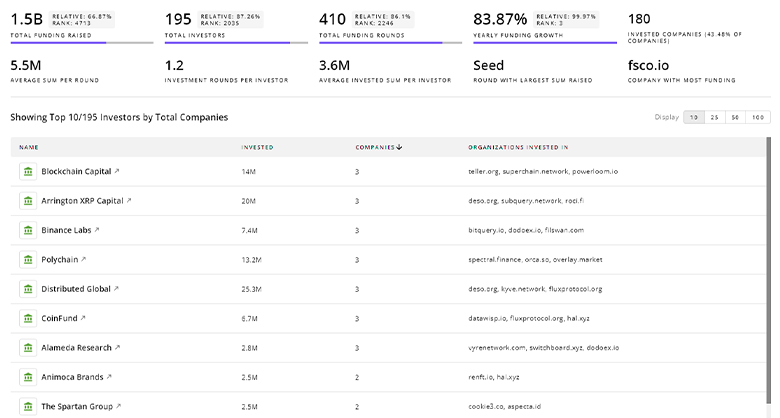
822 Hydrogen Storage Investors
Discover Hydrogen Storage Investors, Funding Rounds, Invested Amounts, and Funding Growth
Hydrogen Storage News
TrendFeedr’s News feature provides a historical overview and current momentum of Hydrogen Storage by analyzing 4.1K news articles. This tool allows market analysts and strategists to align with latest market developments.
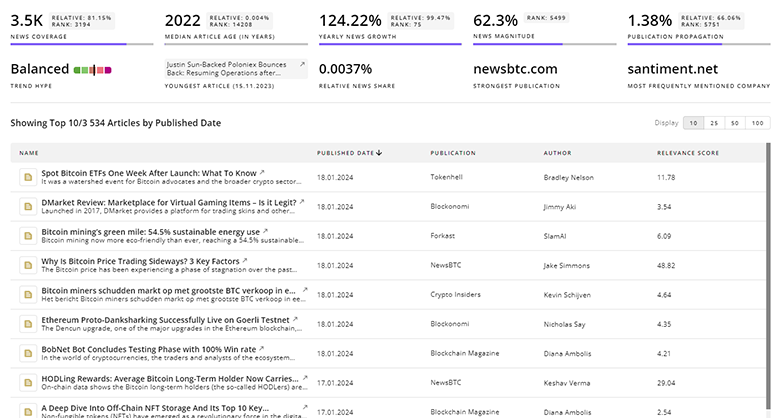
4.1K Hydrogen Storage News Articles
Discover Latest Hydrogen Storage Articles, News Magnitude, Publication Propagation, Yearly Growth, and Strongest Publications
Executive Summary
Hydrogen storage is moving from component research into system-level commercialization where economics, safety and operational simplicity determine winners. Physical compression and geological reservoirs address near-term scale and grid needs, while solid-state materials and liquid carriers offer differentiated value for mobility and logistics. Strategic investors should separate plays that require heavy infrastructure pacing from those that can monetize through niche high-value applications (aviation, specialised mobility, remote industrial power). The immediate commercial battleground will test which trade-offs—density, energy penalty for thermal management, or logistics simplicity—produce viable unit economics at scale.
Interested in contributing your expertise on trends and tech? We’d love to hear from you.