Machine Intelligence Report
: Analysis on the Market, Trends, and TechnologiesThe Machine Intelligence landscape is at an inflection where capital and technical effort concentrate on agentic systems that act, learn, and produce measurable enterprise outcomes: total funding across the machine intelligence topic sits at $20.04B while global AI market estimates report $136B in 2025 that feeds continued enterprise deployments. These numbers reflect a dual reality: enterprises increasingly adopt agentic, explainable, and domain-grounded solutions but investors and procurement functions demand verifiable ROI, pushing winners toward architectures that combine symbolic control, retrieval-grounding, and multimodal sensing.
We last updated this report 25 days ago. Tell us if you find something’s not quite right!
Topic Dominance Index of Machine Intelligence
To gauge the impact of Machine Intelligence, the Topic Dominance Index integrates time series data from three key sources: published articles, number of newly founded startups in the sector, and global search popularity.
Key Activities and Applications
- Autonomous agent deployment for end-to-end business processes, where agents plan, act, and reconcile outcomes rather than only produce text suggestions.
- Industrial autonomy and digital twins for heavy industry and manufacturing, using lightweight models and adversarial simulations to predict system behavior with limited telemetry.
- Explainable autonomy for regulated sectors, delivering certifiable decision traces for safety-critical domains such as autonomous driving and healthcare MOTOR Ai.
- Security automation via multi-agent SOC teams, where specialized agent roles (threat analyst, incident responder) reduce alert fatigue and accelerate remediation Bricklayer AI.
- Human-in-the-loop and hybrid cognitive workflows that preserve expert oversight while transferring repetitive, decision-heavy tasks to digital workers Maisa.
Emergent Trends and Core Insights
- From model access to control: Enterprises prioritize grounded generation and verifiable outputs over raw parameter scale; architectures that couple retrieval and symbolic constraints gain preference.
- Agentic systems are the primary battleground: Multi-agent orchestration that manages memory, tool use, and external APIs is where value concentrates, not just LLM throughput.
- Edge and embodied intelligence growth: Integration of Vision-Language-Haptics and on-device inference reduces latency and enables real-world robotic autonomy.
- Data-efficiency as a moat: Methods that reduce training data needs (causal nets, transfer learning, evolutionary ML) unlock deployments in data-scarce industrial and healthcare environments.
- Trust constraints reshape buying behavior: Demand for explainability, audit trails, and local deployment climbs as regulators and procurement insist on measurable safety and compliance The road to artificial general intelligence.
Technologies and Methodologies
- Neurosymbolic architectures that combine neural pattern recognition with symbolic logic to make outputs auditable and rule-constrained Aigo.ai.
- Retrieval Augmented Generation (RAG) with symbolic overlays to prevent hallucinations and enable fact-checking at scale.
- Agent orchestration platforms and Digital Worker frameworks for lifecycle management of autonomous agents, including monitoring, provenance, and rollback capabilities Agentic Dream.
- Multimodal sensing stacks (Vision-Language-Haptics) for embodied AI and robotics to link perception with action planning and tactile feedback AI armed with multiple senses could gain more flexible intelligence.
- Causal learning, transfer learning, and active learning to reduce data needs and support continual adaptation in production systems Leela AI.
- Edge NPUs and domain IPUs to support low-latency inference and energy-efficient continuous learning close to the data source ABI Research.
Machine Intelligence Funding
A total of 423 Machine Intelligence companies have received funding.
Overall, Machine Intelligence companies have raised $20.0B.
Companies within the Machine Intelligence domain have secured capital from 1.4K funding rounds.
The chart shows the funding trendline of Machine Intelligence companies over the last 5 years
Machine Intelligence Companies
- AITOMATIC — AITOMATIC builds domain-expert agents for industrial operations using a Cognitive Ontology that encodes procedures, context, and causal action logic so agents make reliable, explainable decisions; the company targets semiconductor, manufacturing, and energy sectors where deterministic reasoning and continuous learning yield high-margin automation. Their approach emphasizes ontology-driven autonomy that compounds with each deployment, enabling rapid cross-workflow improvement and measurable accuracy gains in senior-engineer decisions.
- The MachineGenes Group — The MachineGenes Group applies evolutionary ML and adversarial AI to produce compact digital twins that operate on minimal sensor inputs, enabling explainable predictions of complex dynamic systems such as turbines and biological organs; this lightweight, edge-first strategy fits environments where data sharing is restricted or connectivity is intermittent. Their technique prioritizes explainability and local inference, lowering cost and preserving IP for mission-critical customers.
- P-1 AI — P-1 AI pursues engineering-focused AGI for the physical world, training autonomous agents on multi-physics simulations and synthetic data to automate design tasks across engineering R&D; by focusing on reasoning over physics representations, they aim to replace time-consuming CAD/CAE cycles with fast, adaptive agents that propose validated design changes. This positioning makes them a candidate partner for firms seeking to accelerate complex product development lifecycles.
- SIMBO.AI — SIMBO.AI offers a Symbolic RAG overlay for enterprise GenAI, coupling retrieval, symbolic constraints, and fact-checking to make generative systems reliable for regulated settings such as healthcare; their architecture reduces hallucination risk and provides auditable response provenance, which directly addresses procurement and compliance gatekeepers. This makes them a practical integrator for enterprises unable to accept black-box outputs from foundation models.
- T-ROBOTICS — T-ROBOTICS delivers ActGPT, a multimodal robotics platform that fuses computer vision, language understanding, and tactile reasoning to enable flexible robot skill execution on factory floors; by shipping pre-trained skills and adaptive controllers, they lower the cost and time of deploying dexterous automation, moving robotics beyond rigid programming to contextual, task-driven behavior. Their product-market fit centers on manufacturers who need fast scaling of automation without deep robotics teams.
Enhance your understanding of market leadership and innovation patterns in your business domain.
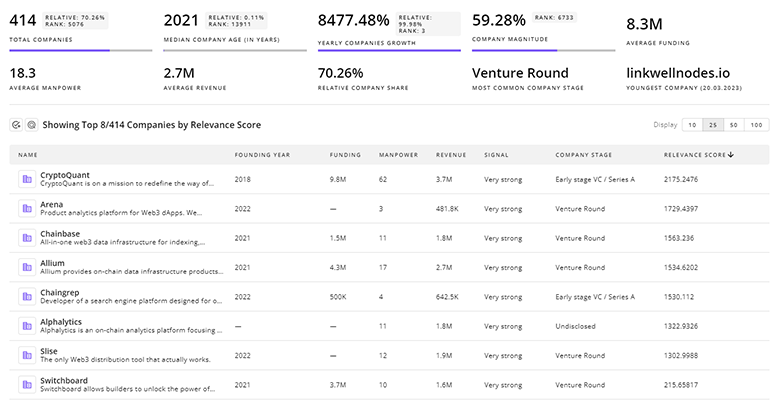
3.8K Machine Intelligence Companies
Discover Machine Intelligence Companies, their Funding, Manpower, Revenues, Stages, and much more
Machine Intelligence Investors
TrendFeedr’s Investors tool offers comprehensive insights into 1.9K Machine Intelligence investors by examining funding patterns and investment trends. This enables you to strategize effectively and identify opportunities in the Machine Intelligence sector.
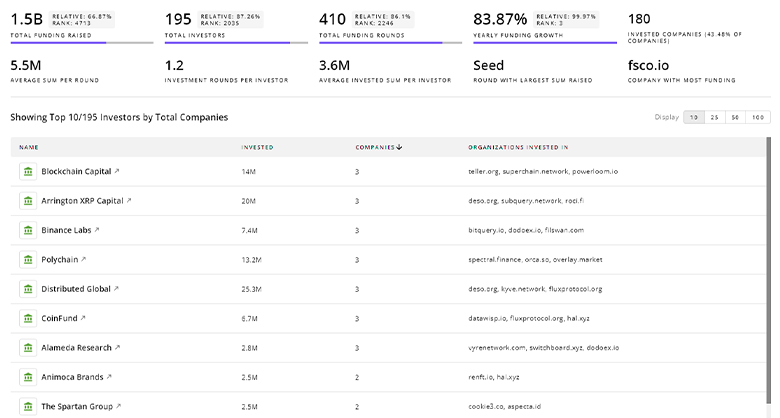
1.9K Machine Intelligence Investors
Discover Machine Intelligence Investors, Funding Rounds, Invested Amounts, and Funding Growth
Machine Intelligence News
TrendFeedr’s News feature provides access to 5.2K Machine Intelligence articles. This extensive database covers both historical and recent developments, enabling innovators and leaders to stay informed.
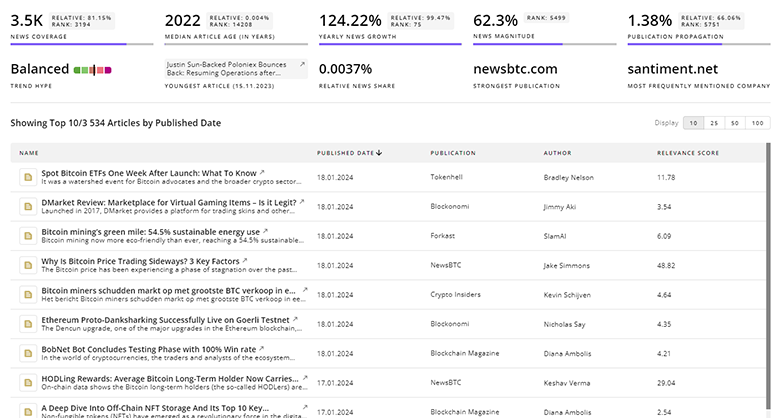
5.2K Machine Intelligence News Articles
Discover Latest Machine Intelligence Articles, News Magnitude, Publication Propagation, Yearly Growth, and Strongest Publications
Executive Summary
The machine intelligence market now rewards companies that produce verifiable, auditable action rather than raw prediction. Firms that combine domain-specific foundation layers, retrieval-grounded generation, and multimodal sensing will command enterprise budgets because they reduce deployment risk and produce measurable ROI. Industrial and regulated verticals will lead demand for explainable autonomy, while democratizing tooling and no-code agent platforms will expand adoption beyond elite engineering teams. For business leaders, the pragmatic moves are to prioritize investments that provide traceability, data locality options, and compact, domain-aware intelligence that can be measured against operational KPIs.
We value collaboration with industry professionals to offer even better insights. Interested in contributing? Get in touch!