Maritime Surveillance Report
: Analysis on the Market, Trends, and TechnologiesThe maritime surveillance market is entering a phase of accelerated capability stacking: AI-native sensor fusion, space-based RF/SAR coverage, and autonomous surface/underwater platforms are converging to convert raw coverage into operationally useful, time-critical intelligence; internal market analysis reports a 9.5% CAGR and $10.64B total funding deployed across the sector, signaling sustained capital flows into data-centric architectures. Governments lead procurement while commercial users expand downstream demand for compliance and operational efficiency, creating a multi-year runway for vendors who can deliver continuous, multi-domain detection plus fast, low-false-alarm inference.
We last updated this report 295 days ago. Tell us if you find something’s not quite right!
Topic Dominance Index of Maritime Surveillance
To gauge the impact of Maritime Surveillance, the Topic Dominance Index integrates time series data from three key sources: published articles, number of newly founded startups in the sector, and global search popularity.
Key Activities and Applications
- Dark-vessel detection and non-cooperative tracking — detecting ships that disable or spoof AIS using space-based RF geolocation and high-revisit SAR, a capability increasingly procured by coast guards and fisheries authorities to counter illegal fishing, smuggling, and transshipment.
- Maritime domain awareness (MDA) and fused operational pictures — continuous synthesis of AIS, SAR, EO/IR, coastal radar, and acoustic sensors into a single command view used by navies and multi-agency centers to coordinate interdiction and patrol assets ResearchAndMarkets - Maritime Surveillance Market.
- Persistent environmental monitoring and ESG compliance — satellite analytics and coastal sensing to detect oil spills, emissions, and illegal dumping for regulatory enforcement and corporate reporting; this activity aligns surveillance with sustainability mandates and commercial value chains MarketResearchFuture - Maritime Surveillance Market.
- Unmanned persistent ISR (USVs/UAVs/AUVs) — long-endurance uncrewed platforms extend sensor reach, enable continuous acoustic and surface sensing, and reduce operational cost per patrol, crucial for ice, Arctic and contested littoral operations
- Port and critical-infrastructure protection — integrated coastal surveillance chains (radar, CCTV, AIS, access control) supporting port safety, cargo integrity and undersea asset protection such as cables and pipelines Allied Market Research - Maritime Surveillance Market.
- Search and rescue (SAR) augmentation — sensor fusion platforms shorten detection-to-rescue timelines by correlating AIS, satellite detections, UAV feeds and onboard edge analytics to prioritize responses SDM Magazine - The Global Maritime and Border Security Market.
Emergent Trends and Core Insights
- Space-first detection plus edge inference is displacing single-sensor solutions: low-cost microsatellite constellations for SAR and RF detection are being paired with edge and cloud AI to generate actionable alerts rather than raw imagery — this materially shortens analyst burden and increases patrol effectiveness mordorintelligence - Maritime Surveillance Market.
- AI for behavioral anomaly and predictive risk is moving from research to procurement: models trained on AIS/SAR/radar histories now flag suspicious loitering, route deviations, and likely EEZ incursions, enabling prioritized investigative tasking and lowering false positives for operational teams MDPI - Sensors, Vol. 25.
- Sensor-fusion supersedes single-sensor differentiation: customers pay a premium for platforms that integrate RF, SAR, EO/IR, acoustic and AIS into a common timeline and geo-referenced schema — the competitive moat shifts to data pipelines and evidence chains rather than point sensors ResearchAndMarkets - Space-based Maritime Surveillance.
- Cyber-resilience and Zero-Trust for maritime OT/IT stacks are now procurement criteria; as vessels and sensors network, attackers can degrade MDA or spoof sensor streams, so maritime-specific cybersecurity services (fleet SOCs, ZTA) gain procurement priority.
- Arctic and undersea monitoring are growth niches: climate-driven traffic increases in polar routes and critical undersea infrastructure detection (subsea radar, hydroacoustics) create specialized demand pockets
- Commercialization of surveillance-as-a-service: subscription models combining imagery, vessel-behavior analytics and alerts are expanding commercial addressable market beyond defense customers market.us - Global Maritime Surveillance Market.
Technologies and Methodologies
- Synthetic Aperture Radar (SAR) constellations and SAR analytics — persistent, all-weather imaging is central for wide-area detection and SAR classification pipelines are a high-value software layer MetaSensing
- Space-based RF geolocation — non-cooperative RF passive detection produces geolocation fixes on vessels that disable AIS, becoming a standard supplement for dark-ship workflows Unseenlabs.
- Passive acoustic monitoring (PAM) and underwater radar — environmental compliance, marine-mammal protection and subsea object detection require PAM and new subsea radar modalities that detect metallic and electronic signatures beneath surface clutter Seiche
- Autonomy stacks for USVs/UAVs/AUVs with edge AI — long-endurance platforms carrying multi-sensor payloads, running on-board classification and anomaly detection to reduce comms load and improve persistence Maritime Robotics AS.
- Multi-sensor fusion frameworks and C2 integration — standardized geospatial event streams, digital twins and time-synchronized sensor layers feeding command dashboards enable faster decision cycles for coast guards and navies MARSS Group.
- AI/ML for SAR/EO object detection, tracking and behavior modelling — hybrid methods (classical CFAR + CNNs) balance recall and runtime for real-time operational use Remote Sensing journal summary.
- Maritime-specialized cybersecurity and managed SOCs — integrated IT/OT security solutions with compliance automation to meet IMO guidance and fleet operator needs Cydome.
Maritime Surveillance Funding
A total of 69 Maritime Surveillance companies have received funding.
Overall, Maritime Surveillance companies have raised $12.5B.
Companies within the Maritime Surveillance domain have secured capital from 219 funding rounds.
The chart shows the funding trendline of Maritime Surveillance companies over the last 5 years
Maritime Surveillance Companies
- SeaCras — SeaCras provides satellite-derived oceanographic and coastal intelligence geared to environmental compliance and ESG reporting; its cloud platform blends AI-driven anomaly detection with reporting tools that support fisheries monitoring and pollution detection, positioning the company where regulatory monitoring meets commercial reporting needs. SeaCras has developed productized services for coastal authorities and corporate sustainability teams
- SEADAR Technologies — SEADAR Technologies delivers a patented subsea radar modality that detects and geolocates underwater metallic objects and electronic signatures, closing a sensing gap between sonar and optical systems; this makes SEADAR Technologies particularly appealing for undersea cable and pipeline protection and covert infrastructure surveillance in defense contexts
- AquaSmartXL B.V. — AquaSmartXL B.V. focuses on digitization and inspection of waterborne infrastructure using purpose-built USVs and ROVs plus 3D deliverables; the company targets ports and asset owners with high-fidelity inspection packages that reduce expensive diver operations and accelerate predictive maintenance cycles
- SeaTrac Systems, Inc. — SeaTrac Systems, Inc. manufactures small, solar-powered persistent USVs optimized for long-duration observation and data collection; their sensor-agnostic platforms host acoustic and surface payloads and are marketed as low-cost persistent nodes for commercial ISR and environmental monitoring missions
- PierSight — PierSight is developing a dedicated SAR+AIS satellite constellation aimed at continuous ocean surveillance and automated vessel tracking; as a small constellation specialist, PierSight bets on verticalized SAR analytics and subscription delivery to provide high-frequency maritime intelligence to insurers, shipping and coastal authorities
Enhance your understanding of market leadership and innovation patterns in your business domain.
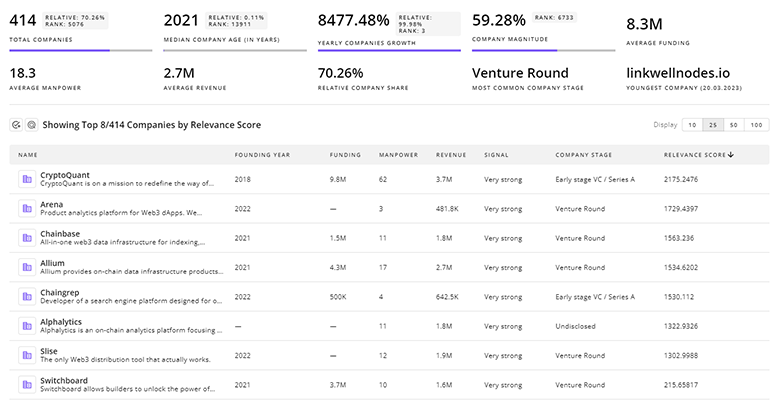
268 Maritime Surveillance Companies
Discover Maritime Surveillance Companies, their Funding, Manpower, Revenues, Stages, and much more
Maritime Surveillance Investors
TrendFeedr’s Investors tool offers comprehensive insights into 224 Maritime Surveillance investors by examining funding patterns and investment trends. This enables you to strategize effectively and identify opportunities in the Maritime Surveillance sector.
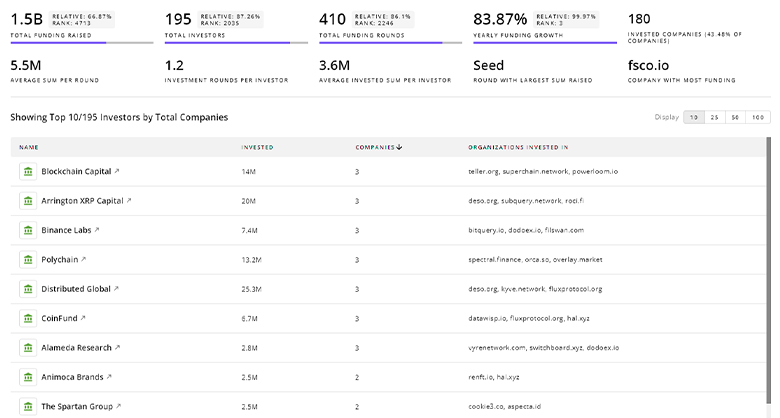
224 Maritime Surveillance Investors
Discover Maritime Surveillance Investors, Funding Rounds, Invested Amounts, and Funding Growth
Maritime Surveillance News
TrendFeedr’s News feature provides access to 1.6K Maritime Surveillance articles. This extensive database covers both historical and recent developments, enabling innovators and leaders to stay informed.
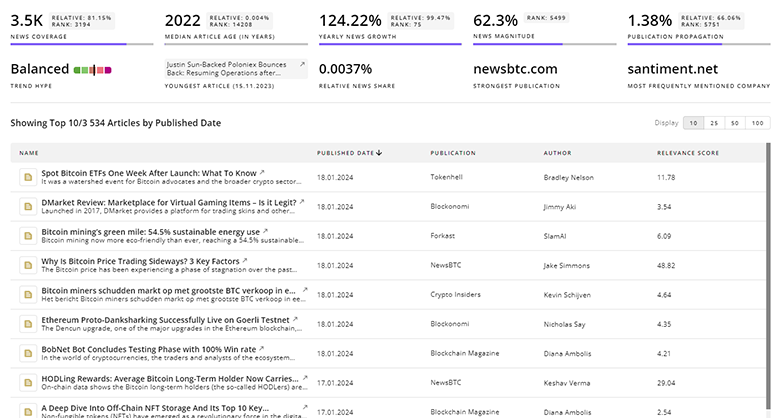
1.6K Maritime Surveillance News Articles
Discover Latest Maritime Surveillance Articles, News Magnitude, Publication Propagation, Yearly Growth, and Strongest Publications
Executive Summary
Maritime surveillance is shifting from sensor ownership to data orchestration: buyers now value sustained coverage, low false alarm rates and verifiable evidence chains more than single-sensor performance. Firms that combine space-based RF/SAR, autonomous persistent platforms, and AI-first fusion pipelines will win the largest contracts and expand into commercial subscription markets. Operators should prioritize modular integration partnerships (sensor suppliers + analytics + cybersecurity + comms) to assemble defensible, enterprise-grade solutions and to meet both defence procurement and environmental compliance needs. Short-term commercial opportunities concentrate on subscription analytics for coastal authorities and ESG reporting, while longer-term strategic value sits with companies that can certify end-to-end, multi-domain accuracy and deliver sensor-agnostic, low-latency decision products.
We value collaboration with industry professionals to offer even better insights. Interested in contributing? Get in touch!