Medical Devices Report
: Analysis on the Market, Trends, and TechnologiesThe medical devices sector is at a pivot where product-market value, regulatory cost, and digital data capture intersect: global market sizing places total device activity at $136,600,000,000 in 2024 with an accelerating technology adoption profile and an indicated CAGR of 10.4%, driven by demand for connected devices and advanced manufacturing. This trajectory creates distinct opportunities for firms that combine procedural hardware with embedded sensing, continuous post-market data services, and streamlined regulatory workflows Medical Devices Market – Global Forecast 2025-2032.
We last updated this report 99 days ago. Tell us if you find something’s not quite right!
Topic Dominance Index of Medical Devices
To gauge the impact of Medical Devices, the Topic Dominance Index integrates time series data from three key sources: published articles, number of newly founded startups in the sector, and global search popularity.
Key Activities and Applications
- Minimally invasive interventional systems: development and commercialization of catheter-based and transcatheter therapies for structural heart, neurovascular, and peripheral vascular indications; these remain high-margin, high-complexity activities and attract concentrated R&D and manufacturing capacity.
- Smart implant and long-term telemetry: embedding sensors into implants to provide longitudinal functional data and enable outcome-based services rather than one-time device sales.
- Software as a Medical Device (SaMD) for diagnostics and workflow: development of AI-driven diagnostic modules, regulatory-grade analytics, and cloud backends supporting continuous monitoring and triage.
- Regulatory engineering and compliance automation: rapid generation of MDR/510(k)-grade technical documentation and QMS automation to reduce time-to-market friction for device makers.
- Device cybersecurity and post-market surveillance: proactive threat modelling, SBOMs, penetration testing, and real-time adverse event monitoring to meet rising regulatory expectations and preserve market access.
- Contract manufacturing and precision micromanufacturing: verticalized CMO offerings that encompass micro-machining, catheter fabrication, sterilization, and assembly for Class I–III products, enabling OEMs to outsource complex production while managing regulatory burden Seisa Medical.
Emergent Trends and Core Insights
- Data-first business models are forming around implanted device telemetry and continuous remote monitoring: companies that monetize longitudinal patient/device data (analytics subscriptions, outcome services) will expand beyond the classic device sale economics.
- Procedural robotics is moving from large-suite incumbency toward compact, image-guided, table-side platforms that enable percutaneous procedures in ambulatory settings; this reduces capital barrier for adoption and creates OEM licensing opportunities.
- Real-world evidence and post-market surveillance are no longer optional: regulators require continuous safety data and manufacturers face rising lifecycle documentation costs; automation of these functions materially affects market-entry velocity and retention of sales channels.
- Manufacturing concentration risk persists: high-volume interventional consumables and complex Class III assembly remain geographically concentrated, creating supply-chain vulnerability that incentivizes regionalization and near-shoring for strategic buyers.
- AI and cloud-native backends are becoming default enablers for diagnostics, regulatory evidence generation, and device lifecycle services; firms that integrate clinical validation pathways with scalable software will command premium multiples.
Technologies and Methodologies
- Embedded sensor fusion and implant telemetry: ultra-low-power biosensors + wireless telemetry stacks for multi-year implanted data capture; this underpins longitudinal outcome datasets and remote titration paradigms.
- Micromachining and Laser LIGA: precision fabrication of micron-scale components for next-generation catheters and sensing arrays; regional capacity in Asia-Pacific offers a short-term production moat MicroBase Technology Corporation.
- AI-enabled SaMD and cloud backends: validated ML pipelines for ECG/ECG-adjacent diagnostics, closed-loop insulin/infusion control algorithms, and automated regulatory documentation generation Medical Device Design Development Services Market.
- Additive manufacturing for customization: 3-D printing for patient-specific implants and rapid prototyping that shortens design cycles and reduces inventory footprint.
- Advanced surface chemistry & biomimetic coatings: engineered nanoscale coatings that reduce thrombosis, infection, and foreign-body response to extend implant life and reduce revision rates.
- Formalized cybersecurity and SBOM practices: integrated into design controls and post-market procedures as mandatory deliverables for regulatory submissions.
Medical Devices Funding
A total of 17.5K Medical Devices companies have received funding.
Overall, Medical Devices companies have raised $1.4T.
Companies within the Medical Devices domain have secured capital from 63.2K funding rounds.
The chart shows the funding trendline of Medical Devices companies over the last 5 years
Medical Devices Companies
- Interventional Systems — Micromate™ is a miniature, FDA-cleared robotic platform designed for image-guided needle and catheter procedures; the company pursues B2B/OEM licensing to embed robotics into third-party workflows, lowering the cost and footprint of robotic assistance and accelerating clinical deployment.
- Canary Medical Inc. — Focused on smart implant telemetry, Canary embeds long-duration sensors into implants to passively capture device function and patient activity for up to ten years, intending to convert one-time device transactions into recurring data and outcome services.
- FormlyAI — Provides AI-driven regulatory documentation and conformity tooling that generates MDR/510(k)-grade artifacts and speeds pre-market submissions; this reduces the administrative cycle that frequently delays commercialization for early-stage device firms.
- MedSec — Specializes in medical device and hospital cybersecurity across the product lifecycle, delivering threat models, penetration testing, and SBOM support that align with current regulatory expectations and mitigate product-access risk in regulated markets.
- Endomimetics, LLC — Developer of a BioNanomatrix implant coating that releases nitric oxide and mimics endothelium to reduce restenosis and inflammation; the technology targets improved implant longevity and fewer revision procedures for stents and other vascular implants.
Enhance your understanding of market leadership and innovation patterns in your business domain.
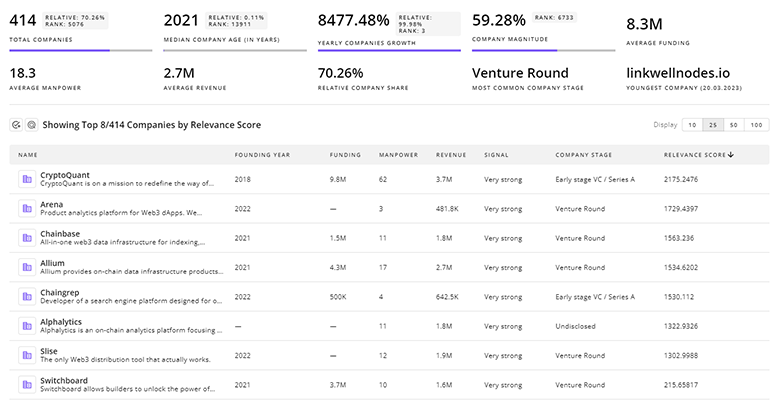
160.7K Medical Devices Companies
Discover Medical Devices Companies, their Funding, Manpower, Revenues, Stages, and much more
Medical Devices Investors
TrendFeedr’s Investors tool offers comprehensive insights into 32.9K Medical Devices investors by examining funding patterns and investment trends. This enables you to strategize effectively and identify opportunities in the Medical Devices sector.
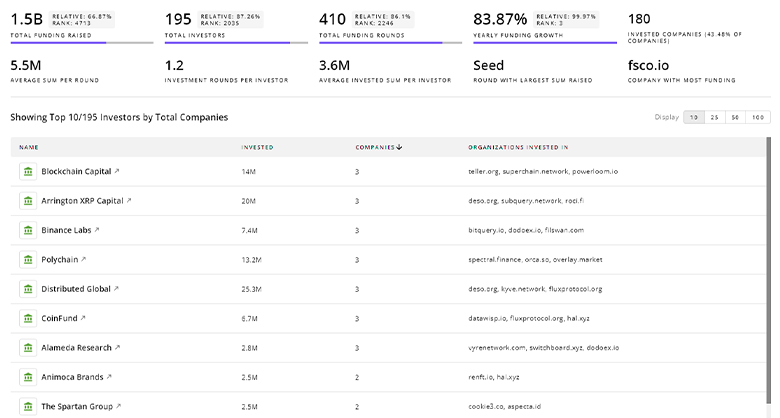
32.9K Medical Devices Investors
Discover Medical Devices Investors, Funding Rounds, Invested Amounts, and Funding Growth
Medical Devices News
TrendFeedr’s News feature provides access to 93.9K Medical Devices articles. This extensive database covers both historical and recent developments, enabling innovators and leaders to stay informed.
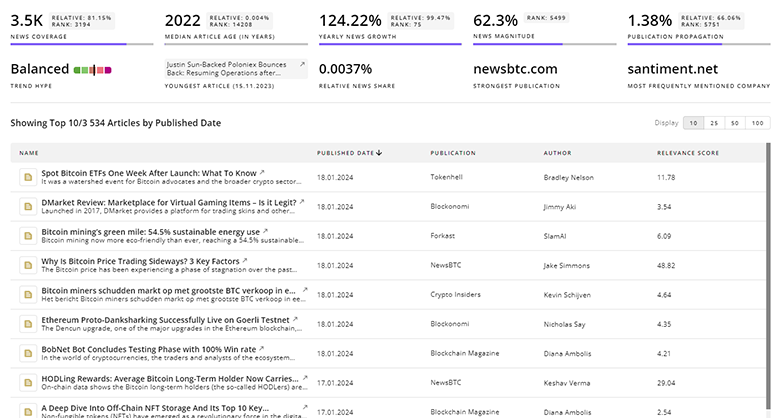
93.9K Medical Devices News Articles
Discover Latest Medical Devices Articles, News Magnitude, Publication Propagation, Yearly Growth, and Strongest Publications
Executive Summary
The medical devices market is expanding in value and complexity: clinical performance, embedded sensing, and regulatory evidence are now as determinative of commercial success as mechanical design. Investors and strategists should focus on firms that pair procedural efficacy with continuous data services and that have engineered regulatory and cybersecurity competence into their product lifecycles. Companies that synchronize high-precision manufacturing, validated software pathways, and survivable supply chains will convert the projected growth of device demand into sustained commercial advantage.
We value collaboration with industry professionals to offer even better insights. Interested in contributing? Get in touch!