Railway Infrastructure Report
: Analysis on the Market, Trends, and TechnologiesThe railway infrastructure market sits at a clear inflection point between heavy physical investment and fast-moving digitalization, with the railway infrastructure maintenance services market alone estimated at USD 118.18 billion in 2025 and projected to a USD 141.39 billion by 2029 (CAGR 4.6%) — a figure that signals where near-term capital and vendor demand concentrate: maintenance, condition monitoring, and digital platforms for lifecycle management. At the same time, broader market studies place the global infrastructure and equipment opportunity in different scopes and ranges, producing segment CAGRs between about 3.5% and 6.5% depending on definition and horizon Railway Infrastructure – MarketResearch.com Rail Infrastructure Market Size, Trends, Growth 2035 – MarketResearchFuture — the mixed estimates require buyers and investors to focus on which sub-market (maintenance services, equipment, telematics, or full infrastructure) they target.
This report was last revised 131 days ago. See a missing piece? Your input can help — contact us.
Topic Dominance Index of Railway Infrastructure
The Dominance Index for Railway Infrastructure delivers a multidimensional view by integrating data from three key viewpoints: published articles, companies founded, and global search trends
Key Activities and Applications
- Track inspections, renewal, and ballast works — continuous demand driven by aging networks and capacity upgrades; inspection activity shifts from manual sampling to sensor-based, high-speed automated inspection for throughput and safety improvements Railway Maintenance Machinery Market.
- Signaling modernization and interlocking upgrades — large-scale ETCS/CBTC and modular interlocking programs that reduce headways and increase throughput are major CAPEX lines for operators Railway Infrastructure Market by Infrastructure Type.
- Electrification and traction power works — overhead line systems, substations, and modular DC power modules to support emission targets and higher speeds; traction electrification remains a government funded priority in many markets Emerging electrification and propulsion trends.
- Digital asset management and predictive maintenance — cloud platforms, digital twins, and ML models that extend asset life and reduce unplanned outages are being adopted in procurement cycles and O&M contracts Rail Asset Management market analysis.
- Intermodal terminal and rail-logistics development — rail hub construction and rail-motorway (road+rail) services designed to take freight off roads while improving door-to-door throughput RAIL HUB EUROPE S.p.A..
Emergent Trends and Core Insights
- Dual-capital channel: "physical renewals" vs "digital operations." Public budgets and PPPs fund track renewal, electrification, and civils while private vendors capture recurring revenue via SaaS, sensor fleets, and predictive-maintenance services; winning vendors will combine both capabilities
- Predictive maintenance moves from pilot to procurement line items. Sensor networks, edge compute, and ML demonstrators translate into multi-year maintenance contracts that shift cost profiles from CapEx to OpEx
- Telecom and data connectivity directly enable the digital spine. Projects that secure continuous mobile/5G coverage and fiber backhaul across corridors unlock remote diagnostics, ATO, and real-time safety feeds — these telecom upgrades are now bundled into larger infrastructure programs RAILSITE TELECOM LIMITED Metro and rail digitalization trends.
- Material- and methods-driven OPEX reduction. Recycled-material sleepers and modular slab-track systems shorten renewals windows and lower life-cycle cost in high-use corridors
- Geopolitical and procurement fragmentation. Regional content rules and "make-local" programs influence supplier selection and drive localized manufacturing and certification pathways; buyers must manage multi-jurisdictional standards
Technologies and Methodologies
- AI and machine learning for predictive maintenance and anomaly detection — deployed on edge nodes and in cloud analytics stacks to convert sensor streams into actionable work orders CEMIT Railway Artificial Intelligence market.
- LiDAR, high-speed 3D vision and inertial sensors for condition capture — enable automated inspections at traffic speeds, reducing possession time and raising inspection cadence MoniRail Ltd.
- Digital twins and lifecycle platforms — virtual replicas integrated with maintenance management systems to plan renewals, run simulations, and optimize long-term capital plans 3B infra
- Modular, COTS-based signaling and interlocking — lowering deployment time and assurance cost for smaller networks through pre-assured building blocks Universal Signalling
- Fiber-optic sensing and distributed acoustic sensing (DAS) for continuous track/structure health monitoring — provides real-time thermal, strain, and intrusion inputs for asset protection.
Railway Infrastructure Funding
A total of 77 Railway Infrastructure companies have received funding.
Overall, Railway Infrastructure companies have raised $9.8B.
Companies within the Railway Infrastructure domain have secured capital from 210 funding rounds.
The chart shows the funding trendline of Railway Infrastructure companies over the last 5 years
Railway Infrastructure Companies
- Railmetrics — Railmetrics deploys high-speed 3D lasers and AI to inspect rails, sleepers, and structures at line speed, enabling near-continuous inspection without extended possessions; that capability shortens inspection cycles and feeds predictive-maintenance platforms used by infrastructure owners
- RailSense Solutions Ltd — RailSense provides compact IoT track sensors and cloud analytics targeted at continuous buckling and thermal-stress monitoring; the product fits operator O&M programs that require low-cost wide-area coverage and integration into maintenance workflows
- Greenrail Group — Greenrail manufactures sleepers combining recycled plastics and rubber with concrete cores to reduce lifecycle maintenance costs and enable embedded electronics (solar cells, sensors), offering a materials-centric route to lower noise, reduce renewals, and host asset electronics
- Stabirail — Stabirail's slab-track milling and assembly approach accelerates slab-track delivery in tunnels and stations, cutting on-site labour and track closure time; it targets fast renewals and constrained urban projects where possession windows are short
- Rail Connected — Rail Connected commercializes a wireless axle-counter and wireless trackside measurement nodes intended to reduce cabling, speed ERTMS deployments, and densify measurement points cheaply; the technology directly addresses rollout cost and schedule risk for digital signalling programs
TrendFeedr's Companies feature is your gateway to 1.1K Railway Infrastructure companies.
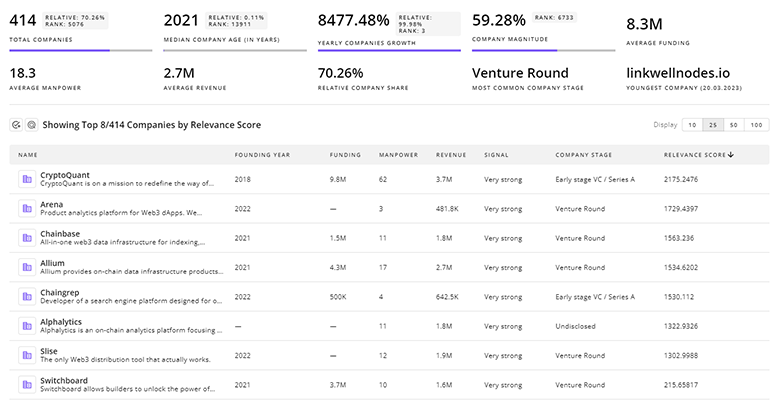
1.1K Railway Infrastructure Companies
Discover Railway Infrastructure Companies, their Funding, Manpower, Revenues, Stages, and much more
Railway Infrastructure Investors
The Investors tool by TrendFeedr offers a detailed perspective on 201 Railway Infrastructure investors and their funding activities. Utilize this tool to dissect investment patterns and gain actionable insights into the financial landscape of Railway Infrastructure.
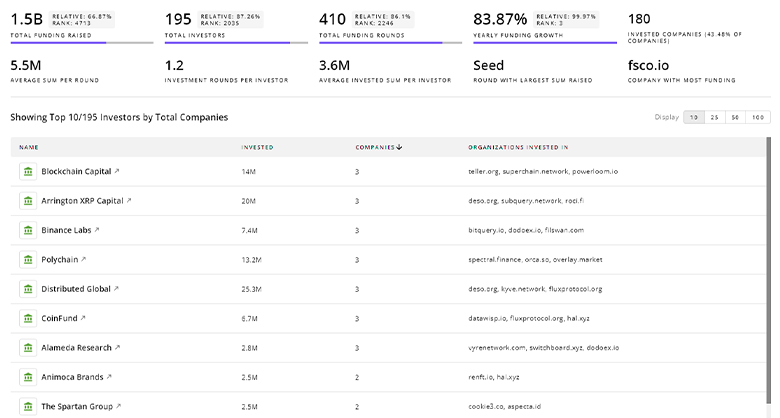
201 Railway Infrastructure Investors
Discover Railway Infrastructure Investors, Funding Rounds, Invested Amounts, and Funding Growth
Railway Infrastructure News
TrendFeedr’s News feature allows you to access 3.1K Railway Infrastructure articles as well as a detailed look at both historical trends and current market dynamics. This tool is essential for professionals seeking to stay ahead in a rapidly changing environment.
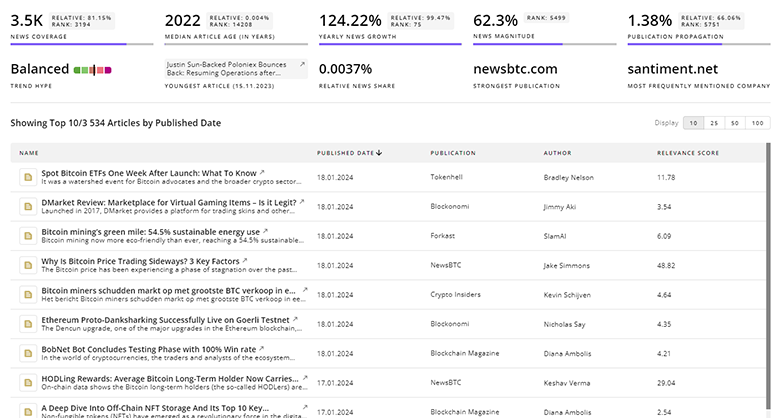
3.1K Railway Infrastructure News Articles
Discover Latest Railway Infrastructure Articles, News Magnitude, Publication Propagation, Yearly Growth, and Strongest Publications
Executive Summary
The data indicates that near-term commercial opportunity concentrates on maintenance services, sensor-to-cloud platforms, and targeted civil renewals where operators can reduce whole-life costs. Investors and procurement teams should segment opportunities by (a) immediate O&M savings via sensors and AI, (b) medium-term signaling and electrification programs that require integrated telecom and power upgrades, and (c) longer-term civils and materials projects that reduce life-cycle renewals. To win contracts, vendors must pair demonstrable field performance with procurement-ready commercial models, for example outcome-linked maintenance contracts and SolaaS deployments. Operators should prioritize connectivity and data interoperability so sensor investments scale into network-level asset management, while policymakers should align budgeting to multi-year maintenance commitments rather than one-off renewals, to capture the full value of predictive analytics and reduce lifecycle cost.
Partner with us to offer cutting-edge insights into trends and tech. We welcome your input.